.jpg)
Amphiareion of Oropos
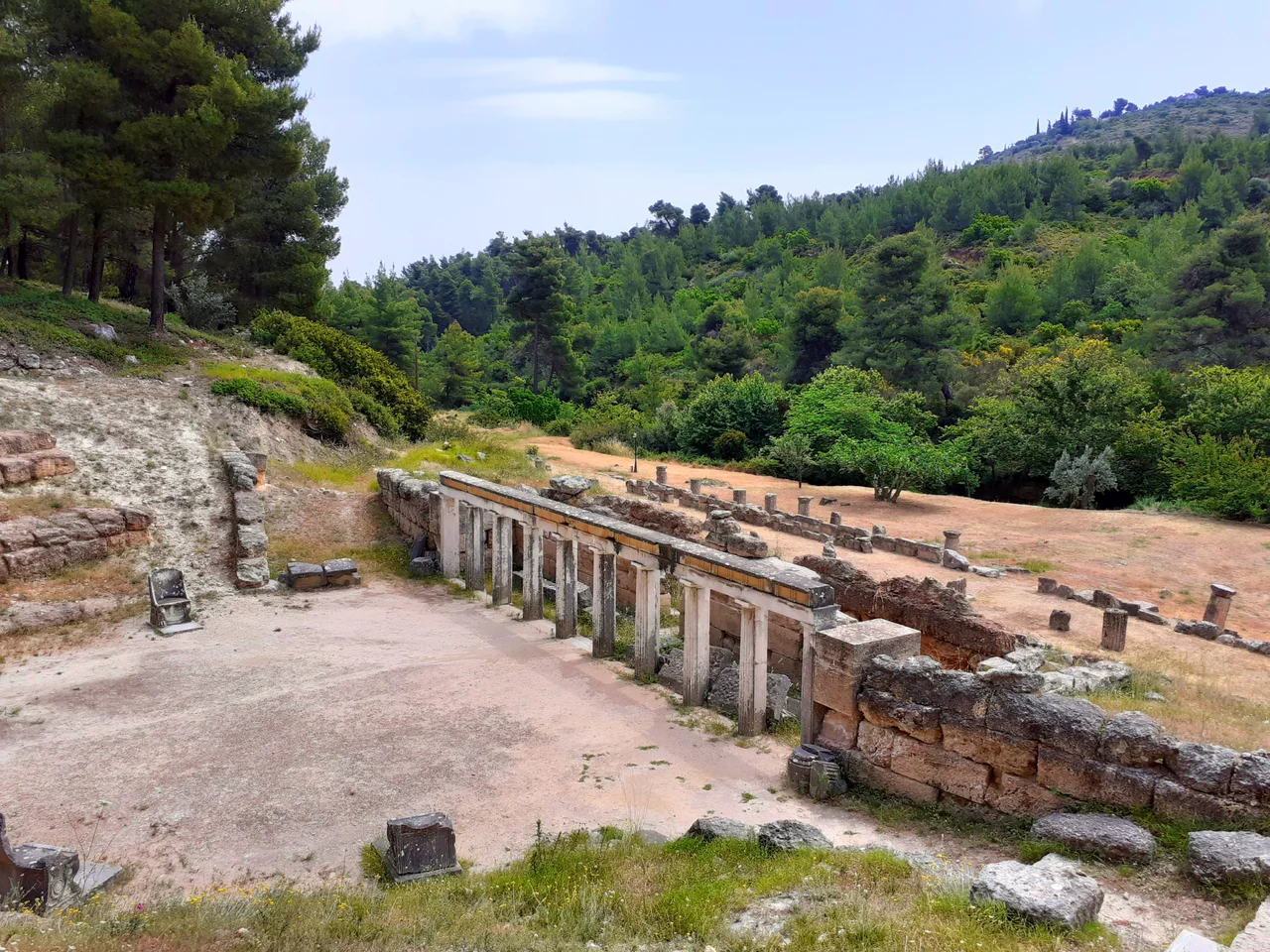
You came here to fall asleep. That was the whole point. After bathing in the sacred water, after sacrificing a ram and abstaining from wine for three days, you spread the animal's fleece on a stone bench in the long stoa and lay down among strangers, all of you waiting for the same thing: a dream. Somewhere in the night, the hero Amphiaraos was supposed to appear and tell you how to be cured. For nine centuries, people walked into this quiet ravine northeast of Athens and entrusted their bodies and their futures to the visions that came in sleep.
The Hero Who Refused the War
Amphiaraos was a seer before he was a healer, a descendant of the legendary prophet Melampos. When the expedition known as the Seven Against Thebes was being raised - the campaign Aeschylus turned into tragedy - Amphiaraos wanted no part of it. He could see the future, and the future he saw was catastrophe. He marched anyway, dragged into a war he had foretold would destroy him. As he fled the rout of Thebes, the myth says, Zeus split the ground with a thunderbolt and the earth swallowed his chariot whole. He did not die so much as descend. He became a chthonic hero, a power of the underworld - and from below, where the dead and the dream-world meet, he gained the ability to answer the living. A man who could not escape his own prophecy became the one people trusted to read theirs.
Sleeping for a Cure
The ritual was precise, recorded by the traveler Pausanias in the 2nd century CE. First you purified yourself. Then you sacrificed to Amphiaraos and to the long roster of gods and heroes named on the altar - Apollo the Healer, Hygeia, Iaso, Panacea whose name means "all-cure," Athena the Healer. Then came a ram. You killed it, spread its skin on the ground, lay down on the fleece, and waited for revelation in a dream. This practice, called incubation, treated sleep as a doorway rather than an escape. The god would arrive in the night with a diagnosis, a remedy, sometimes a cryptic instruction. Inscriptions found at the site suggest the rules loosened over the centuries - one says simply that each person may sacrifice whatever they wish - but the heart of it never changed: you came, you slept, you hoped to wake healed.
The Spring and the Stoa
The sanctuary unfolds along a streambed for some 240 metres, sheltered between two low hills at about 154 metres of elevation. The early 4th-century BCE temple held an acrolithic statue of the hero - a figure of wood faced with stone - of which a single marble arm still survives in place. Beside the altar lies the sacred spring, and here Pausanias recorded one of the loveliest details of all: those who were cured threw coins into the water, silver and gold, in thanks to the hero who had risen from the earth. The great stoa, 110 metres long with thirty-nine Doric columns, ran beside the temple, its back wall lined with stone benches - very likely the place where suppliants slept and dreamed. A second-century theatre seated around three hundred, its marble seats of honour still ringing the orchestra.
A Border That Kept Changing Hands
The Amphiareion sat on a fault line of power, near the contested boundary between Attica and Boiotia - between Athens and Thebes. Control of the sanctuary slid back and forth between the rival cities until Alexander the Great destroyed Thebes in 335 BCE and settled the question. Its prestige reached far beyond local quarrels. Herodotus reports that when the Lydian king Croesus tested the great oracles of the Greek world, only two gave the correct answer - and Amphiaraos was one of them. Centuries later, the avenue of dedications filled with Roman names: a monument honoring Brutus as a Tyrannicide in 42 BCE, inscriptions for the dictator Sulla, for Agrippa, for Appius Claudius Pulcher. Conquerors and generals came to the same hillside as the sick and the desperate, all seeking favor from a hero who saw what others could not.
Telling Time by Falling Water
Across the streambed from the sacred spring stands one of the sanctuary's quietest marvels: a klepsydra, a water clock, dating to the 4th century BCE and remarkably well preserved. Water seeped from a square reservoir through a tiny bronze valve barely two and a half millimetres wide, and as the level dropped, a calibrated scale marked the passing hours. Its builder understood a subtle problem - as a tank empties, water pressure falls and the flow slows - and solved it by sloping the reservoir walls inward toward the bottom, keeping the rate steady. A nearly identical clock, perhaps by the same hand, once stood in the Athenian agora. In a place devoted to dreams and the unseen, someone had also measured time itself, drop by falling drop. The cult finally ended near the close of the 4th century CE, when imperial decrees outlawed non-Christian worship - but the stones, the spring, and the long bench where the hopeful once slept remain.
From the Air
The Amphiareion lies at 38.291°N, 23.846°E, in the hills about 37 km north-northeast of Athens and roughly 6 km southeast of the old port of Oropos, just east of modern Markopoulo Oropou. From the air, look for the wooded ravine and streambed running northeast, near the Attica-Boeotia border facing the Euboean Gulf and the island of Euboea. Recommended viewing altitude 2,500-4,000 ft AGL for the sanctuary terraces; the broad Asopos valley and gulf give good orientation. Nearest major airport is Athens International (LGAV), about 35 km southeast; the region sits under Athens approach airspace, so expect controlled traffic. Clear summer mornings offer the best light across the ravine.
Nearby Stories
- Acropolis Museum 0.2 km away
- Battle of Leuctra 4.9 km away
- Sousaki Volcano 11 km away
- Ancient Greece 18 km away
- Great Sand Beach 23 km away
- Euboea 24 km away
- HMHS Britannic 30 km away
- Skyros 48 km away