
Andrew Johnson National Cemetery
In 1847, Andrew Johnson sat down and wrote out his preferred funeral arrangements. He wanted his body taken to some mountain peak and either left for the vultures or burned to ash, so that the smoke might pass off in triumph over the God-forsaken and hell-deserving, money-loving, hypocritical, backbiting, Sunday-praying scoundrels of the town of Greeneville. Five years later, in 1852, he bought twenty-three acres on a rise just outside town called Signal Hill. He pointed the spot out to a friend and said this was where he wanted to rest. Johnson kept his promise to be buried away from the town, more or less. The hill where he lies became Monument Hill, then the Andrew Johnson National Cemetery in 1906, and today holds over two thousand graves.
The Man at the Center
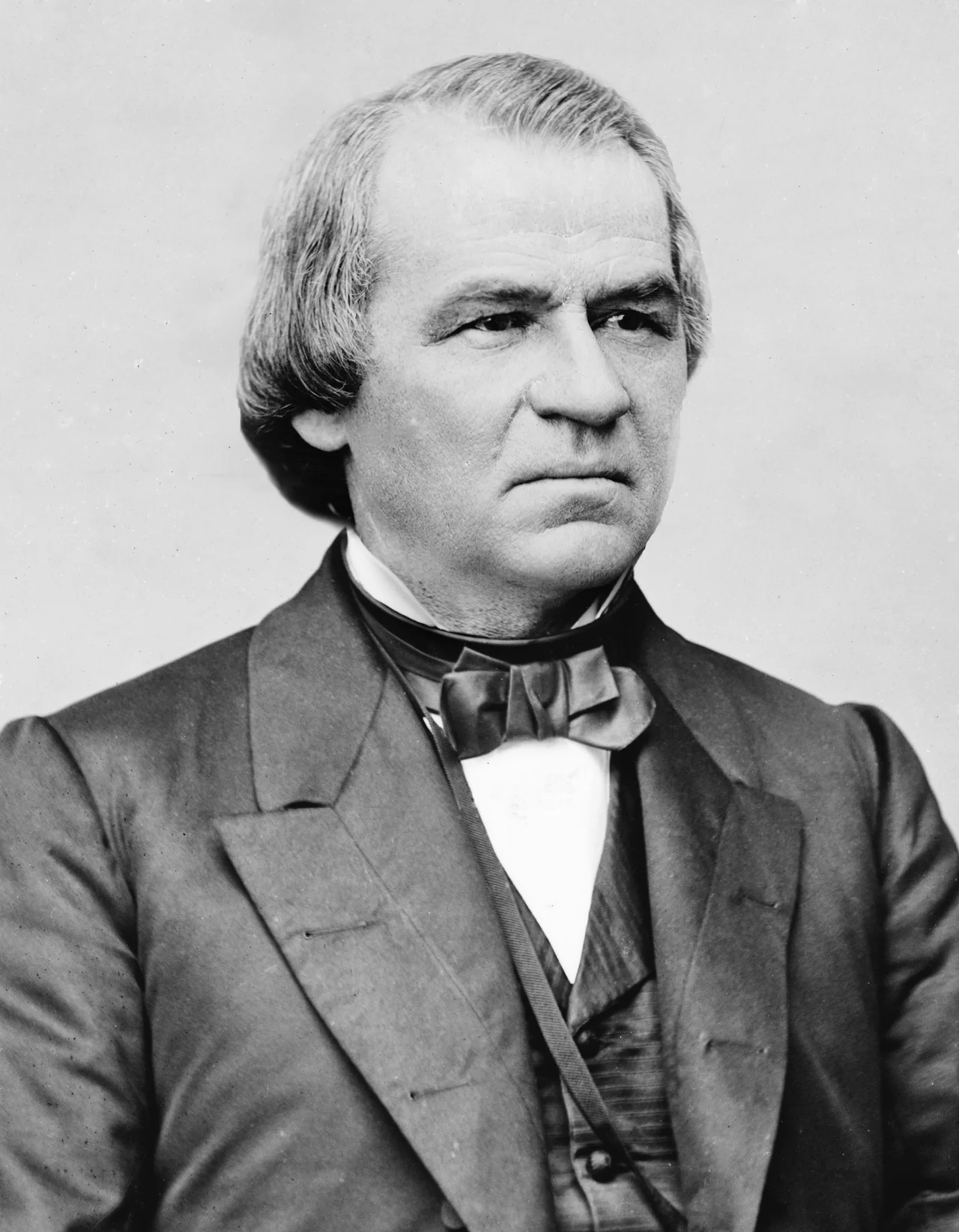
Johnson became the seventeenth president on April 15, 1865, when Abraham Lincoln died from John Wilkes Booth's bullet. The accidental president inherited Reconstruction at its most consequential moment, and he used the office to sabotage it. Johnson opposed civil rights for the formerly enslaved, vetoed the Civil Rights Act of 1866 and the Freedmen's Bureau Bill, and worked to restore former Confederate elites to political power. Congress impeached him in 1868 for violating the Tenure of Office Act; he survived removal by a single Senate vote. He died in 1875 having spent his post-presidency trying to return to the Senate, which he briefly accomplished in March of that year. His grave marker reads his faith in the people never wavered — an epitaph that even an 1891 newspaper called singularly enigmatic, because nobody could quite say which people he had been faithful to.
How a Hill Becomes a Cemetery
Johnson was buried atop Signal Hill on August 3, 1875, in a Masonic funeral. Three years later, on June 5, 1878, the city erected a 28-foot marble monument over his grave — tall enough that the hill was renamed Monument Hill almost immediately. His daughter Martha Johnson Patterson, who had served as his White House hostess and inherited the property, did not want the family bound to maintaining it forever. She willed the land for use as a public park in 1898 and lobbied hard from 1900 to transfer the site to the federal government. Congress designated it a National Cemetery in 1906, the War Department took control in 1908, and the National Park Service inherited it in 1942.
Who Else Rests Here
Beyond Johnson and his immediate family, the cemetery now holds soldiers from every American conflict from the Civil War through the War on Terror. That breadth is unusual — when the Park Service took over in 1942, it briefly closed the cemetery to new interments to preserve its historic character. Pressure from the American Legion and the Daughters of the American Revolution reopened it, and for the next seventy-seven years veterans of every twentieth-century war were buried among the white marble rows. New interments stopped in 2019, leaving Andersonville in Georgia as the only Park Service-administered national cemetery still accepting burials. The eagle carved into the monument cost a small fortune at the time. The names on the stones cost more.
An Epitaph You Have to Squint At
The grave marker's inscription — his faith in the people never wavered — was meant to honor Johnson's lifelong populist self-image as a tailor's apprentice who rose to the presidency without formal schooling. It also obscures whom that faith excluded. Johnson's people did not include the four million Americans freed by emancipation, whose civil rights he actively worked to deny. Standing on Monument Hill today, looking down at Greeneville and out toward the Bald Mountains on the Tennessee–North Carolina line, the view is undeniably beautiful. The harder work is holding both the view and the history at the same time: a self-made man who became a president, and a president who used the office to entrench white supremacy at a moment when the country might have moved differently.
From the Air
The Andrew Johnson National Cemetery sits at roughly 36.155 N, 82.838 W on Monument Hill just southeast of downtown Greeneville, Tennessee, at about 1,640 feet elevation. The site is part of the larger Andrew Johnson National Historic Site. Best viewed from low altitude on clear days — the 28-foot marble monument is visible from a few miles out. Tri-Cities Airport (KTRI) lies about 22 nm north-northeast; Greeneville Municipal (0A9) is roughly 4 nm northeast of the cemetery; McGhee Tyson Airport in Knoxville (KTYS) is about 60 nm west-southwest. The Bald Mountains rise to the south along the Tennessee–North Carolina border, with peaks above 4,800 feet within 15 nm.
Nearby Stories
- Black Mountains (North Carolina) 11 km away
- Holston Mountain 13 km away
- Amis House (Rogersville, Tennessee) 15 km away
- Mitchell County, North Carolina 16 km away
- The Titanic Museum: The Ship That Docked in Tennessee 24 km away
- Richmond Hill Inn 34 km away
- Cumberland Gap 39 km away
- 2016 Great Smoky Mountains Wildfires 57 km away