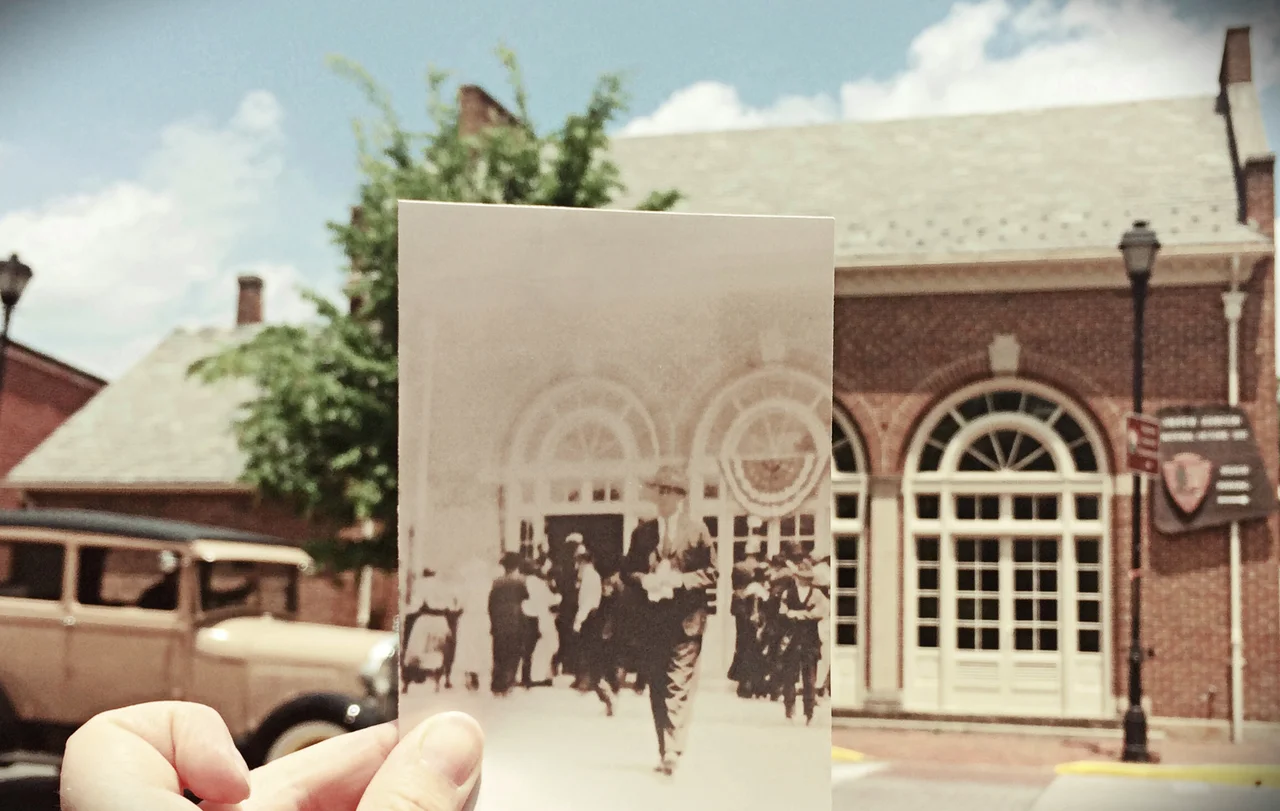

Andrew Johnson National Historic Site
Every May 26, visitors to the Andrew Johnson National Historic Site in Greeneville, Tennessee, are handed a replica admission ticket to the 1868 impeachment hearings and asked to vote on whether the seventeenth president should have been removed from office. The actual Senate, in May 1868, fell one vote short of conviction. The visitor tally rarely runs the same way. That this is the central interactive exhibit at a presidential historic site — a roughly annual re-trial of its honoree — tells you something about how the National Park Service has chosen to interpret Andrew Johnson. The site preserves his tailor shop, two of his homes, and his grave. It also preserves the question he never quite answered: what was he doing there?
From Tailor Shop to White House
Johnson was born poor in Raleigh, North Carolina, in 1808, lost his father at three, and was apprenticed to a tailor as a child. He arrived in Greeneville around 1826 and set up his own one-room tailor shop, which still stands at the center of the visitor complex — preserved inside a memorial building the state of Tennessee constructed in 1923 to shield the original wooden structure from weather and tourists. From the tailor shop, Johnson moved into local politics, then the U.S. House, the Tennessee governorship, the Senate, and the vice presidency under Lincoln in 1865. The arc is genuinely remarkable. The trajectory mattered to a country that liked to believe it could be true. The trouble came when Johnson reached the office and used it to undo what Lincoln had begun.
The Homestead and the War
Johnson bought a two-story Greek Revival brick house on Main Street in 1851. He and his wife Eliza McCardle Johnson lived there before and after the presidency, from 1869 to his death in 1875. During the Civil War, the house sat in occupied territory and was used as quarters by soldiers from both sides at different times. By the time the Johnsons returned in 1869, it needed significant restoration. The Park Service has maintained the homestead to look as it did during those final post-presidential years. Eliza, who suffered from tuberculosis and rarely appeared publicly, died here in 1876, six months after her husband. The first Greeneville home — a smaller property Johnson bought earlier — still stands across the street from the visitor complex.
The Impeachment Vote They Hold Every Year
The May 26 visitor vote is a genuine piece of pedagogy disguised as a gimmick. It gets people to actually engage with the question the Senate decided in 1868: had Johnson committed impeachable offenses by firing Secretary of War Edwin Stanton, in apparent violation of the Tenure of Office Act, as part of his broader sabotage of Congressional Reconstruction? The legal pretext was thin and the underlying conflict enormous. Johnson opposed every meaningful effort by Congress to protect the rights of newly freed Black Americans. He vetoed the Civil Rights Act of 1866 and the Freedmen's Bureau Bill, fought the Fourteenth Amendment, and used his pardon power to restore Confederate elites. The Senate trial came down to seven Republican senators who declined to convict. Modern historians broadly regard Johnson as one of the worst American presidents. The visitor vote in Greeneville suggests visitors generally agree.
What the Site Asks You to Hold
The Andrew Johnson National Historic Site totals sixteen acres across three units — the visitor complex with the tailor shop, the homestead, and the national cemetery on Monument Hill. It became a National Monument in 1935, was formally established April 27, 1942, and was redesignated a National Historic Site on December 11, 1963. Kids can become Junior Rangers by completing an activity book. The 13.5-minute orientation film in the visitor center traces Johnson's rise from poverty to the presidency. The harder material — Reconstruction, his white-supremacist politics, the impeachment — is woven through the exhibits with more honesty than presidential sites often manage. Visitors leave able to admire the tailor shop, the climb out of poverty, and the genuine craftsmanship of the homestead, while also reckoning with what Johnson did when power finally reached him. The site asks you to hold both. That is harder than admiration, and more useful.
From the Air
The Andrew Johnson National Historic Site sits at approximately 36.158 N, 82.835 W in downtown Greeneville, Tennessee, at about 1,580 feet elevation. The three units — visitor complex, homestead, and national cemetery — span roughly half a mile in town. Best viewed at low altitude over downtown Greeneville on clear days. Greeneville Municipal Airport (0A9) lies about 4 nm east-northeast. Tri-Cities Airport (KTRI) is about 22 nm north-northeast; McGhee Tyson (KTYS) in Knoxville is roughly 60 nm west-southwest. The Bald Mountains rise to the south along the North Carolina border with peaks above 4,800 feet within 15 nm. Greeneville lies in the Ridge-and-Valley Appalachians; expect long parallel ridges running northeast-southwest with valley winds that channel along that axis.
Nearby Stories
- Black Mountains (North Carolina) 11 km away
- Holston Mountain 13 km away
- Amis House (Rogersville, Tennessee) 15 km away
- Mitchell County, North Carolina 16 km away
- The Titanic Museum: The Ship That Docked in Tennessee 24 km away
- Richmond Hill Inn 34 km away
- Cumberland Gap 39 km away
- 2016 Great Smoky Mountains Wildfires 57 km away