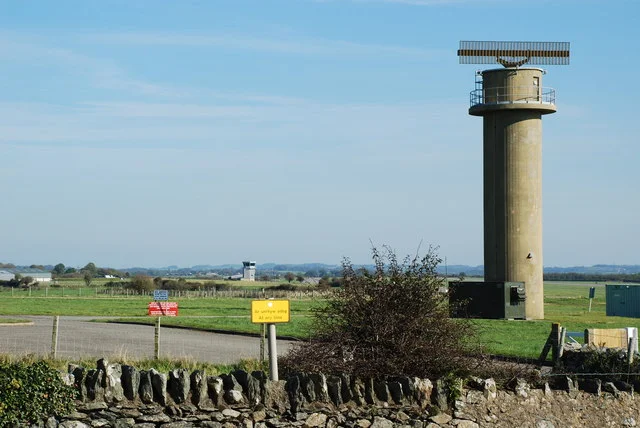

Anglesey Airport
Until June 2022 you could buy a ticket in Cardiff on a Monday morning and be in Holyhead, on the far side of Wales, before noon. The journey took one hour by air on a small turboprop, against five hours by train through Birmingham or six by car around the long way. The single-storey terminal at Anglesey Airport, a £1 million prefabricated building delivered to the airfield in 2007, was the only civilian face of the country's only commercial connection between its capital and its northwest tip. Then COVID grounded the route, and the Welsh Government announced it would no longer pay the subsidy. The terminal still stands. The runways are still active, as part of RAF Valley. But for the first time since 2007, you cannot fly between Cardiff and Anglesey at all. In May 2024, Isle of Anglesey County Council confirmed in writing what everyone in the area already knew: the airport had closed.
Built on a Hawk Base
The runways belong to RAF Valley (ICAO: EGOV), a Royal Air Force station on the southern coast of Holy Island that has been training military pilots since 1941. Today Valley is home to No. 4 Flying Training School and 22 Squadron, who teach the fast-jet pilots of the RAF on BAE Systems Hawk T2 trainers - the same type the Red Arrows fly. Civilian movements at Valley have always been a side activity. In early 2006 the National Assembly for Wales, now the Senedd, decided that connecting the country's capital to its northwest corner was a strategic priority and put up a subsidy to make a daily service viable. The Isle of Anglesey County Council leased a small parcel of land from the Defence Infrastructure Organisation. The architects MAP designed a prefabricated terminal - check-in, departure lounge, baggage area - that was built off-site by Yorkon, brought to the airfield by lorry, and craned into position in 2007. Bilfinger Europa Facility Management, a subsidiary of the German construction group Bilfinger, operated the place under contract.
Thirteen Years on the Subsidy
The Anglesey-Cardiff route went live in May 2007 with two flights each weekday in each direction, the trip taking just under an hour. The operating airline changed several times - Links Air ran it first, then Citywing, then Eastern Airways under a Flybe franchise - reflecting how thin the commercial margins were even with the public-money cushion. Passenger numbers stayed modest but steady: the route was used by Welsh civil servants going to or from Cardiff Bay, by businesspeople visiting the Anglesey Aluminium plant or Holyhead Port, and by occasional tourists. There were no scheduled commercial flights to anywhere else. The terminal stayed open during the day and closed in the evening. In March 2018 the airport was briefly closed after a Red Arrows Hawk crashed on takeoff at Valley, killing the engineer in the rear seat; flights were diverted to Hawarden Airport in Flintshire and passengers coached across. The route reopened. Then in March 2020 the COVID-19 pandemic shut down nearly all UK domestic aviation overnight, and the Anglesey service was suspended as a precaution.
Decision in Cardiff
The Anglesey-Cardiff route never resumed. In June 2022, after two years of subsidy paid for an aircraft that was not flying, the Welsh Government formally announced that the service would not be restarted - the case for the subsidy in a changed travel landscape, post-COVID and with sharpened scrutiny of public spending on aviation carbon, could no longer be made. The terminal was mothballed. In May 2024, following a Freedom of Information request, Isle of Anglesey County Council confirmed in plain language that the airport had closed. RAF Valley continues to fly Hawk T2s on its training circuits, the same way it has since 1976 (and earlier with the T1). The civilian apron is quiet. The car park, built to hold passengers headed for Cardiff, sits empty. Whether the terminal can ever be repurposed is a question that will outlast its first inhabitants; for now, it stands as a recent monument to the perennial difficulty of running scheduled commercial aviation in a small country with very good trains.
From the Air
Anglesey Airport sits at 53.248N, 4.535W at Llanfair-yn-Neubwll on the southern coast of Anglesey, just east of the Holy Island causeway. The shared runways are those of RAF Valley (EGOV) - currently active for RAF Hawk T2 training under No. 4 FTS and 22 Squadron. Civil operations have ceased. Check NOTAMs and the UK Military AIP before any approach; military airspace remains active. Nearest civilian alternate is Caernarfon (EGCK) 14 nm east-southeast. RAF Mona (EGOQ), a satellite airfield, is 3 nm northeast. The terminal building is the small, single-storey structure on the eastern (civilian) apron. The A55 North Wales Expressway runs less than 2 miles north. Holyhead Port and Mountain are visible 6 nm to the north-northwest.
Nearby Stories
- Wakestock 1.7 km away
- Trefriw 3.8 km away
- Irish Sea 8.7 km away
- Irish Sea Bridge 20 km away
- East–West Interconnector 30 km away
- Machynlleth 36 km away
- HMS Tyler 41 km away
- New Brighton Lifeboat Station 54 km away