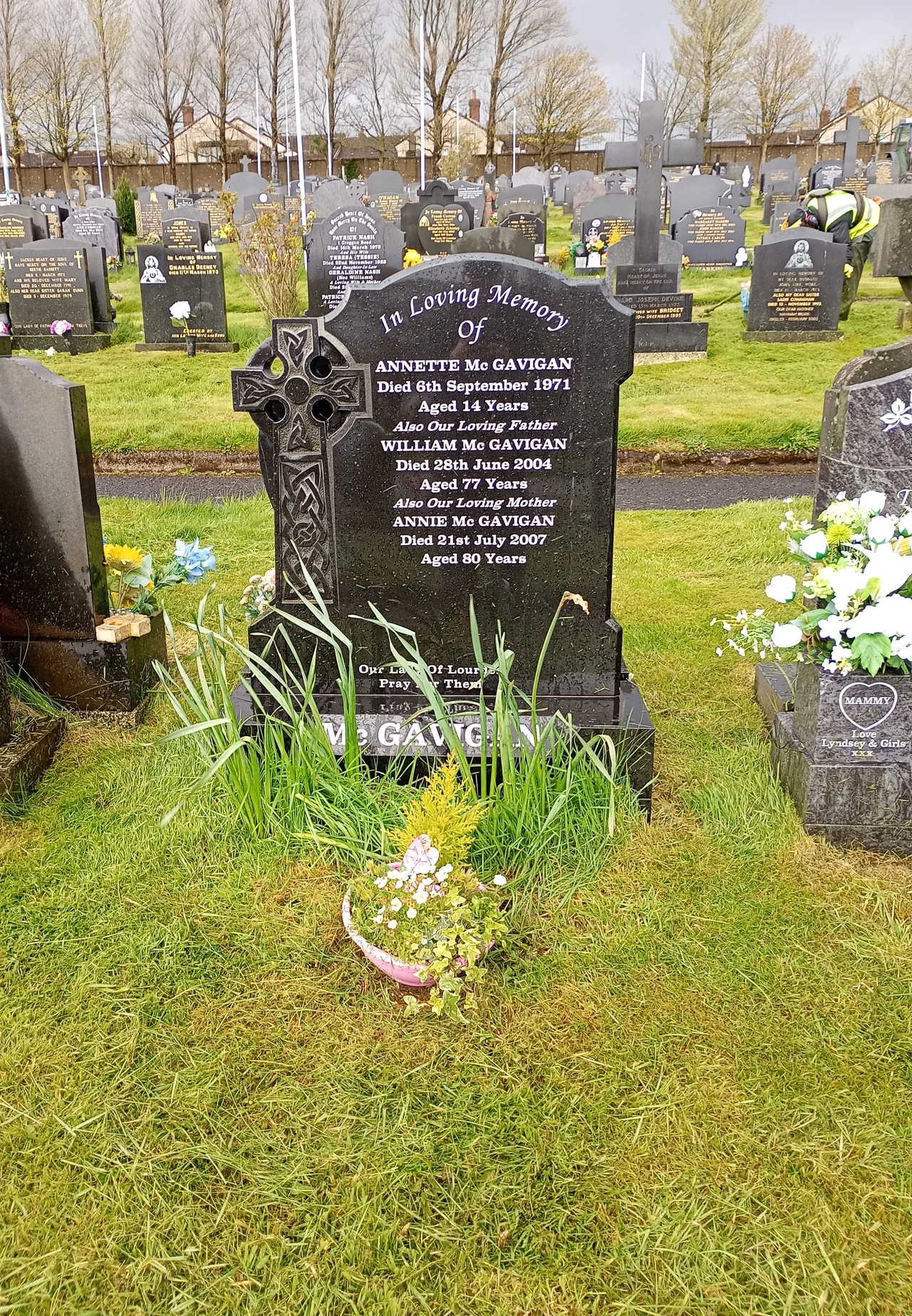

Annette McGavigan
She was still in her school uniform. She was holding an ice cream. The rioting in the Little Diamond had been winding down for an hour or so by the time Annette McGavigan and her friends went looking for rubber bullets to add to their growing collection of riot souvenirs. It was 6 September 1971. She had turned fourteen in June. At the corner of Blucher Street and Westland Street, in the Catholic Bogside in Derry, she was shot in the back of the head. The bullet's path through the streets of a city already at war made her, after three years of conflict, the one hundredth civilian killed in the Troubles. No one has ever been charged.
A Daughter of the Bogside
Annette lived with her parents, four brothers, and two sisters in Drumcliffe Avenue, a small Bogside street built when Derry's nationalist majority had been packed into a few wards by gerrymander. She attended St Cecilia's College and, by her family's accounts, wanted to be a nurse. Her younger sister May remembers her as artistic and bubbly. The school sent the pupils home early that afternoon because rioting had broken out near the Little Diamond, the kind of rioting that had become unremarkable in a neighbourhood where children grew up tracking what tear gas felt like and which streets the army was likely to enter. After three years of the Troubles, picking up spent rubber bullets had become a hobby like collecting stamps. Annette had a small collection already. She was looking to add to it. The ordinariness of the impulse is what is hardest to think about now.
Six O'Clock in the Evening
At about six in the evening the streets had quieted and Annette stood with friends. British soldiers were positioned a short distance away, in the grounds of the old post office between the Little Diamond and Frederick Street, where they had been confronting youths on Fahan Street and Eglinton Place. Crossfire between soldiers and IRA gunmen, according to official accounts, came down the streets. Annette McGavigan's family has always maintained that the bullet which killed her was fired by a British soldier. She fell, her ice cream beside her on the pavement. Father Edward Daly, the priest who four months later would lead the wounded through Bloody Sunday holding a white handkerchief, reached her first. He gave her the last rites and then walked through the Bogside to break the news to her mother. Her mother collapsed. Father Daly remembered the moment, decades later, as the kind of thing that does not let you go.
The Telephone Game
Her sister May, sent by their mother to buy fruit at a local shop, met a friend on the way home. A wee girl's been shot, the friend told her. Without knowing she was talking about her own sister, May carried the news home to her mother, who said, God help that poor girl and her mother and father, whoever they are. The telephone call from the hospital came a few minutes later. The Ministry of Defence has refused to release intelligence documents relating to Annette's death. No soldier has ever been named. The family has spent more than fifty years asking for an inquest that examines the original evidence properly. They have not received it. May still speaks, when she is asked, about what her sister was like before that afternoon, and how the ice cream and the uniform are the details people remember when they try to understand what kind of conflict this was.
The Mural and the Butterfly
On 1 September 1999, twenty-eight years and a few days after she died, the Bogside Artists unveiled a mural on the gable wall of a maisonette at the corner of Lecky Road and Westland Street, near Free Derry Corner. They called it The Death of Innocence. Annette stands in her school uniform looking out at the street where she was killed. Above her right shoulder hovers a blue butterfly. To her right, pointed downward, is a black rifle. In June 2006, after the official end of armed conflict, the artists repainted the mural. The butterfly became multicoloured. The rifle was painted broken in half. Both changes were deliberate; both were arguments about what the past three decades had been for. Tour buses now stop at the corner. Visitors photograph the wall. Schoolchildren walk past it on their way home from St Cecilia's College, the same school Annette never finished.
What Is Still Owed
There is a way of writing about civilian deaths in conflicts that turns the dead into statistics or into symbols. Annette McGavigan was both, eventually, but she was also a girl who liked drawing, who collected rubber bullets without quite knowing why, who would have been almost seventy in 2026 had she lived. Her family has insisted, for half a century, that the cost of pretending to have moved on is paid by people who have not yet been allowed to grieve in the daylight. The McGavigans still gather at the corner on the anniversary. They still want a fresh inquest. They still want to know whose finger was on which trigger and what orders had been given. Father Daly, who died in 2016, said until the end that her death made an impression on him deeper than almost anything else he saw in his long life as a priest in Derry. There were, of course, far worse things to come. That is not a defence.
From the Air
Annette McGavigan was killed in the Bogside in Derry, around 54.99 degrees north, 7.33 degrees west, at the corner of Blucher Street and Westland Street near where the Death of Innocence mural now stands at Lecky Road. From cruise, look for the bend of the Foyle and the city walls rising above the Bogside on the west side of the river. The nearest controlled airport is City of Derry (EGAE) just outside the city; Donegal Airport (EIDL) lies west across the Republic of Ireland border. Belfast International (EGAA) is the closest major hub at around 100 km east. The walled medieval centre of Derry on its hill, with the Bogside spreading out below the western walls, is one of the most distinctive urban layouts in Ireland from the air.
Nearby Stories
- Portrush Lifeboat Station 1.9 km away
- Main Street, Letterkenny 2.1 km away
- Inishowen 6 km away
- Rosguill 6.3 km away
- County Tyrone 7.1 km away
- St Patrick's College, Maghera 9.6 km away
- St Patrick's Purgatory 11 km away
- Coalisland Canal 17 km away