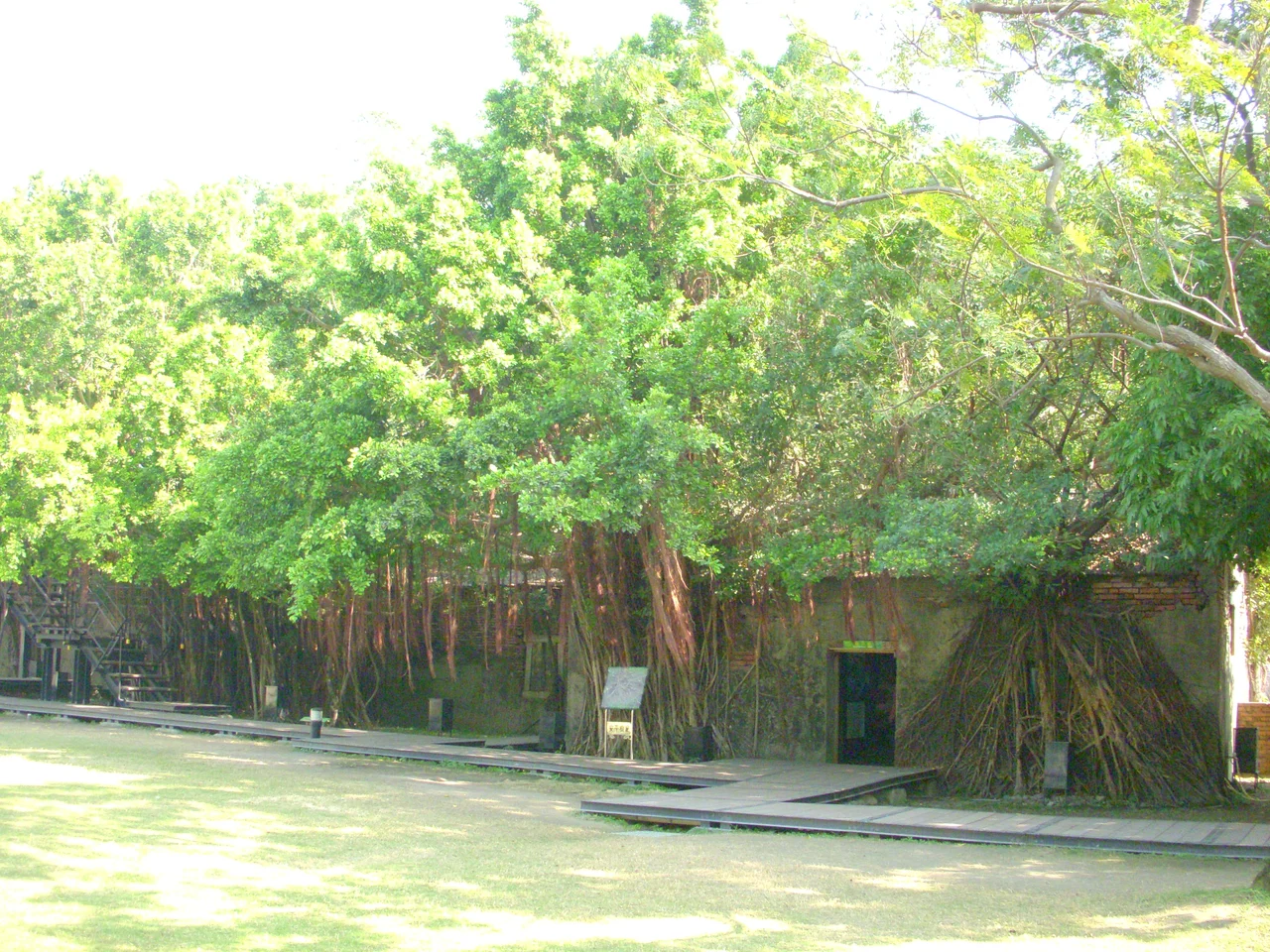

Anping Tree House
Nobody planned the Anping Tree House. A banyan tree did the designing, one root at a time, over decades of neglect. What started as a warehouse built by the British trading firm Tait & Company in 1867 is now a building consumed by a living organism -- roots snaking through walls, branches punching through the roof, the entire structure wrapped in a wooden embrace that no architect could have conceived. The warehouse was abandoned; the tree was patient. By the time the Tainan City Government decided to do something about it in 2004, there was no separating the two. So they built staircases and viewing platforms instead, and invited people to come see what happens when a building and a tree negotiate for the same space over a century and a half.
Sugar, Camphor, and Treaty Ports
The warehouse exists because of the Treaty of Tientsin, signed in June 1858, which forced the Qing dynasty to open several Taiwanese harbors to international trade. Anping was one of them. The British trading company Tait & Company arrived and by 1867 had constructed both a merchant house and this warehouse, where granulated sugar and camphor were stored before being loaded onto transport ships. Camphor was the commodity that mattered most -- Taiwan was one of the world's major producers, and the aromatic chemical had uses ranging from medicine to the manufacture of celluloid. The warehouse was a link in a global supply chain, a holding pen for raw materials extracted from the island's interior and shipped to ports across Asia and beyond.
The Tree Takes Over
When the Empire of Japan took control of Taiwan in 1895, it turned the trading of camphor and opium into government monopolies, pushing foreign merchants like Tait & Company out of the market and off the island. By 1911, the merchant house and warehouse had been converted into offices for the Japan Salt Company. At some point after that, the warehouse was abandoned -- and the banyan tree that grew nearby began its slow invasion. Banyan roots do not politely avoid obstacles; they grow through them, around them, over them. Brick walls became trellises. The roof became a garden. Rooms filled with aerial roots hanging from branches that had burst through the ceiling. The process took decades, proceeding with the unhurried persistence that characterizes banyans across tropical Asia.
Salt Works to Skyway
After Taiwan's handover from Japan to the Republic of China in 1945, the warehouse was repurposed as an office for the Tainan Salt Works. A renovation in 1981 modernized the building, but time and the tree continued their work. When the Tainan City Government finally addressed the site in 2004, the decision was not to clear the tree or restore the warehouse to its original state. Instead, designers built wooden and metal staircases, elevated walkways, and viewing platforms that let visitors move through and above the intertwined structure. A skyway runs above the tree house, offering an aerial perspective on the canopy below and the brick walls threaded with roots. The adjacent merchant house, now called the Former Tait & Co. Merchant House, has been turned into a museum. Together, they form one of Tainan's most visited historical sites -- a place where colonial trade history, Japanese occupation, and the relentless growth of a tropical tree converge in a single surreal structure.
From the Air
Located at 23.00N, 120.16E in the Anping District of Tainan, on Taiwan's southwestern coast. The tree house is part of a cluster of historical sites in Anping, near the old harbor area. Nearest airport is Tainan Airport (ICAO: RCNN), approximately 8 kilometers to the east. The Anping district is visible from the air as a dense urban area meeting the coastline, with historical fort structures and canal waterways nearby.
Nearby Stories
- Chung Li-ho Museum 0.7 km away
- Jingzaijiao Tile-paved Salt Fields 8 km away
- Wanchin Basilica of the Immaculate Conception 9.3 km away
- Namasia District 16 km away
- Battle of Penghu 21 km away
- Shoushan (Kaohsiung) 21 km away
- Penghu Air Raids 62 km away
- Daya Bay 512 km away