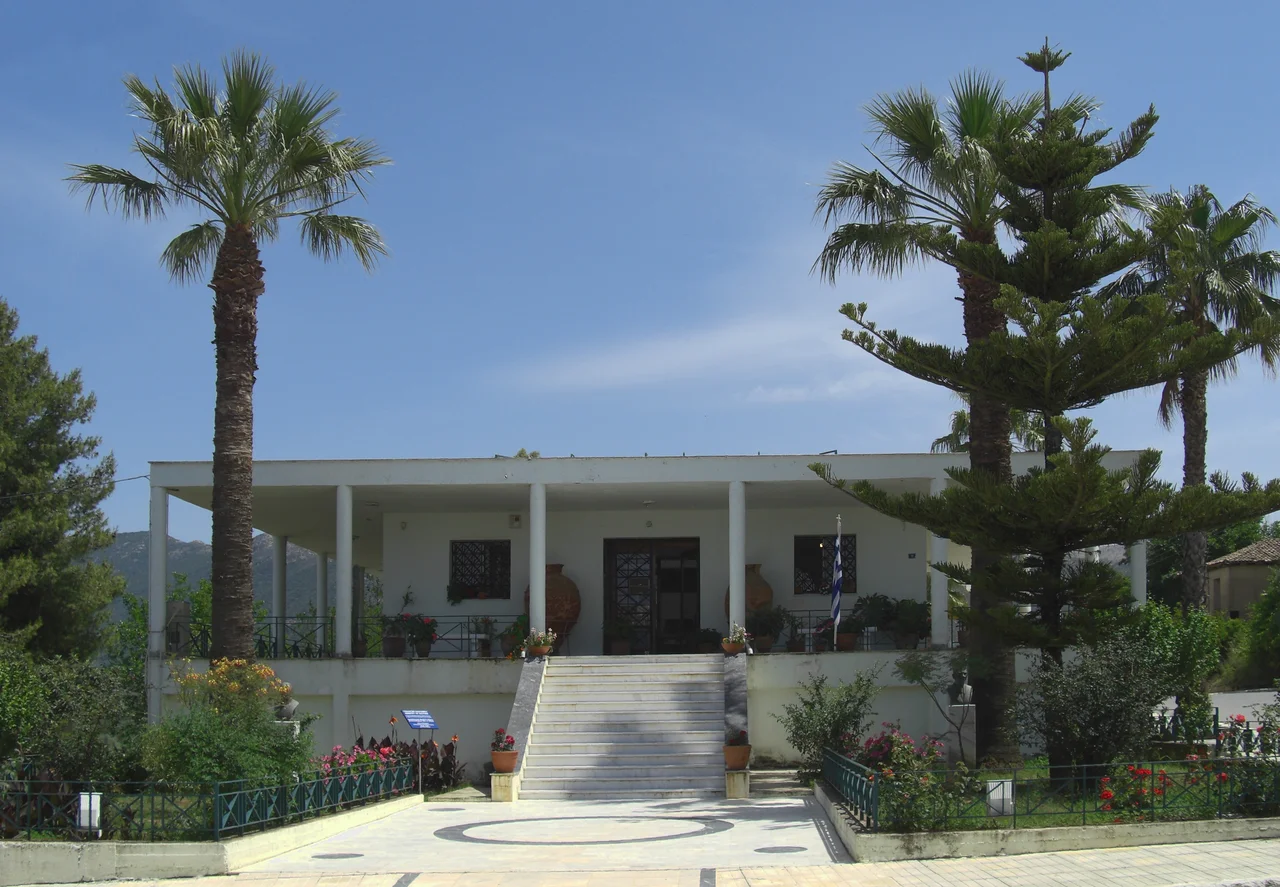

Archaeological Museum of Chora
The museum in Chora does not announce itself. It sits in the center of a small village four kilometers north of the Palace of Nestor, flanked at its entrance by two enormous burial jars from the Middle Helladic period — perhaps 3,500 years old, standing quietly like sentinels that have long since stopped expecting visitors. Inside, arranged in three consecutive galleries, is some of the most significant Mycenaean material ever excavated: the gold, the clay, the painted walls, and the clay tablets that prove this corner of the southwestern Peloponnese was once among the most powerful kingdoms in the Bronze Age Mediterranean world.
What Fire Preserved
The story of the Chora museum begins with destruction. Around 1180 BC, the Palace of Nestor at Englianos burned — suddenly and completely, apparently without warning. The fire was so intense that it accomplished something its architects never intended: it hardened thousands of clay tablets inscribed in Linear B script and made them nearly indestructible. Those tablets are why archaeologist Carl Blegen, excavating at Englianos from 1939 and again from 1952 to 1966, could reconstruct an entire Bronze Age administrative state from what was left in the ash. The palace's accounts survived because the palace did not.
The museum was founded in 1969 specifically to house Blegen's finds and those of Spyridon Marinatos, who excavated sites across the Pylia and Trifylia regions. The busts of both archaeologists stand on the staircase at the entrance — a quiet institutional acknowledgment of how much this building owes to two men's decades of careful work.
Gold from the Tombs
The first gallery focuses on the dead — or more precisely, on what the Bronze Age living placed beside them. Grave goods from the extensive cemetery at Volimidia span a period from roughly 1550 to 1200 BC: small stirrup jars used to hold aromatic oils, composite vessels assembled from alabaster pieces, keftiu-type cups whose very name derives from Egyptian texts that identified the Minoans of Crete. The Mycenaean aristocracy of Messenia traded widely and absorbed influences from across the eastern Mediterranean.
The most arresting objects from Room 1 come from the 'gold-bearing' tombs of Peristeria, excavated by Marinatos in 1965. A golden diadem and two golden cups with embossed spiral designs, found in Tholos tomb 3, closely resemble artifacts from the Royal pit tombs at Mycenae. Accompanying them are golden bees, tassels, discs, and lamellae — small works of extraordinary refinement from a civilization that flourished here for four centuries and then, in a span of a few generations, collapsed entirely. A pair of small scale discs in the same gallery represents a belief scholars have traced across the ancient world: that the scales were placed in tombs to weigh the soul of the deceased in the underworld.
Walls That Speak
Room 2 is dedicated to the palace itself, and its most haunting exhibits are fragments of wall paintings. Cases 11 through 18 hold pieces of the painted plaster that once covered the palace's interior — a lyre player, hunting dogs, lions, griffins, a bull-leaper found in the wine magazine floor, and a female head labeled simply 'The White Goddess.' On the walls above the cases, the architect and designer Piet de Jong painted reconstructions of the complete scenes, giving visitors a sense of what the palace looked like in use. De Jong worked for the British School at Athens on multiple Mycenaean and Minoan sites and brought careful scholarly rigor to his reconstructions.
Among the most resonant fragments is a lyre player depicted in procession — a figure that scholars connect to Apollo and to Thamyris, a musician from Pylia who appears in the Iliad (Book 2, lines 594–600) as a man so confident in his skill that he challenged the Muses and was punished for it. Whether the painter intended this reference or not, the image survived three thousand years because the fire that killed the palace baked the plaster hard.
The Language of Administration
Case 32 contains something that looks, at first glance, modest: replicas of Linear B tablets. The originals are divided between this museum and the National Archaeological Museum in Athens. But the tablets represent a pivot point in Western intellectual history. Linear B was the first script used to write Greek — an administrative notation system used by Mycenaean palace economies to record livestock, land holdings, and the names of officials. It was deciphered in 1952 by British architect Michael Ventris, who died in a car accident four years later at the age of thirty-four.
The tablets from Nestor's palace, fired hard by the same blaze that destroyed the palace around 1180 BC, listed the names of places, people, and goods across a kingdom that extended over much of the southwestern Peloponnese. The word 'Pylos' itself — pu-ro in Mycenaean Greek, 𐀢𐀫 in Linear B — appears in those records. The city named itself three thousand years ago, and the name endured.
The Weight of Everyday Life
Room 3 widens the view. Among the grave goods on display are copper bowls with handles shaped like human hands, personal care sets of copper and ivory, sheaths for daggers from a warrior's tomb, and swords — some of them deliberately bent. The bent swords are among the most humanly legible objects in the museum: bent so that their owner, a former warrior, would never again need them. Whoever made that choice understood something about ceremony, about ending, about the passage from one state to another.
The museum is open every day except public holidays and Tuesdays. It is small enough to see completely in an afternoon and layered enough to reward return visits. What it holds is not, at its core, a collection of beautiful objects, though some of the objects are beautiful. It is evidence: that people lived here with great sophistication for many centuries, that they traded with Egypt and Crete and the wider Mediterranean world, that they recorded their transactions in a script that took three thousand years to decipher, and that a fire, in the end, preserved what their civilization could not.
From the Air
The Archaeological Museum of Chora is located in Chora, Messenia, at approximately 37.054°N, 21.721°E — about 4 km north of the Palace of Nestor at Englianos. From the air, Chora is a small inland village in the gentle hills of Messenia, roughly 18 km northeast of Pylos and the Navarino Bay coast. The nearest airport is Kalamata International (LGKL), approximately 40 km to the northeast. Recommended viewing altitude: 2,500–4,000 ft to distinguish the village from surrounding agricultural land. The Palace of Nestor site at Englianos is visible as a fenced archaeological area approximately 1.5 km to the south-southeast of the museum.
Nearby Stories
- 1986 Kalamata Earthquake 2.8 km away
- Peloponnese 20 km away
- Kalamakia Cave Site 21 km away
- Lepreum 22 km away
- Strofades 29 km away
- 2018 Ionian Sea Earthquake 55 km away
- Apidima Cave 67 km away
- Valletta 597 km away