
Ard na Caithne
The Norse named it for butter. They sailed past in raiding ships and saw a sheltered bay on the Kerry coast where the dairy was rich, the cattle plentiful, and the harbour deep enough to land a longboat. Smoer wick. Butter harbour. Smerwick. But the Irish-speakers who actually lived here had their own name, and theirs is older and gentler: Ard na Caithne, the height of the strawberry tree, after the arbutus that once grew on the slopes above the shore. Both names describe the same place. Only one of them holds the memory of the massacre that took place at the foot of those slopes in November 1580 - and only one of them connects, by way of a Cromwellian execution and a poet who became a folk hero, to a Kerry that never quite stopped resisting.
The Height of the Strawberry Tree
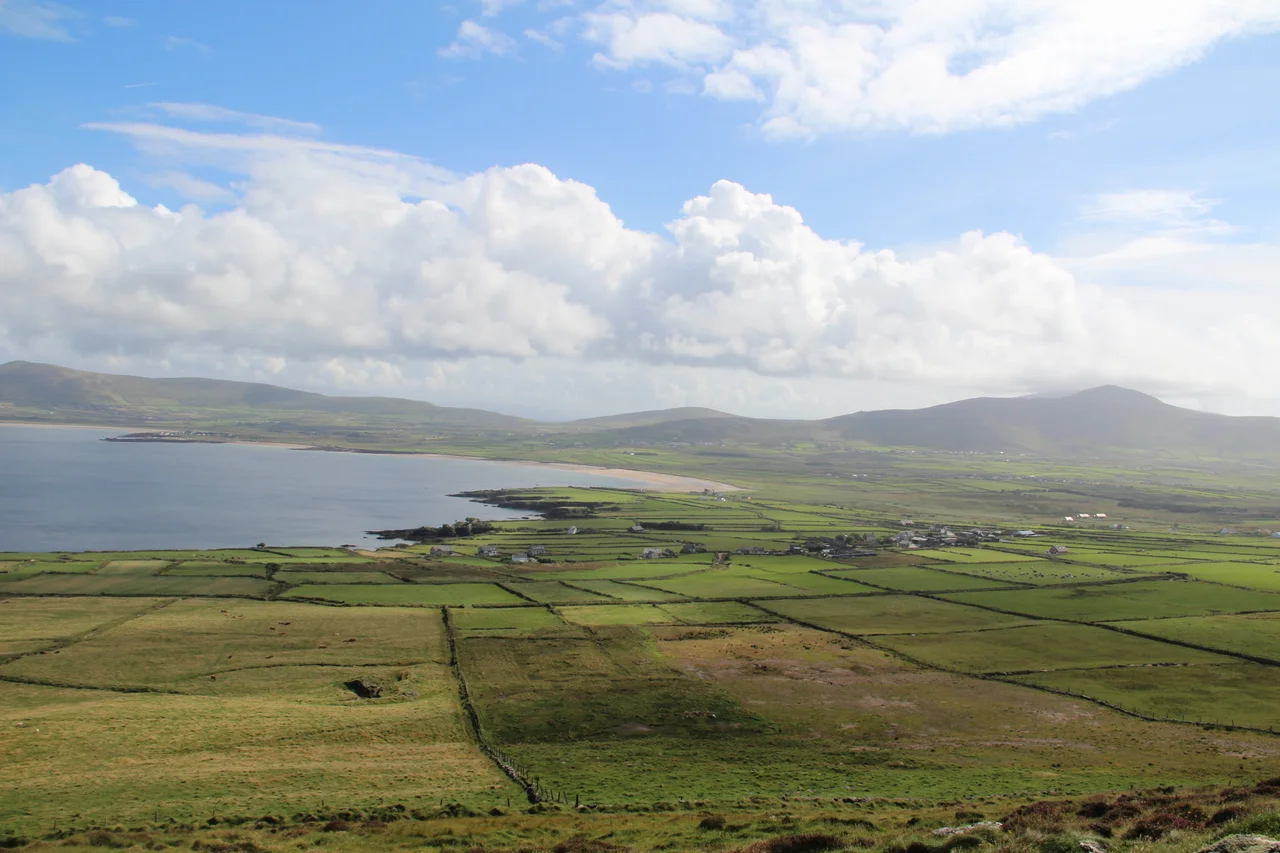
Ard na Caithne sits at the foot of An Triur Deirfear, the Three Sisters, and within the shadow of Mount Brandon. It is one of the principal bays of Corca Dhuibhne - the Kerry Gaeltacht - bounded by the villages of Baile an Fheirtearaigh, Baile na nGall, and Ard na Caithne itself. This is the Fior-Ghaeltacht, the true Irish-speaking heartland, an area in which Irish remains the official and principal language of daily life. The name Ard na Caithne means the height of the arbutus, sometimes translated as the strawberry tree - a small Mediterranean evergreen rarely found this far north but historically present on the warmer slopes of the Kerry coast. Other Irish names appear in the records: Iorras Tuaiscirt, the northern peninsula, and Gall-Iorras, the peninsula of the strangers. The strangers were the Vikings, and they had landed here long before anyone counted years.
The Geraldine Landing
In July 1579, James Fitzmaurice Fitzgerald - cousin of the Earl of Desmond, Catholic, exiled by Elizabethan rule - landed in Smerwick Harbour with a small force of Spanish and Italian mercenaries. He had spent years in Continental Europe gathering support, papal banners, and the promise of more troops to come. His landing in the Butter Harbour was meant to ignite a rebellion across Munster, restore Catholic faith and Geraldine power, and begin pushing back against the English plantation of Ireland. Fitzmaurice himself was killed weeks later in a skirmish in Limerick. But the rebellion - the Second Desmond Rebellion - dragged on for years, drawing more papal troops and triggering one of the harshest English responses in the long English-Irish conflict.
The Massacre at Dun an Oir
In September 1580, a second papal force of about 600 Italians and Spaniards landed at Smerwick under the command of Sebastiano di San Giuseppe, and dug in at a small earthen fort called Dun an Oir - the Fort of Gold - on the headland above the harbour. They held out for ten days under siege from the forces of the Lord Deputy of Ireland, Arthur Grey, fourteenth Baron Grey de Wilton. On 10 November 1580 the garrison surrendered. What followed, by every contemporary account, was a slaughter. Almost all the prisoners were killed - bound, then beheaded or stabbed - over the next two days. Two of the English officers who took part in the killings were Walter Raleigh - then a young captain, later the courtier of Elizabeth I - and Edmund Spenser's friend Captain Mackworth. Raleigh was later charged in connection with the massacre. He defended himself by claiming he had only followed orders from a superior officer. He was not convicted. A small memorial today marks the site of Dun an Oir, where six hundred soldiers lost their lives in two days.
Frobisher's Return
The harbour holds a quieter history too. In 1578, two years before the massacre, the English explorer Sir Martin Frobisher made landfall at Smerwick on his return from his third Arctic expedition. Frobisher had spent the previous summer in what is now Baffin Island, in Canadian Arctic waters, where his crews loaded their ships with what they believed was gold ore. The ore turned out to be worthless - mostly hornblende, mistaken in the dim light and the desperation for return. Frobisher's voyages collapsed in financial scandal. But for a brief moment, Ard na Caithne welcomed home one of the great Elizabethan exploration failures, and the bay that the Vikings had called Butter Harbour became the unlikely receiving point for a hold full of Canadian rock.
The Poet of Ferriter's Castle
Up the slope from the harbour, the remains of Caislean an Fheirtearaigh - Ferriter's Castle - stand against the green hillside. In the seventeenth century the castle was the home of Piaras Feiritear, an Irish-language bard and chief of his Norman-Irish clan. Feiritear is one of the great lyric voices of the seventeenth-century Gaelic tradition - his love poems and laments remain popular as oral literature on the Dingle Peninsula. When the Cromwellian conquest of Ireland reached Kerry, Feiritear led his clansmen in resistance. He was captured. In 1653 he was executed at Killarney by a Cromwellian general. The poet is still remembered locally as a folk hero. His castle is mostly tumbled stones now, looking down on the same harbour where the Geraldine soldiers had landed almost a century before him, and where the strawberry trees - if any are left - still grow on the slopes that gave the place its older, quieter name.
From the Air
Located at 52.188 degrees north, 10.421 degrees west, on the northwest coast of the Dingle Peninsula in County Kerry. The bay opens northward, sheltered by the Three Sisters peaks (An Triur Deirfear) on its western flank and by the ridge running south toward Ballyferriter. Kerry Airport (EIKY) lies about 30 nautical miles east-northeast. Recommended observation altitude 2,000 to 3,500 feet AGL in clear weather. Look for Dun an Oir fort site on the western headland and the ruins of Ferriter's Castle on the slope south of the bay. Be aware of strong onshore winds from the north and rapid weather changes in this exposed coastal area.
Nearby Stories
- Ballyheigue Castle 1 km away
- Killemlagh Church 2.8 km away
- Pouldergaderry Sinkhole 6.8 km away
- Derreen Garden 11 km away
- Kilkee 59 km away
- The Laki Eruption: The Volcano That Changed World History 1366 km away
- The Northern Lights: The Sky Show That Vikings Thought Was Bridge to the Gods 1469 km away
- Sao Miguel 1935 km away