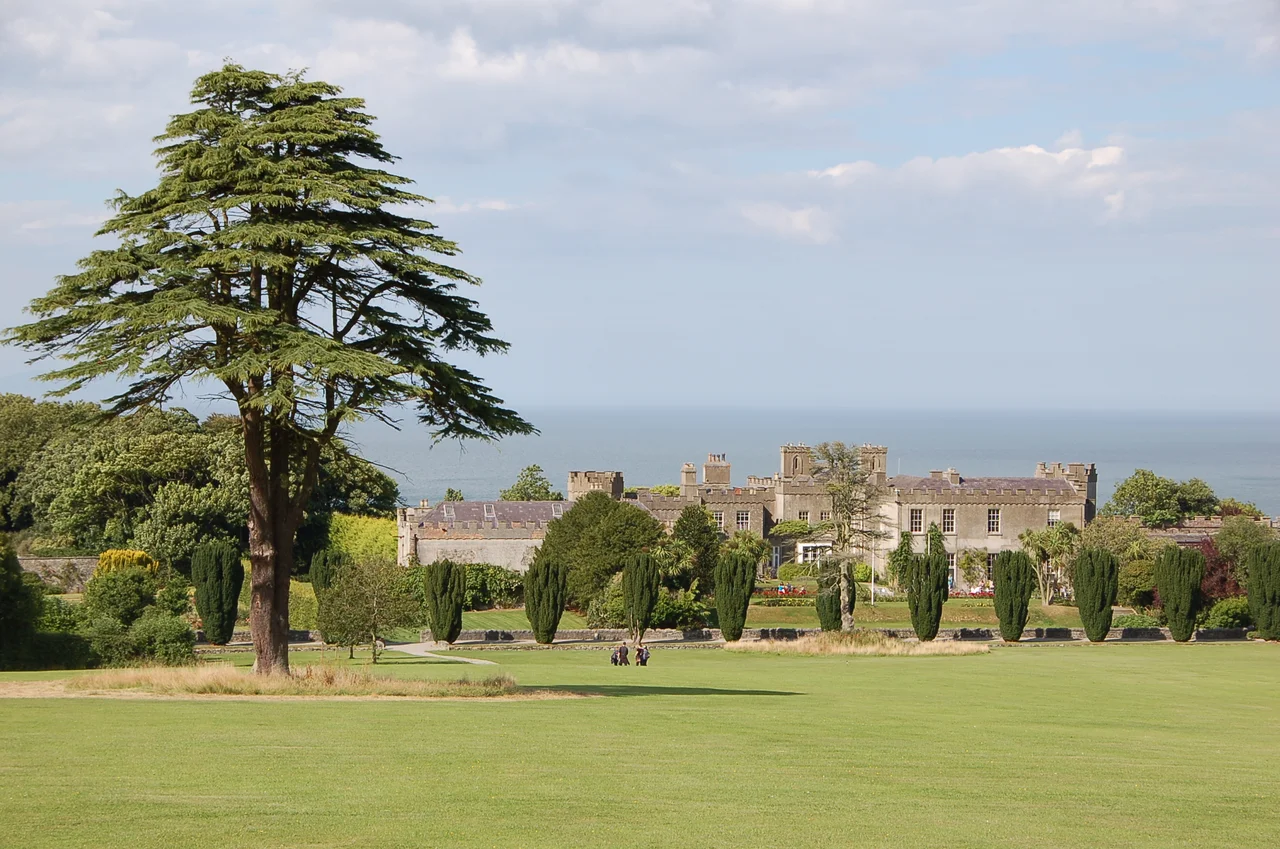

Ardgillan Castle
The labourers who cleared the wooded slopes for Ardgillan Castle in 1738 were paid one penny a day plus meals and a bed for the night. They were former soldiers from Bangor in County Down. They also got a tot of Irish whiskey from Bushmills - which arrived by sea at two shillings and tuppence the gallon - and they earned every drop. The Reverend Robert Taylor, son of the 1st Baronet of Headfort, had purchased a steep, tree-covered ridge above Barnageera Beach with views across the Irish Sea, and he wanted the trees down and a house up. What they built that year still stands today, a castellated country house set in 200 acres of public parkland twelve miles north of Dublin.
A Wine Merchant's Hill
The land before the Taylors belonged to Robert Usher, a wine merchant from Tallaght who had probably never lived on the property himself. The Irish name was Ard Giollain - Giollan's Height - perched on a steep coastal headland where the rising ground gives long views north to Drogheda Head and south past Lambay Island. The Reverend Robert Taylor was the grandson of Thomas Taylour, 1st Earl of Bective. His family would hold the place through eight generations and 224 years. After Robert Taylor's house was built, the estate passed eventually to his great-nephew Thomas Edward Taylor, a Conservative MP and Chief Secretary for Ireland. In the 1850s, George Papworth - an architect who had also worked on the nearby Kenure House at Rush - was hired to renovate, and Frederick Darley designed new stable blocks. The Taylor family finally sold up in 1962.
Castellated, but Not a Castle
Ardgillan is not really a castle. It is a Georgian country house with castellated battlements added for romantic effect - a style fashionable among Irish gentry in the late 18th and 19th centuries who wanted their houses to look medieval without sacrificing comfort. Two storeys rise above a basement that extends out under the south lawns. The ground and first floors held the family's living quarters; the east and west wings housed servants and estate offices; the basement was the working kitchen with stores and pantries. From the south front the lawn drops steeply away toward the Irish Sea, with Balbriggan visible to the north and the Mourne Mountains, on clear days, painted blue on the horizon.
The Lady's Stairs
Below the castle, the Dublin-to-Belfast railway line runs along the foot of the cliff between the demesne and the sea. To reach the strand, walkers cross a footbridge called the Lady's Stairs that arches over both the railway and the R127 coast road. Local folklore says a young woman in a wedding dress haunts this bridge. The most often repeated version of the story is that Lord Langford of Summerhill House in County Meath brought his recently wed wife to Ardgillan while he travelled to Scotland for the hunting. Against the advice of the household, she went swimming - in November - and drowned in the cold sea. Lord Langford died not long after. Her ghost, the story goes, returns to the bridge in her bridal gown, climbing the steps toward a castle where her husband never returned. Another version warns that if you stand at the end of the bridge at midnight on Halloween, she will throw you to your death below.
A Public Park
Henrich Potts of Westphalia bought the estate from the Taylors in 1962 and held it for two decades. In 1982 the Fingal County Council acquired the property, and over the next ten years - with help from FAS, the Irish state training agency - the council restored the house and grounds. President Mary Robinson formally opened Ardgillan Castle to the public in 1992. The 200-acre demesne now mixes mature woodland and rolling lawns with a walled herb garden, a rose garden, a working Victorian glasshouse, tea rooms in the former gardener's quarters, and an 18th-century ice house dug into the slope. A children's playground was added in 2006. From 2005 to 2007 the castle hosted summer open-air concerts; Moby, REM, Meat Loaf, and Status Quo all played here before the council ended the series. From 2016 to 2019 a small experiment called Paws at Ardgillan - one of the first dog-friendly cafes in any Irish municipal park - operated out of the old gardener's cottage.
What to See Today
Ground-floor rooms and the kitchen are open for guided tours. Upstairs the former bedrooms host changing exhibitions, including a permanent display of the Down Survey - the great 17th-century cartographic project undertaken by William Petty in the 1650s that mapped Irish lands forfeited under Cromwell. The Victorian glasshouse still grows vines along its iron arches. The walled garden, sheltered from the salt wind, produces herbs and cut flowers through the season. From the south terrace the view stretches across the railway line and out across the sea to Lambay Island, the privately owned wallaby-haunted lump of land that punctuates the Fingal coast. On a clear day the Mourne Mountains are visible 70 km to the north. Admission to the grounds is free; the castle interior is open most of the year for a modest charge.
From the Air
Ardgillan Castle sits at 53.59 N, 6.16 W on a coastal ridge just north of Skerries in north County Dublin, Ireland. From the air the demesne forms a distinctive wedge of green between the coastal town of Balbriggan and the smaller settlement of Skerries, with Barnageera Beach immediately to the east and the Irish Sea opening beyond. Dublin Airport (EIDW) lies about 25 km south; Belfast (EGAA) is roughly 120 km north. The Dublin-Belfast railway corridor runs along the foot of the demesne, and Lambay Island is visible 8 km south-east. The castle itself is small from cruising altitude; the surrounding parkland is the easier landmark, ringed by farmland and the M1 motorway 3 km west.
Nearby Stories
- Carrickmines Castle 1.8 km away
- Trim Castle 8 km away
- Irish Military Intelligence Service 12 km away
- Cabra Castle 15 km away
- Athclare Castle 16 km away
- German submarine U-1051 21 km away
- Irish Sea Bridge 51 km away
- Ardglass 52 km away