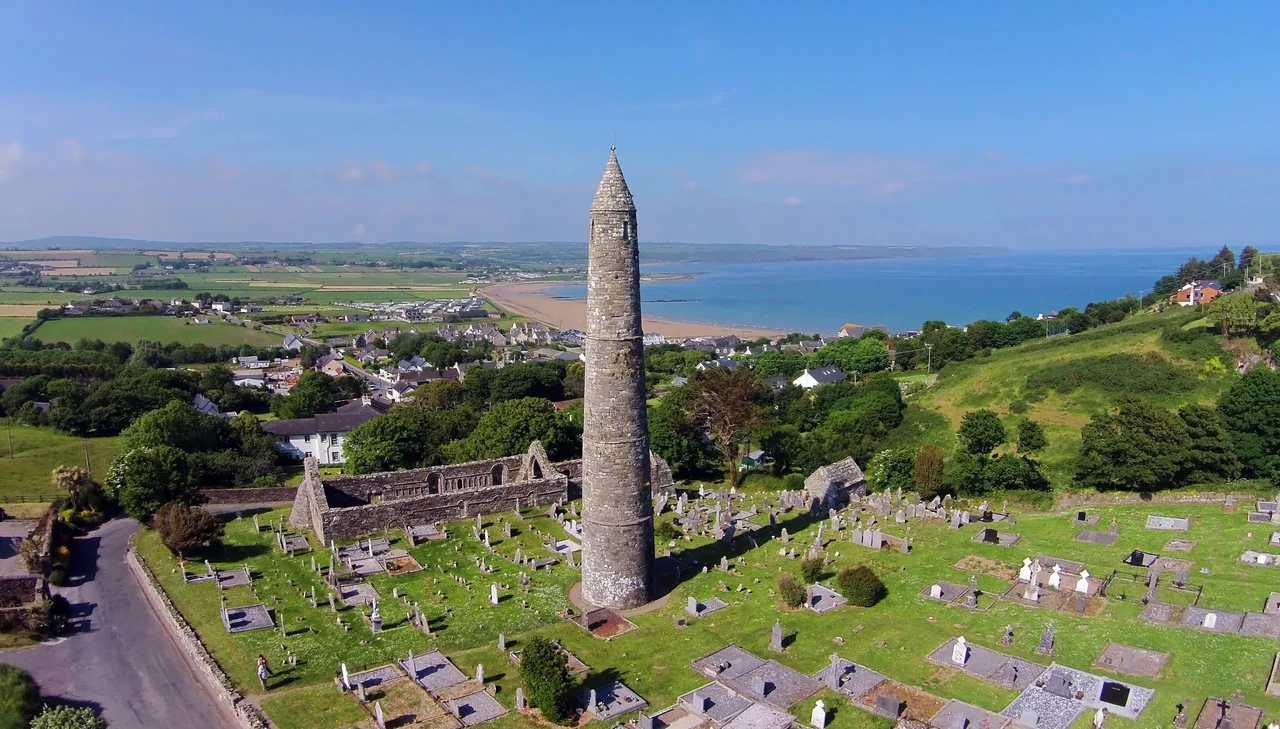

Ardmore, County Waterford
Olivia Wilde spent her childhood summers here. The American novelist Nora Roberts has set three of her books here, drawing American tourists who have no idea that they are walking the same headland where a 5th-century missionary saint reputedly baptised the local Déisi people before Saint Patrick set foot in Ireland. The hotel where the actress and the novelists ate is now the Cliff House, with a Michelin-starred restaurant called The House perched above the bay. Ardmore is a small village that absorbs each new layer of history without erasing the last one, and the mile-long beach in front of it has been a working shoreline for fifteen hundred years.
Declán of the Déisi
Tradition holds that Saint Declán founded his monastery on the hill above this village in the 5th century, while Patrick was still in Britain or perhaps Gaul. Declán is one of four Munster saints credited with bringing Christianity to Ireland before Patrick - the others are Ailbe, Ciarán, and Ibar - and modern medievalists are still divided on how much of any of these biographies is fact. What is undisputed is that the cult became powerful enough that the Synod of Rathbreasail in 1111 recognised Ardmore as the seat of a diocese. Its bishop swore fealty to Henry II of England at Cashel in 1171, in the years just after Strongbow's invasion. By 1210 the diocese had been swallowed into Lismore. Today Árd Mór - "the great height" - is listed in the Catholic Church as a titular see, a bishopric in name only.
The Hill of Stone
Up on the hill above the village stand the ruins that brought the pilgrims. A 30-metre round tower, built in the 12th century and considered one of the last such Irish towers ever constructed, rises beside the unroofed shell of a 12th- and 13th-century cathedral and an 8th-century stone oratory. The cathedral's west gable carries stone carvings retrieved from an earlier 9th-century building - an early image of a harp, Adam and Eve in the garden, the Judgment of Solomon, the Archangel Michael weighing souls. Two ogham stones rest in alcoves inside the building, their notched Old Irish inscriptions older than the church around them. The present Church of Ireland church stands just beside the ruins, still in use. Pilgrims have walked between these stones for so many centuries that the path is worn into the grass.
Wrecks in the Bay
The bay below the village is a graveyard of ships. The Samson, a crane ship being towed from Liverpool to Malta, broke loose in a December storm in 1987 and was wrecked on Ram Head; its rusting hulk is now a popular diving spot. Older wrecks lie beneath: the Marechal de Noailles, the Bandon, the Peri, the Scotland, the Sextusa, the Peg Tranton. The Anne Sophie and the Fee des Ondes joined them in the late 20th century; the keel of the latter is still visible at low tide on the main beach. The SS Folia, a Cunard Line passenger ship pressed into wartime service, was torpedoed four miles east-southeast of Ram Head in March 1917 with the loss of seven crew - the 78 survivors rowed to the Ardmore shore and were taken in by the villagers. The deck gun salvaged from her wreck in 2014 is now on display in the village.
Fishing, Tourism, and a Tidy Town
Ardmore was once a working fishing village, but tighter fishing regulations and the lack of deep water at the existing pier have squeezed the fleet down to a handful of small boats keeping the old practices alive. The shift towards tourism has been steady - Ardmore won the overall Irish Tidy Towns Competition in 1992, and the main beach was awarded Blue Flag status in 2018 after a new wastewater treatment plant came online in 2015. The mile-long Main Beach attracts day-trippers from Waterford and Cork; nearby Goat Island, Ballyquin, the Curragh, and Whiting Bay are quieter alternatives. The Cliff House Hotel, opened in 2006 to replace the older Cliff Hotel, is the village's economic anchor. The cliff walk that begins near it passes the wrecked Samson, an old remodelled coastguard station, St Declan's Cell and Holy Well, a ruined church, two coastguard lookouts, and Fr. O'Donnell's Well with its stone canopy.
Famous Neighbours
The novelist Molly Keane lived in Ardmore for many years and is buried here; her former home now serves as a writers' retreat. The Waterford hurlers Séamus and Declan Prendergast played local senior club hurling. The British journalist Claud Cockburn moved to Ardmore in 1947 and stayed. His granddaughter, the actress and director Olivia Wilde, spent her childhood summers in the village - which she has described publicly in Irish press interviews as a formative place. Nora Roberts, the American romance novelist whose Ardmore-set trilogy drew an entire new wave of literary tourism, has done as much for the village as any of the saints. The local Bus Éireann route 260 still runs daily from Cork through Midleton and Youghal to Ardmore - the same line of villages and ports that connect the headland of Declán to the city, fifteen centuries later.
From the Air
Located at 51.95°N, 7.72°W on a coastal headland in southwest County Waterford, approximately 16 km east of Youghal. Best viewed from 2,000-3,500 ft AGL. The village sits below the cliff line; St Declan's monastic complex with its distinctive 30-metre round tower stands prominently 400 metres southwest on the hilltop. Nearest airports: Cork (EICK) approximately 60 km / 32 nm to the west-southwest, Waterford (EIWF) approximately 45 km / 24 nm to the northeast. The mile-long Main Beach curves north from the village and is easily identifiable from low altitude. Ram Head, with the wreck of the Samson, lies to the south of the village; the cliff walk loops around it. The Munster Blackwater estuary at Youghal sits to the west.
Nearby Stories
- Clonmult Ambush 5.9 km away
- Dunbrody Abbey 9.8 km away
- Mitchelstown Castle 15 km away
- All Together Now (festival) 16 km away
- Hook Lighthouse 21 km away
- Walter Siepmann 29 km away
- Alfred Lämmerhirt 60 km away
- Action of 17 November 1917 117 km away