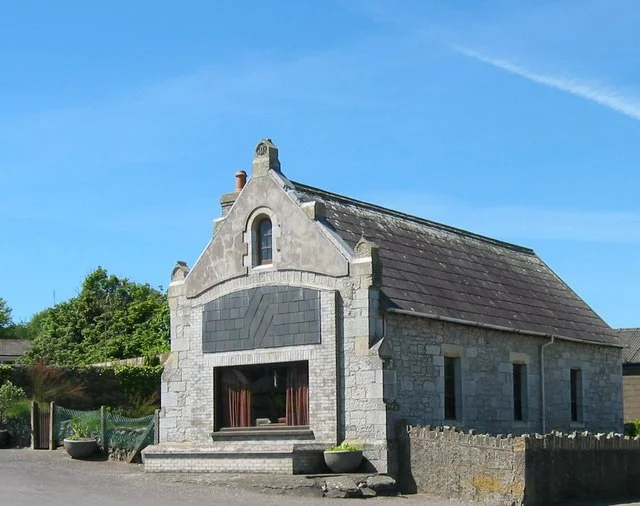

Ardmore Lifeboat Station
Boxing Day 1860. A south-east gale was hammering the Waterford coast. The brigantine Diana of Frederikshavn, on passage from Bordeaux to Belfast with a cargo of wheat and brandy, struck a reef in Ardmore Bay and began to break up. The Ardmore lifeboat launched into the storm with one vacant seat - filled at the last moment by a local gentleman named John S. Roderick. The first attempts to get close to the wreck failed. Eventually, with two lines attached, the lifeboat was hauled in close enough that seven of the eight crew managed to scramble aboard. The eighth man jumped into the sea with a makeshift raft as the wreck was driven closer inshore and was pulled to safety. The lifeboat itself was badly damaged. Four RNLI Silver Medals were awarded for the service, including one to Roderick - a passenger who, on the day, had decided not to be one.
Why a Station Here
The Ardmore Lifeboat Station opened in 1858, just thirty-four years after the founding of the Royal National Lifeboat Institution. The October 1858 edition of the RNLI journal The Lifeboat announced the establishment of a station at Ardmore, in County Waterford, Ireland. A 28-foot, six-oared self-righting Pulling and Sailing lifeboat - with oars and sails - had been placed there along with a carriage for transport. Local donations had built the boathouse; annual subscriptions had been promised toward upkeep. The location made obvious sense. The coast from Helvick Head west to Youghal was notorious for wrecks. Ardmore sat roughly midway between the existing stations and could cover the gap. It was also the village nearest the offshore reefs that had taken the Killarney, the Mermaid, and so many others.
Diana's Crew
The Diana service is the rescue the station is best remembered for. The award of four Silver Medals at a single incident was unusual; most services produced none. The detail that John S. Roderick - described in the records as a local gentleman - voluntarily filled the empty seat tells you something about how lifeboat work was organised in the Victorian period. The professional crews were small. Volunteers in good weather were easy to come by; volunteers in a south-east gale were not. Roderick took his place in a boat that would be returned to shore badly damaged, and he stayed in it until all eight of the Diana's crew were saved. The wheat and brandy went to the bottom. Everyone aboard lived. The lifeboat was repaired and put back into service.
Granite and the Hooper
A new boathouse was commissioned in 1877 after a visit by the Inspector of Lifeboats. The replacement was a fine granite building constructed at a cost of £255 - a serious sum for a small fishing village. In September 1880 Ardmore received its third and final lifeboat, funded by Miss A. M. Hooper of Bristol and named Hooper (Operational Number 303). Like other RNLI vessels of the period, the boat travelled from London to Cork by free passage on the City of Cork Steamship Company. The Hooper was a 34-foot self-righting Pulling and Sailing boat - longer, heavier, and harder to launch by hand than its predecessors, but better in serious weather. It would serve fifteen years.
Closed by Committee
On Thursday, 14 February 1895, the RNLI committee of management in London read a report following a visit to Ardmore by the deputy Chief Inspector of Lifeboats. The decision that followed was administrative and brief: Ardmore Lifeboat Station should be closed. The reasons are not fully spelled out in the surviving paperwork, but several factors were probably in play. Steam tugs and improved coastal communications were changing the shape of sea rescue. Neighbouring stations - Youghal to the west, Helvick Head to the east - could now cover the area more efficiently than a station whose lifeboat had been called out only occasionally over the previous decade. The Hooper was withdrawn. The granite boathouse was repurposed. The lifeboat had operated for thirty-seven years.
The Building, the Memory
Walking the Ardmore cliff path today you pass the old coastguard lookouts, the wreck of the Samson on Ram Head, St Declan's Cell and Holy Well. The lifeboat station building at the junction of Main Street and Cois Trá is still there, repurposed but identifiable - the granite is hard to mistake. The nearest active RNLI station is now Youghal, eight miles up the coast, operating the inshore lifeboat Gordon and Phil since 2016. When ships still wrecked on this coast - the SS Folia in 1917, the SS Ary in 1947 - the rescues came from elsewhere. Ardmore had given thirty-seven years to a service most Victorian villages of its size never even tried to maintain. Four medals from a single Boxing Day in a storm was the high point. It was enough to be remembered for.
From the Air
Located at 51.95°N, 7.72°W at the junction of Main Street and Cois Trá in Ardmore, County Waterford. Best viewed from 1,500-2,500 ft AGL. The original station building still stands in the village; the granite boathouse from 1877 is a distinctive stone structure on the main approach to the seafront. Ardmore Bay - the rescue zone for most of the station's operational career - opens to the south. Ram Head, with the wreck of the 1987 Samson, marks the southern boundary. Nearest active RNLI station is Youghal, approximately 13 km / 7 nm to the southwest. Nearest airports: Cork (EICK) approximately 60 km / 32 nm to the west-southwest, Waterford (EIWF) approximately 45 km / 24 nm to the northeast.
Nearby Stories
- Clonmult Ambush 5.9 km away
- Dunbrody Abbey 9.8 km away
- Mitchelstown Castle 15 km away
- All Together Now (festival) 16 km away
- Hook Lighthouse 21 km away
- Walter Siepmann 29 km away
- Alfred Lämmerhirt 60 km away
- Action of 17 November 1917 117 km away