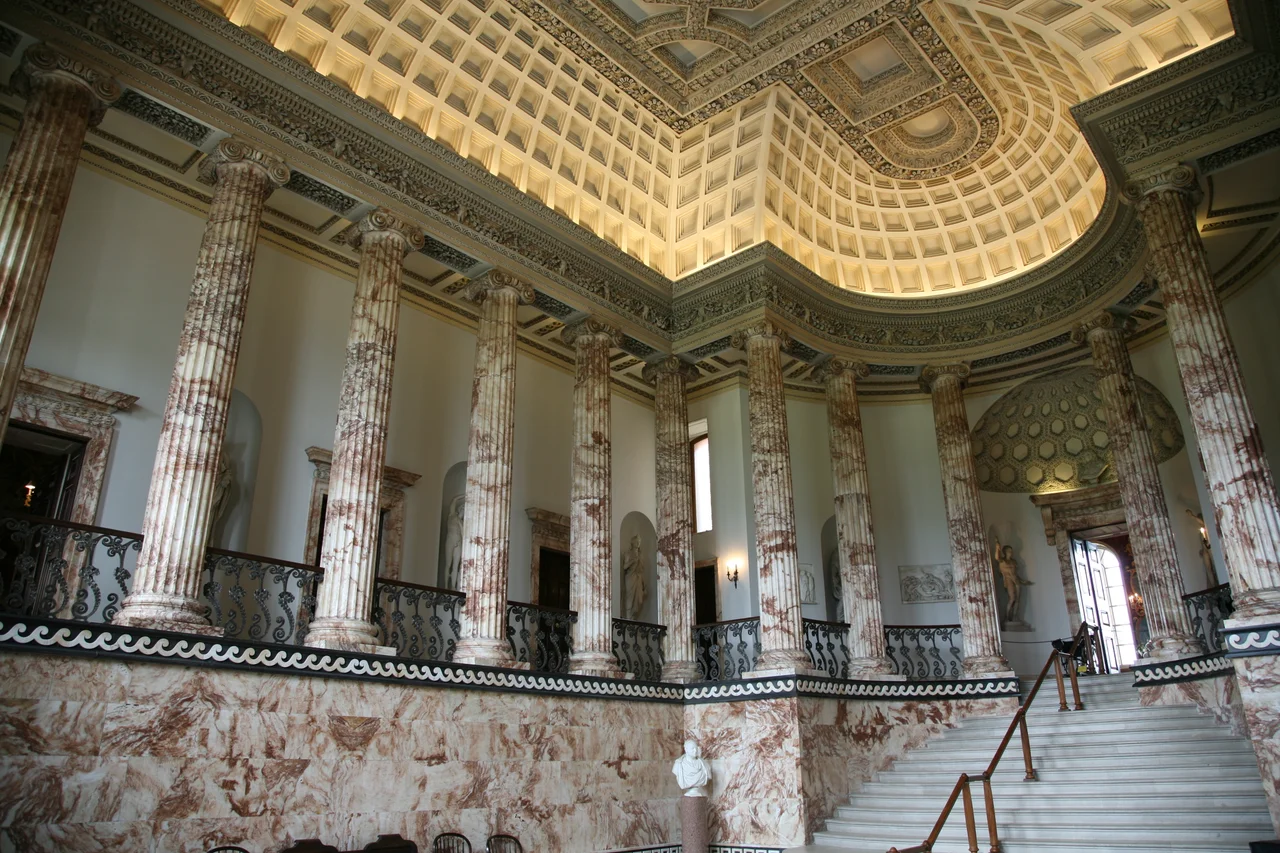

Art Collections of Holkham Hall
Thomas Coke, 1st Earl of Leicester, left England in 1712 at the age of fifteen and spent six years travelling Italy. He returned in 1718 with a library, an art collection, and a vision for a house that would be built around what he had gathered. The result — Holkham Hall in Norfolk — was designed from the beginning as a setting for objects, not the other way around. The niches in the Statue Gallery were cut to exact dimensions to fit the sculptures that would fill them. The rooms were planned around the paintings that would hang in them. When the house was finished, the collection that had crossed the Alps on pack mules and through Papal customs had become one of the finest private assemblages of classical and old master art in England.
Sixty Sculptures from Rome
The collection of ancient Roman marble sculptures at Holkham — 60 pieces in total — is among the finest in any private collection in the world. Most are life-size or larger: gods, emperors, philosophers, and mythological figures gathered in Italy during Coke's Grand Tour and supplemented between 1747 and 1754 by Matthew Brettingham the Younger, who was sent back to Rome specifically to complete the scheme.
Among the most significant pieces: a bust of Thucydides dated 100–120 AD, Carrara marble, 79.5 centimetres high, described as one of the finest busts of the era to survive. A marble Artemis/Diana of 190–200 AD, believed to be a copy of a mid-4th-century BC Hellenistic original — Coke's most expensive purchase at 900 crowns. A statue of the Empress Livia in Parian marble, 2.23 metres high, purchased for 300 crowns. The god Poseidon/Neptune, also Parian marble, 1.73 metres, acquired for 800 crowns in 1752. These are not decorations. They were chosen for meaning: the sculpture in the two exedras of the Statue Gallery was arranged so that satyrs, symbols of ungoverned passion, face the virgin Athena, goddess of wisdom, and Ceres, the preserver of marriage and sacred law.
The Paintings and Their Meanings
The paintings at Holkham were arranged with the same deliberate intelligence as the sculpture. In the Saloon, two paintings commissioned by Coke hang above the fireplaces: Andrea Procaccini's Tarquin Raping Lucretia and Giuseppe Bartolomeo Chiari's Perseus and Andromeda. In the first, a man violates a woman; in the second, a man rescues one. The result of the rape leads to the overthrow of a tyrant. The rescue leads to the rescuer becoming a king. These are not decorative choices.
The Landscape Room contains 22 paintings arranged symmetrically, including seven works by Claude Lorrain and five by Gaspar Poussin. Rubens' Return of the Holy Family hangs in the Saloon alongside Van Dyck's portrait of the Duc d'Arenberg on horseback, purchased in Paris by Coke on his way back from Italy in 1718. Thomas Gainsborough's portrait of Coke of Norfolk occupies the South Dining Room. The full list runs to scores of works across Dutch, Flemish, French, English, and Italian schools — a survey of seventeenth and eighteenth century European painting assembled over decades.
The Books and the Codex
Coke did not only collect art and sculpture. He collected books. The Long Library contains 2,000 of the 10,500 books and manuscripts he acquired during and after the Grand Tour, all bound in leather with gilt titles. The full library holds around 15,000 volumes. The core of the collection centres on Italy and the Renaissance.
Among the rarest items Coke purchased was the Codex Leicester — one of Leonardo da Vinci's scientific notebooks, acquired in 1719. The notebook was sold from the Holkham collection in 1980. It was subsequently purchased by Bill Gates in 1994 and is now the most expensive manuscript ever sold at auction. The Manuscript Library still holds 558 literary, theological and legal manuscripts dating from the 12th to the 18th centuries, including documents related to the settlement of North America drafted with the help of Sir Edward Coke, founder of the family fortune, and a 15th-century copy of Magna Carta.
A House Designed for Its Contents
What makes the Holkham collection unusual is not simply its quality but its integrity. Most great country house collections have been dispersed over generations — sold in financial crisis, broken up in death duties, scattered through inheritance. The Holkham collection remains largely as Thomas Coke intended it: the house designed around the objects, the objects placed according to a scheme of meaning that the designer himself worked out.
The 7th Earl of Leicester restored most of the paintings to the positions designed for them. Some losses are significant — Titian's Venus and the Lute Player was sold in 1931 and is now in the Metropolitan Museum of Art in New York. Most of the old master drawings have been sold. But the sculpture in the Statue Gallery still faces the same walls. The paintings in the Landscape Room still hang in their symmetrical arrangement. Coke's scheme, formulated on a Grand Tour that ended in 1718, survives in the rooms he built for it.
From the Air
Located at 52.95°N, 0.80°E near the village of Holkham in north Norfolk. The hall and its parkland are visible from altitude as a large formal estate. Nearest airport is Norwich (EGSH), approximately 30 miles southeast. The estate sits close to the north Norfolk coast, with Holkham Bay and its nature reserve immediately to the north.
Nearby Stories
- Wroxham 3.2 km away
- East Dereham Windmill 8.5 km away
- Alford Windmill 11 km away
- Mundesley 14 km away
- Batemans Brewery 14 km away
- Wisbech 15 km away
- HMS Cobra 24 km away
- SM U-97 118 km away