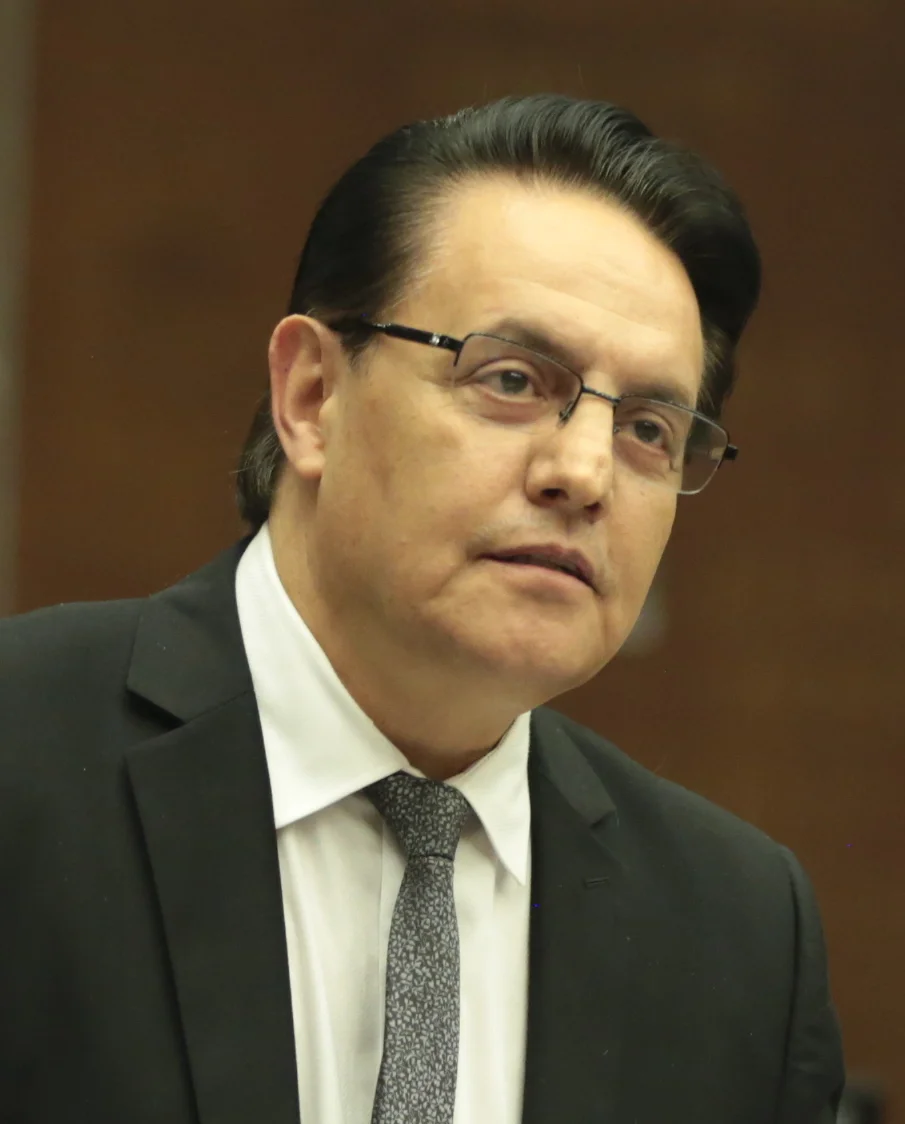

Assassination of Fernando Villavicencio
It was 6:20 in the evening on August 9, 2023, when Fernando Villavicencio finished speaking at the Colegio Anderson in Quito. He had just wrapped a campaign rally for Movimiento Construye, the small party carrying his late-arriving presidential bid into the final stretch of Ecuador's 2023 general election. Security personnel moved him toward a white truck. Cameras caught what happened next from multiple angles, and the footage has been dissected in Ecuadorian courts ever since. Gunmen opened fire. Nine people were hit. Villavicencio was rushed to a nearby clinic, where he was pronounced dead. One of the attackers, Johan David Castillo Lopez, died in the shootout. Six others were captured within hours. Villavicencio was the first Ecuadorian presidential candidate to be assassinated while campaigning since Abdon Calderon Munoz in 1978. The election was eleven days away.
The Journalist Who Named Names
Villavicencio had built his career exposing corruption. As a journalist and later an assemblyman, he had been central to reporting on oil deals, alleged ties between politicians and drug traffickers, and misuse of public funds. In September 2022, he said he had survived an earlier assassination attempt. His campaign advisor, Patricio Zuquilanda, later revealed that Villavicencio had received multiple death threats before the shooting, including one traced to the Sinaloa Cartel that led to an arrest. A day before his death, Villavicencio filed a report with Ecuador's Ministry of Justice about an unnamed oil business. He was polling in second place in the final weeks of the race - 13.2 percent in a La Republica survey in late July, trailing only former assemblywoman Luisa Gonzalez - behind the scenes, apparently making enemies among those he was investigating.
Who Pulled the Trigger
The gunmen were Colombian, police quickly established. Johan David Castillo Lopez died from wounds sustained in the firefight. Six others were detained within hours, along with firearms and grenades. Warrants for some of them had actually been issued only two hours before the attack, after they failed to report to the police under earlier bail conditions. On September 8, 2023, a second round of raids arrested seven more suspects in Quito and Latacunga. Among them was Laura Dayanara Castillo Velin, a leader of the Los Lobos gang in southern Quito, who had been investigated for arms trafficking and had been briefly detained alongside the dead attacker in June 2023 before both were released. On October 6 and 7, 2023, six of the imprisoned suspects were killed inside the Litoral Penitentiary in Guayaquil, followed by another inside a Quito prison - a pattern of silence that Ecuadorean authorities read as professional work.
The Order from Prison
On February 27, 2024, a preparatory hearing revealed the prosecution's theory. According to attorney Ana Hidalgo, the orders for the assassination had been given by Carlos Edwin Angulo Lara - a leader of the Los Lobos gang nicknamed El Invisible - from inside the Latacunga Penitentiary, where he was serving a four-year sentence for arms and drug trafficking. Angulo Lara had exchanged messages with the dead gunman and with Castillo Velin, who had provided weapons, transport, and logistics for the attack. On the day of the killing, Angulo Lara reportedly texted Castillo Lopez: When you see (him), hit it. I trust you, do it. On July 12, 2024, a Quito court sentenced Angulo Lara and Castillo Velin to 34 years in prison for ordering the assassination, and three accomplices to 12 years each.
Who Paid For It
The gunmen were convicted. The actual masterminds behind the killing remained an open question for more than two years. On September 3, 2025, prosecutors charged former minister Jose Serrano, former lawmaker Ronny Aleaga, and businessman Xavier Jordan as intellectual authors of the assassination. In November 2025, a prosecution witness named Marcelo Lazo, who had shared a prison cell with drug trafficker Leandro Norero, testified that journalist Christian Zurita - Villavicencio's close friend and eventual replacement on the ballot - had allegedly solicited 200,000 US dollars from Norero through an intermediary in exchange for not publishing information about an investigation against him. According to the witness, Norero paid the money, but Villavicencio continued publishing, and Norero ordered the killing. Zurita has denied the allegations. The investigation continues. Villavicencio's widow, Veronica Sarauz, has publicly accused Ecuadorian Attorney General Diana Salazar Mendez and President Daniel Noboa of concealing information about her husband's murder.
An Election Under a Shadow
President Guillermo Lasso declared three days of national mourning and a 60-day state of emergency. The election still went forward on August 20, 2023, as scheduled. Villavicencio's name and face remained on the printed ballots because there was no time to reprint them; votes cast for him counted toward his replacement. Movimiento Construye first nominated his running mate Andrea Gonzalez, then switched to his friend the journalist Christian Zurita. The MC-25 ticket finished third with over 16 percent of the vote, a result many described as a condolence vote. Luisa Gonzalez and Daniel Noboa, a 35-year-old newcomer, advanced to the October runoff, which Noboa won. In the years since, the assassination has come to symbolize the broader crisis of Ecuador's descent into drug-trafficking violence. Former president Rafael Correa called the country a failed state in the wake of Villavicencio's death. Whatever the ultimate truth of who ordered the killing and why, it changed the arc of Ecuadorian politics in ways that are still unfolding.
From the Air
The assassination took place at Colegio Anderson in central Quito at approximately 0.17 degrees S, 78.48 degrees W. Quito sits at 2,850 meters on the eastern flank of Pichincha Volcano. Nearest airport is Mariscal Sucre International Airport (SEQM/UIO) in Tababela, about 18 km east of the city. Urban dense neighborhood with mixed residential and commercial buildings. Weather is variable year-round with afternoon convective activity common; morning clearing typical.
Nearby Stories
- History of Ecuador (1830-1860) 7.8 km away
- Baeza 22 km away
- Illiniza 38 km away
- Quinindé Canton 45 km away
- Guandera Biological Station 60 km away
- Sumaco Napo-Galeras National Park 64 km away
- La Mana 67 km away
- Jatun Sacha Foundation 85 km away