
Illiniza
The Colorados people of the western Andes tell a story about two peaks that stand two kilometers apart south of Quito. A father did not approve of his daughter's suitor, so he asked a wizard to turn the young man into stone. The wizard obliged. The suitor became a mountain - Illiniza Sur, the glaciated southern summit. When the daughter learned what had happened, she asked the wizard for the same fate. He made her stone too, and she stands beside her lover, frozen forever at 5,126 meters. The summits are still known today as the man summit and the woman summit. Ecuadorian climbers took a third of her name - Tioniza - and handed Illiniza to the pair.
The Volcano That Blew Itself Apart
What you see from the Chaupi valley is not one mountain but the remains of one. Geologists believe a single, higher stratovolcano once stood where Illiniza now sits. A massive ancient eruption - the date is not recorded - tore out the central peak and left the flanks standing on either side. The north summit, ice-free and rocky, reaches roughly 5,126 meters; estimates range from 5,116 to 5,126 depending on the source. The south summit, wrapped in glacier, reaches 5,248 meters by some measurements and as high as 5,263 by others. Together they are the sixth and eighth highest peaks in Ecuador. The volcano is extinct. The glacier on Illiniza Sur has been shrinking for decades, exposing unstable terrain and falling rocks.
The Race to the Top
Illiniza became a prize in the nineteenth-century race to summit the high Andes. Edward Whymper, the English mountaineer who had first climbed the Matterhorn in 1865 and Chimborazo in 1880, tried twice to reach Illiniza Sur and failed both times. In 1880, the Carrel brothers from the Italian Alps succeeded. Jean Carrel had already made his name as the second man to stand on the Matterhorn, arriving just days behind Whymper. Illiniza Norte belongs to a different tradition. On May 3, 1912, three Ecuadorian climbers - Nicolas G. Martinez, Franz Hiti, and Alejandro Villavicencio - made the first ascent. It remains the only five-thousander in Ecuador first summited by Ecuadorians, and the summit still carries a cross to mark the accomplishment.
Death Pass and the Rampa
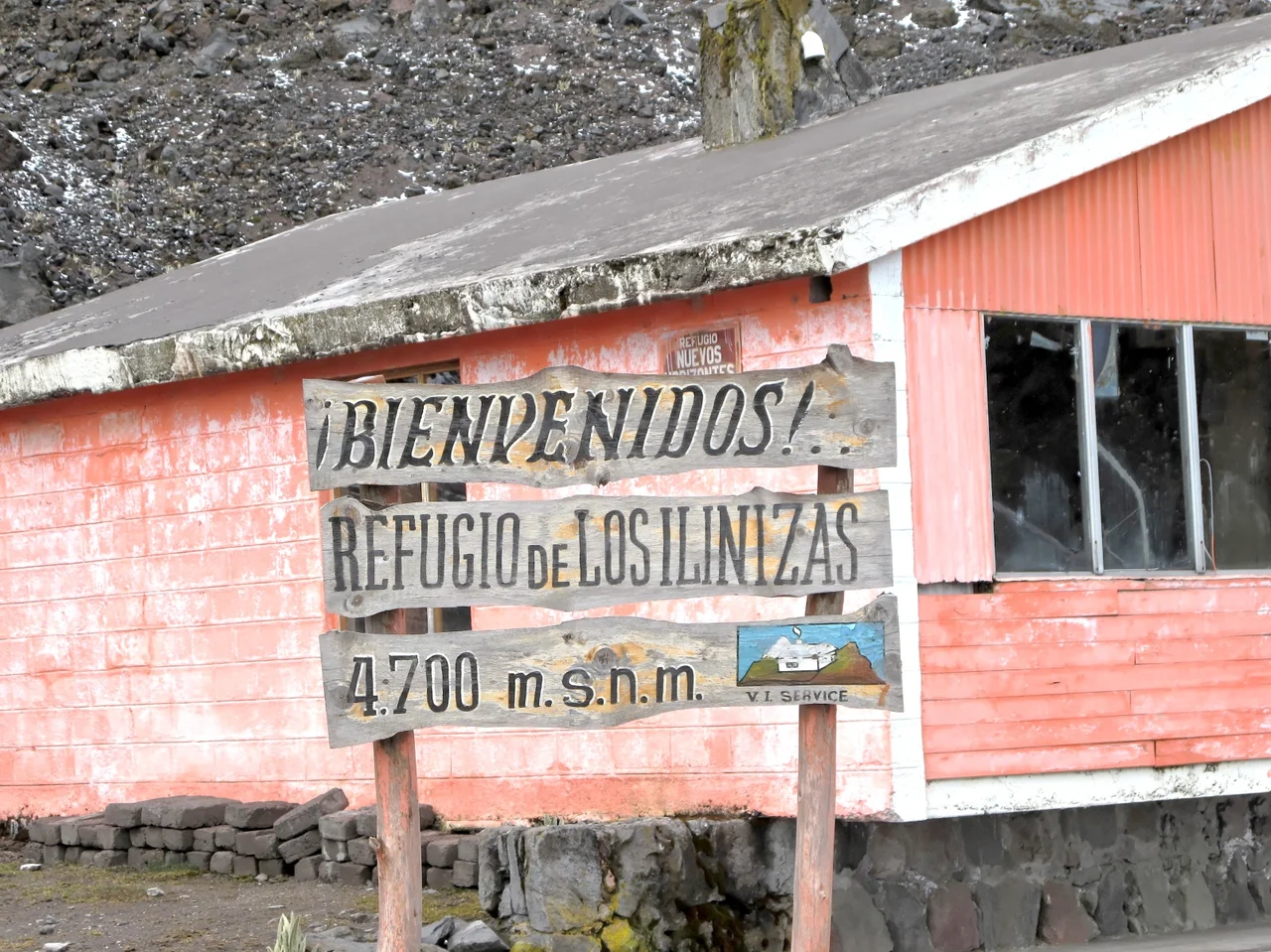
The two peaks demand very different skills. Illiniza Norte is the rite of passage for anyone training for Cotopaxi or Chimborazo - a challenging scramble rather than a technical climb. From the Nuevos Horizontes refuge at the saddle between the peaks, climbers work up the rocky southeastern wall to a pre-summit called Pico Villavicencio, then cross into the northeastern wall known as Paso de la Muerte - Death Pass. A short, steep chute of loose rocks near the top makes a helmet essential. Illiniza Sur is serious ice climbing. The glacier walls tilt up to 70 degrees, and the melting ice exposes crevasses and crumbling rock. The easiest route winds along the northwestern wall. La Rampa runs more directly up a crevasse system. The Celso Zuquillo Route along the eastern ridge is the most technically demanding.
A Reserve Built Around Water
In 1996, Ecuador established the Reserva Ecologica Los Illinizas - roughly 1,500 square kilometers protected from about 800 meters of elevation up to the summits. Inside the reserve sits the Quilotoa crater lake, the Corazon volcano, and the headwaters of three significant rivers: the Toachi, the Rio Zarapullo, and the Esmeraldas. There is no tourist infrastructure to speak of. A seven dollar fifty entrance fee, a parking lot at 4,200 meters that takes an hour to reach from the village of Chaupi because the volcanic-ash road is pocked with deep ditches, and a three-hour walk to the refuge are what you get. After 2012, when three Ecuadorian climbers died descending from the southern summit, the government required licensed mountain guides for every summit above 5,000 meters. The mountain had not become more dangerous - the rules had simply caught up with what the mountain had always been.
From the Air
Located at 0.66 degrees S, 78.71 degrees W, about 55 km south of Quito, Ecuador. Illiniza Sur reaches 5,248 m (17,218 ft) and Illiniza Norte reaches 5,126 m (16,818 ft). The two summits lie about 2 km apart on the border between Pichincha and Cotopaxi provinces. Mariscal Sucre International (SEQM) in Quito is the nearest major airport. Cotopaxi Volcano (5,897 m) rises to the south. Best flying conditions are in the dry season from July through December, with September offering particularly stable weather during the Veranillo. Afternoon fog and precipitation are common during the January through June rainy season. Below-freezing temperatures and strong winds are possible at the summits year-round.
Nearby Stories
- Cubana de Aviación Flight 389 11 km away
- La Mana 16 km away
- Baeza 25 km away
- Tena 28 km away
- Ambato, Ecuador 41 km away
- Valencia, Ecuador 47 km away
- Quinindé Canton 87 km away
- Guandera Biological Station 111 km away