_(40391577161).jpg)
Sumaco Napo-Galeras National Park
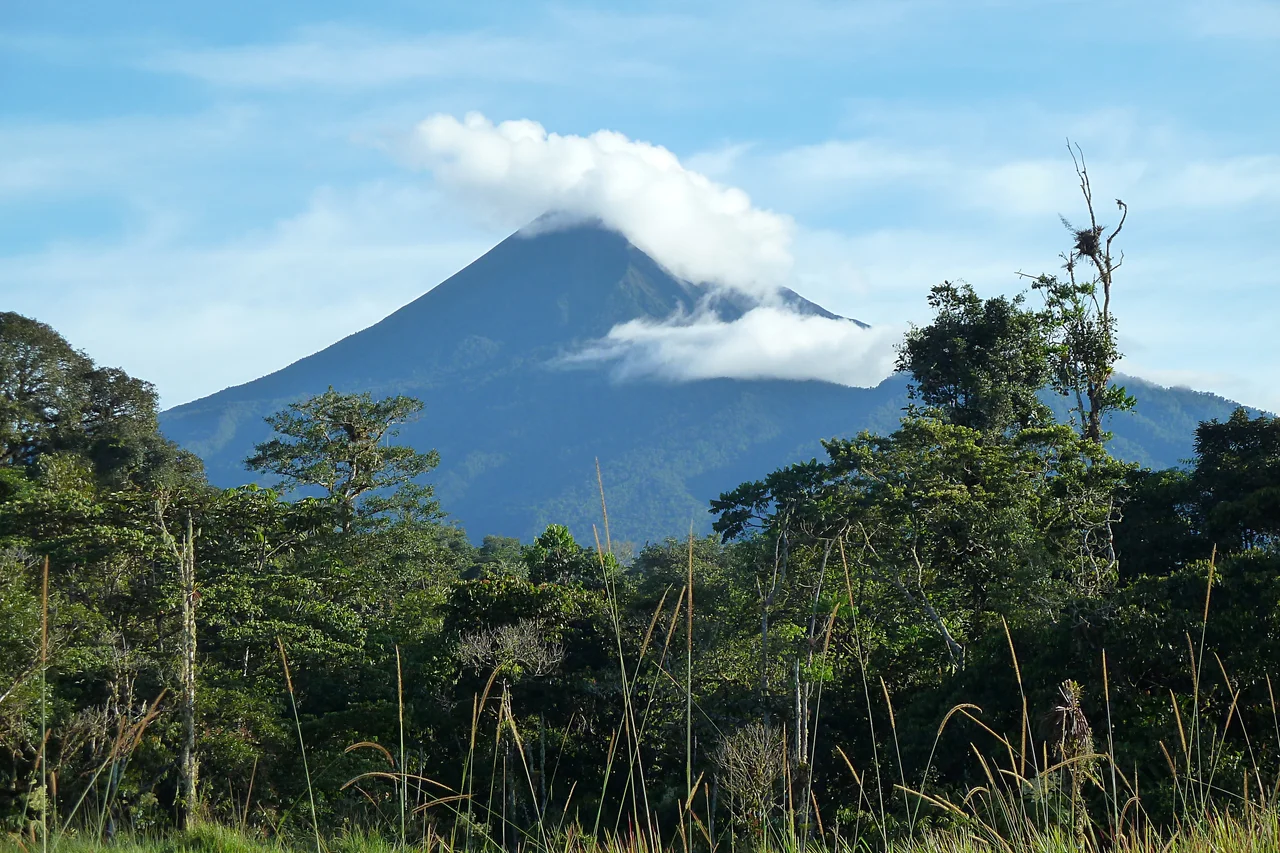
Volcan Sumaco last erupted around 1895, or close to it, or possibly somewhat later. The date is a scholarly estimate because nobody saw the eruption happen. The volcano sits so deep in Amazon jungle, so far from any road or village, that its most recent fit went entirely unrecorded. Geologists reconstructed the event from lava flows and ash deposits long after the fact. Sumaco is unlike any other Ecuadorian volcano in another sense too: it stands apart from the Andean spine, and geochemical analysis shows its lavas come from a different deep source than any other volcano in the country. It is, in the language of volcanology, an outlier.
A Park Without Roads
Sumaco Napo-Galeras National Park covers more than 200,000 hectares of Amazonian Ecuador, about 100 kilometers southeast of Quito. The park was created in 1994 and UNESCO added it to the World Network of Biosphere Reserves in 2000. There are highways around the park's perimeter, but only one practical entry point threads the boundary: the hamlet of Pacto Sumaco, near the larger town of El Chaco. From Quito, a buses operated by Cooperativa de Transportes Loja Internacional leaves Terminal Carcelen daily for El Chaco. The two-hour ride costs about ten dollars. When landslides close highway E20, as they do periodically, the alternate route swings 400 kilometers south along the Panamericana and takes more than seven hours. Inside the park itself, the only way to move is on foot. There is no fee to enter. There are no stores, no restaurants, and almost no trails in any conventional sense.
Eight Hundred Bird Species
What the park lacks in infrastructure it compensates for in biological density. More than 830 bird species have been cataloged within its boundaries, placing Sumaco among the most diverse parks on Earth. The number is remarkable partly because most of the park has never been systematically surveyed. Jaguars and pumas hunt the big cats' usual niches. The giant anteater, endemic to South America, patrols the lower forest. Monkey populations are dense and varied, from howler monkeys whose dawn calls carry several kilometers to marmosets and tamarins flitting through the mid-canopy. Researchers who spend time in the park note something other tropical parks do not offer: the monkeys are not afraid of humans. So few people have walked these valleys that the animals have not learned to associate the human silhouette with danger. They stare, they follow, they occasionally come close enough to touch a branch the observer is holding.
The Volcano in the Trees
Sumaco rises to 3,990 meters, tall enough to break free of the lower forest and wear a ring of high-elevation cloud forest and paramo near the summit. The crater at the top is broad and largely overgrown with jungle foliage, which does not happen on many volcanoes. A small crater lake sits in the bowl. The climb to the summit is technically a trek rather than a mountaineering route, but the difficulty lies in the approach: days of muddy jungle trail through dense rainforest before the slope even begins to steepen. Local guides based in Pacto Sumaco are essential. The weather is wet year-round, the trail is rarely dry, and the biting insects are relentless. Those who complete the climb describe the summit view as unlike anywhere else in Ecuador: the Andes rising in a dark ridge to the west, the Amazon basin rolling eastward in an unbroken green horizon.
Before You Go
Sumaco is for travelers with backcountry experience. Tour operators in Quito can arrange guided treks that include ground transportation and local guides in the park, and this is how most visitors approach the area. Bring everything: food, shelter, fuel, water purification. Plan on two to three liters of drinking water per day and assume that every water source will need filtering, chemical treatment, or boiling. Pack out every piece of trash. The monkeys have not learned to scavenge from humans yet, a rare state in modern parks, and responsible visitors keep it that way. Backcountry camping is allowed but there are no improved sites. The reward for the effort is one of the last corners of the Ecuadorian Amazon that has never been seriously developed, a biosphere reserve in the strictest sense, where a volcano can erupt and nobody notices.
From the Air
Located at 0.38 S, 77.55 W in the Ecuadorian Amazon, east of the main Andean cordillera. Volcan Sumaco rises to 3,990 m, the highest point in the park. The park covers more than 200,000 hectares. Recommended viewing altitude 5,500 to 6,500 m to clear Sumaco's summit and take in both the isolated volcano and the surrounding lowland forest. Nearest commercial airport is Mariscal Sucre International (SEQM) in Quito, 100 km northwest. The park lies southeast of Cayambe Coca National Park and north of the Napo River watershed. From altitude, Sumaco's conical silhouette stands out as the only significant peak east of the Andes in this latitude.
Nearby Stories
- Ecuadorian Amazon 15 km away
- Hacienda Guachala 20 km away
- Oriente (Ecuador) 41 km away
- Tababela 44 km away
- Tena 46 km away
- Llanganates National Park 52 km away
- Pambamarca 77 km away
- Cuyabeno Wildlife Reserve 129 km away