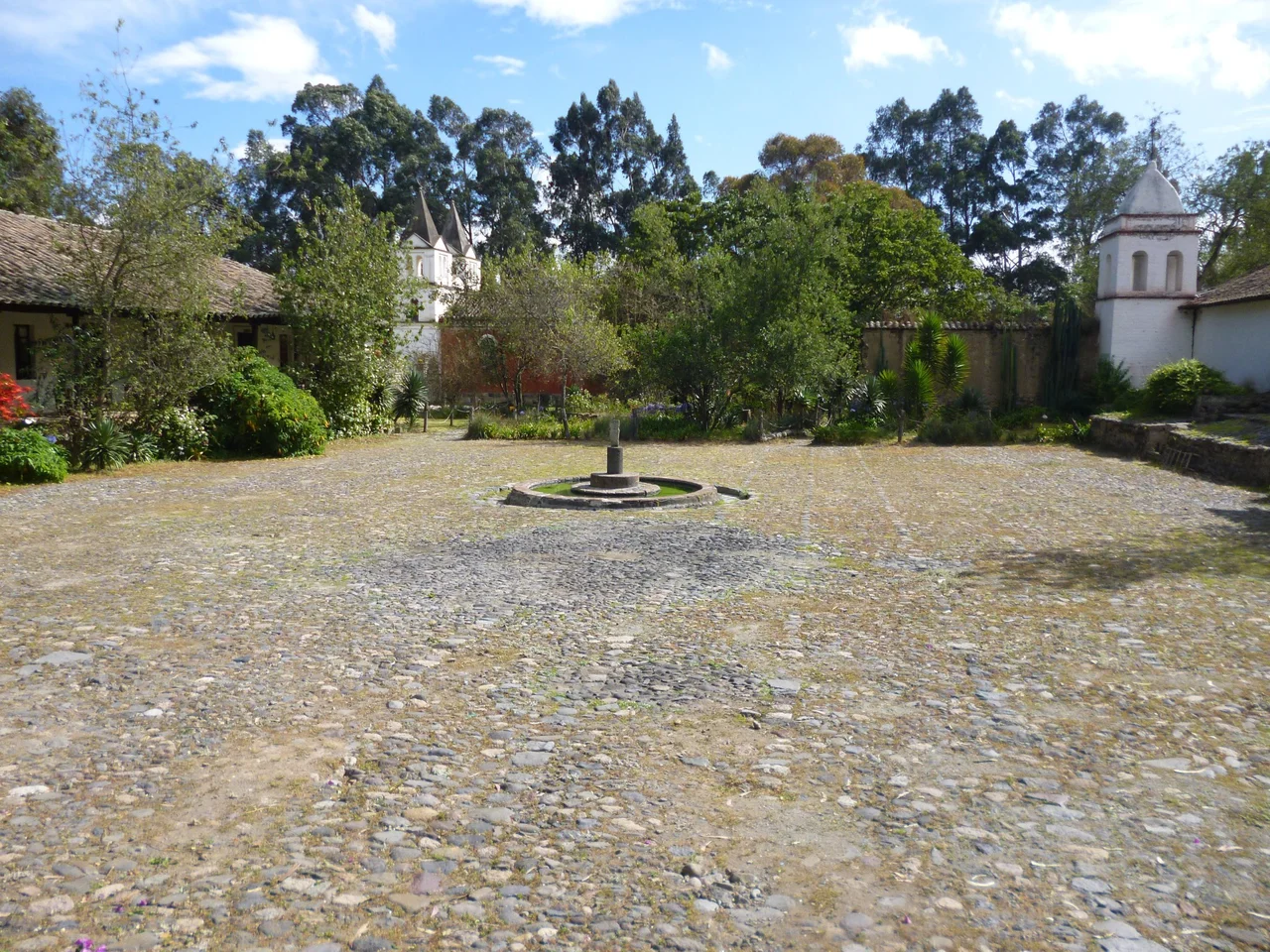

Hacienda Guachala
In 1736, a French expedition arrived at a hacienda in the Cayambe Valley to settle a scientific dispute that had divided Europe for decades: was the Earth flattened at the poles or stretched at them? Charles Marie de La Condamine had traveled from Paris to measure the shape of the planet at the equator. His team tried to plant survey stakes on Guachala's steep grounds, and local Kayambi people pulled them up night after night. They believed the stakes were markers for Spanish land seizures - and given two centuries of colonial experience, they were not wrong to be suspicious. The expedition moved on to flatter ground at Yaruqui. But before they left, they reportedly placed a stone tablet two kilometers from the hacienda's main house, splitting it between the northern and southern hemispheres.
A Chapel on a Temple
The oldest buildings at Guachala date from 1580, making it the oldest hacienda in Ecuador. The chapel built that year sits on the foundation of an Inca temple - one civilization's sacred space directly beneath another's. On one wall, a deteriorated painting from 1757 depicts Heaven and Hell, its inscription noting it was given by Dona Ana Maria Munoz Chamorro on January 1 of that year. The chapel was closed in 1922 by Colonel Juan Manuel Lasso Ascasubi, founder of the Ecuadorian Socialist Party, who used Guachala as the base for a brief, failed socialist revolution. When the landowner Neptali Bonifaz later tried to reopen it, Catholic priests refused to consecrate it again, insisting it had been profaned. He built a new church instead, completed in 1938.
The Worker's Silent Record
A hacienda's official history names the owners. Its real history belongs to the workers whose names were rarely written down. In 1698, the hacienda's owners obtained a royal license to export textiles to Lima, Bogota, and Spain. The mill that produced those textiles operated under conditions that shocked even Spanish crown officials. Jorge Juan and Antonio de Ulloa, the Spanish scientists who traveled with the French Geodesic Mission, recorded what the historian Ramon Galo later summarized: indigenous workers feared the order to enter the mills more than any punishment. The workday stretched twelve hours or more, and many never emerged alive. The huasipungo system - land granted to workers in exchange for labor - tied families to the estate for generations. Ecuador did not fully abolish huasipungaje until land reforms beginning in 1964.
Presidents and Beetles
Gabriel Garcia Moreno, the Ecuadorian president whose name still divides historians, rented Guachala in 1868 and planted the first eucalyptus forests in Ecuador with seedlings imported from Australia. He returned the hacienda in 1875, a few months before his assassination on the steps of the presidential palace. On March 28 and 29, 1880, the English mountaineer Edward Whymper - the first man to summit the Matterhorn - visited and, between climbs, discovered eleven insect species new to science. In 1931, the hacienda's then-owner Neptali Bonifaz Ascazubi was elected president of Ecuador. Congress disqualified him before he could take office, citing his Peruvian birth. His supporters rose. The resulting War of the Four Days killed more than 2,000 people. Bonifaz returned to Guachala and spent the rest of his life managing the estate and introducing European agricultural techniques.
Treasures, Earthquakes, and a Hostel
The money-lender Vicente Tinajero bought Guachala in 1889 for 170,000 sucres. He died of typhoid fever two years later, and local legend holds that he buried fifty thousand sterling pounds somewhere on the estate and took the location to his grave. Treasure hunters have never found it. What the hacienda has found, repeatedly, is disaster. Pichincha Volcano erupted on October 27, 1660, burying crops under ash. The 1987 Ecuador earthquakes damaged the Old House of Finance and destroyed many indigenous houses in surrounding communities. In 1993, Diego Bonifaz - an electrical engineer and former mayor of Cayambe - bought out his siblings and converted the hacienda into a hostel. Today, the main patio centers on a Huaca Siqui, a sacred Kayambi stone given as a gift by the community of Oyacachi in 1987, placed above an old water pile. Visitors can sleep in rooms that once housed presidents, scientists, and the occasional socialist revolutionary.
From the Air
Located at 0.04 degrees S, 78.17 degrees W in the Cayambe Valley north of Quito, Ecuador. The hacienda straddles the equator - a stone tablet reportedly placed by the French Geodesic Mission in 1736 still marks the divide between hemispheres roughly 2 km from the main buildings. Nearest major airport is Mariscal Sucre International (SEQM) in Quito, roughly 60 km south. Cayambe Volcano (5,790 m / 18,996 ft) dominates the eastern horizon. Best viewed in morning light before afternoon clouds build against the Andes.
Nearby Stories
- Otavalo 8.1 km away
- Mindo 8.2 km away
- Sumaco Napo-Galeras National Park 17 km away
- Baeza 39 km away
- Quilotoa Loop 58 km away
- San Miguel (Ecuador) 66 km away
- Sanctuary of Las Lajas 71 km away
- Ecuadorian Amazon 119 km away