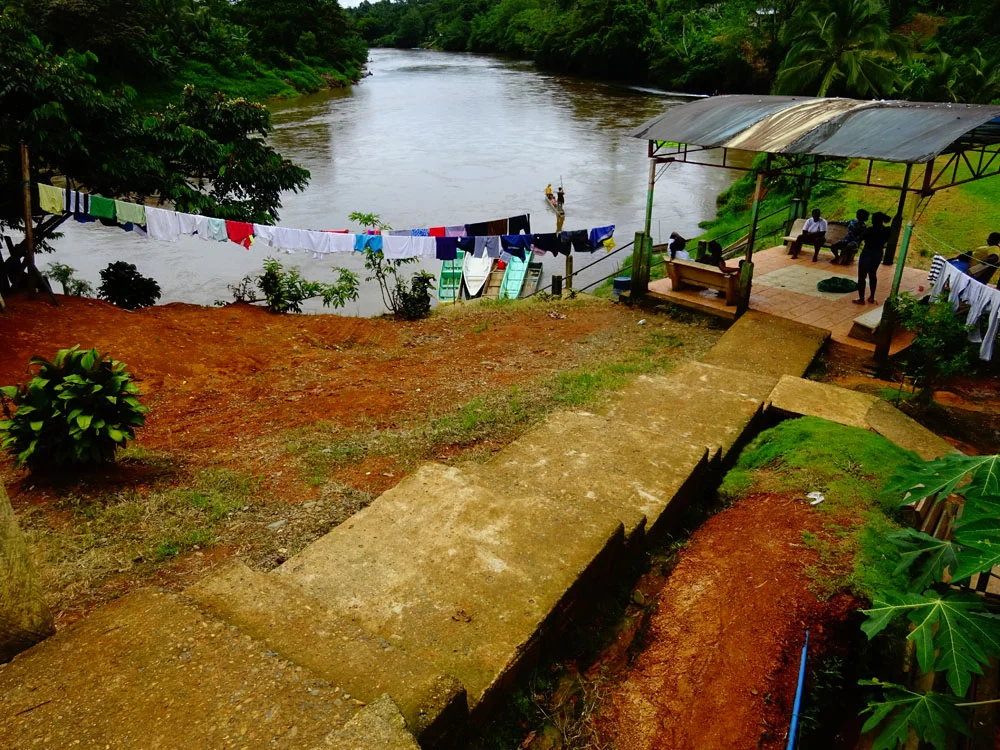

San Miguel (Ecuador)
There are no roads to San Miguel. Not even walking paths link it to the next village. Everything arrives by boat: passengers, cooking oil, salt, letters, visitors who phoned ahead and hope someone is waiting at the river port of Borbón at 9:30 in the morning. Four hours later, a single-engine launch noses up to a hill above the Cayapas River, and the rainforest begins almost where the dock ends. This is home for a small Afro-Ecuadorian community in Esmeraldas Province, on the edge of the Cotacachi-Cayapas Ecological Reserve — one of the most biodiverse places on Earth, and one of the least visited.
A Highway Made of Water
The locals call the river their highway, because everything depends on it. Motorised canoes ferry people between clearings; smaller dugout canoes, carved from single trunks, ply the side channels and explore the Rio San Miguel, the Rio Cayapas, and the long canals that wind inland. The daily passenger service between San Miguel and Borbón leaves San Miguel at two in the morning, when the rain usually holds off, and returns in mid-morning. At ten US dollars for the four-hour trip, it barely breaks even. The community runs the boat themselves, and every passenger matters. Travellers who show up are welcomed with a mix of curiosity and practical warmth — and usually told, with a smile, to wrap their luggage in plastic before boarding, in case the sky opens on the way back.
The Forest Behind the Hotel
Step off the back terrace of the community hotel and the rainforest begins. A network of footpaths threads into the trees, past small clearings where families grow pineapples, cooking bananas, and yuca. The paths are easy enough to follow without a guide, though a GPS is a sensible precaution — the canopy closes quickly, and distance blurs. Birds work the upper layers in the early light; colours flash through leaves before your eyes can resolve them. Farther in, the soundscape shifts from village to insect hum to the occasional distant howl of something unseen. The Cotacachi-Cayapas Ecological Reserve stretches from the wet coastal lowlands up into the cloudforests of the Andes, and San Miguel sits on its lower, greener edge.
Neighbours Along the River
San Miguel's Afro-Ecuadorian residents share this stretch of river with the Chachi, an Indigenous people whose villages sit a short way downstream. Around Easter and Christmas, the Chachi hold mass wedding ceremonies that outsiders are sometimes invited to attend. Their baskets — tight, patterned, made from forest fibres — are among the few things visitors can buy here; there is a small shop for salt and cooking oil, and little else. For food, the arrangement is simple and generous: for about eleven dollars a day, a woman from the community will cook three meals from local ingredients, arriving in portions better suited to a farmhand than a tourist. Everyone, as the villagers put it, gains from visitors, and everyone treats them accordingly.
Off the Grid, On Purpose
San Miguel has no mobile signal and no internet. A stable landline connects the community hotel to the outside world, and a satellite WiFi connection flickers on and off at the Chachi village of Loma Linda, a kilometre and a half downriver — intended for the school, but open after hours if the weather cooperates. The village sits at around 100 metres elevation in a humid lowland pocket of northern Ecuador, roughly 80 kilometres inland from the Pacific. Black flies bite hard in daylight near the river; mosquitoes are rare, malaria essentially absent. In 2014 the World Health Organization declared Ecuador free of river blindness, which used to be the black flies' worst gift. The nearest doctor is thirty minutes downstream in Zapallo Grande. You come here knowing those things, and accepting them.
Why People Come
The reasons are quiet ones. Sitting on the wooden terrace of the community hotel, watching hummingbirds work the flowers a few metres from your coffee. Learning to handle a dugout canoe against the current. Swimming in the river where the villagers wash clothes. Talking with Afro-Ecuadorian neighbours who are, by their own easy description, curious about the outside world but in no hurry to become it. The whole operation — the boat, the hotel, the meals — is a deliberate experiment in keeping a place on its own terms while letting a little of the world in. When the generator goes quiet at night and the forest takes over, you understand what they are protecting, and why it is worth the four-hour ride.
From the Air
San Miguel sits at approximately 0.74°N, 78.92°W, in Esmeraldas Province, northwestern Ecuador, at low elevation near the Cayapas River. The village is about 160 km northwest of Quito's Mariscal Sucre International Airport (SEQM). No airstrip; access is by boat from Borbón. From the air, look for the broad, tea-coloured braid of the Cayapas winding through unbroken rainforest canopy, with tiny rectangular clearings marking upstream villages. Weather is humid and often overcast; afternoon convective buildups are typical during rainy months.
Nearby Stories
- Quinindé Canton 22 km away
- 1958 Ecuador–Colombia earthquake 25 km away
- Northwestern Andean Montane Forests 34 km away
- Otavalo 36 km away
- History of Ecuador (1830-1860) 57 km away
- Mira River 66 km away
- 1906 Ecuador–Colombia earthquake 101 km away
- Isla Gorgona 214 km away