
Otavalo
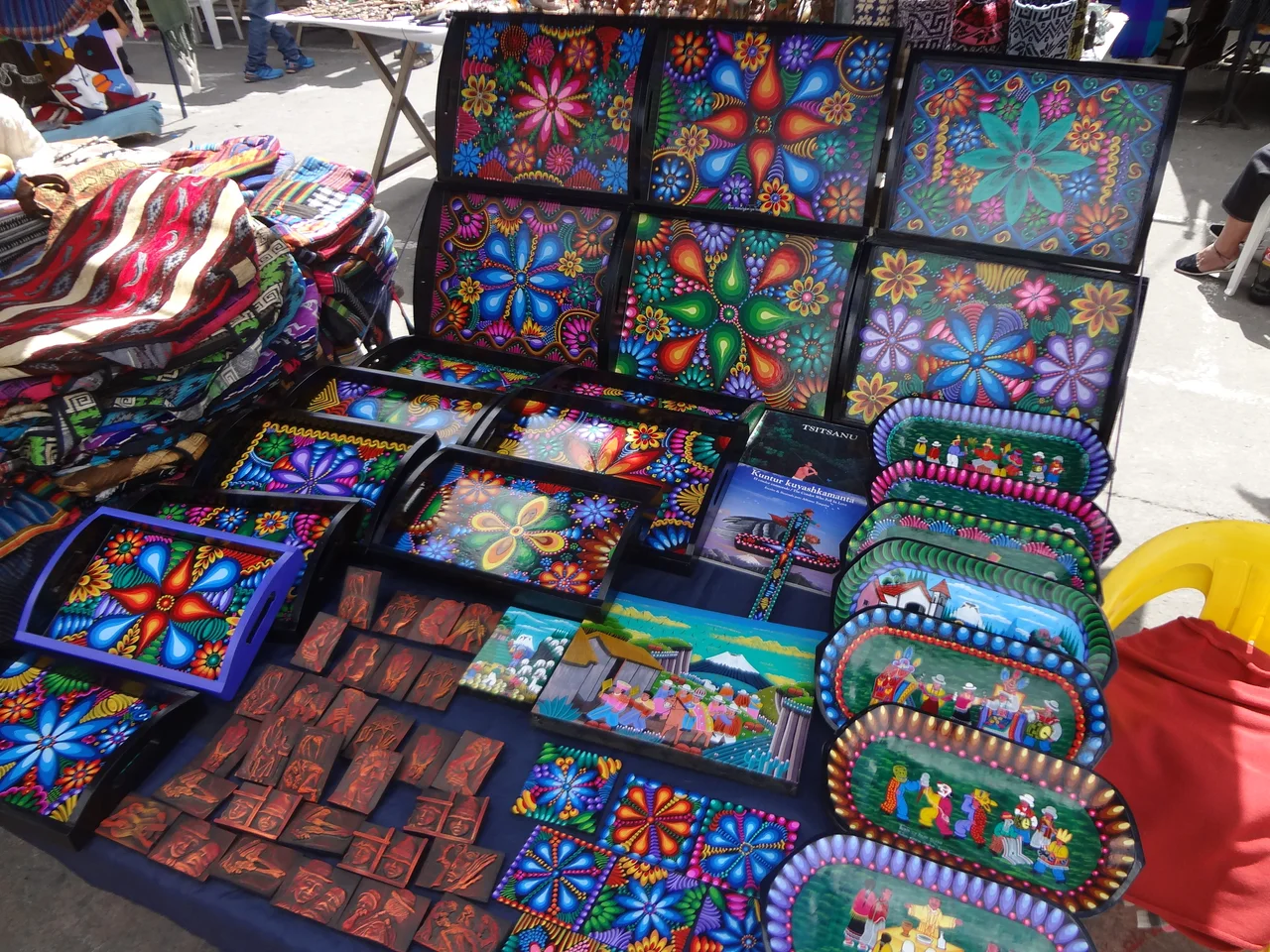
The concrete umbrellas came first. In 1970 the Dutch architect Tonny Zwollo designed a market for Otavalo made of mushroom-shaped concrete canopies with benches under them - permanent shade for a Saturday market that had already been going on for centuries. Today the canopies still stand in the Plaza de los Ponchos, and on market days about a third of this Ecuadorian town fills with stalls of handwoven textiles, tagua nut jewelry, panpipes, alpaca blankets, and the calls of Otavaleños bargaining in Kichwa, Spanish, and occasionally English. The market is famous. What it represents is more unusual: an indigenous people who, against nearly every regional precedent, turned themselves into one of Latin America's most economically successful indigenous groups.
Three Volcanoes Watching
Otavalo sits at about 2,550 meters on the inter-Andean corridor of northern Ecuador, in Imbabura Province. Three volcanoes form its skyline. Imbabura, 4,630 meters - the "Taita" in local tradition, the father of the people, the protector of crops. Cotacachi, 4,939 meters - the mountain that local legend calls Maria Isabel Nieves Cotacachi, a woman whose unfinished love affair with Taita Imbabura is still discussed in the villages. Mojanda, to the south, holding a set of high-altitude crater lakes. The volcanic soil is good. For centuries the economy here was farming, and it still partly is. But tourism has become the main industry, and the Plaza de los Ponchos is its engine. According to the 2022 census, the town itself holds 41,718 people, many of them members of the Otavalo indigenous group.
The Weaver's Town
The Otavalo people were weaving textiles before the Inca arrived, before the Spanish arrived, before Ecuador was Ecuador. Wool became the dominant fiber after sheep came with the conquest, but the looms, the patterns, and the coloring traditions came forward from deeper in time. Today Otavaleño textiles are sold on six continents. Musicians - sometimes called Andean New Age players - tour the world playing panpipes and charangos in shopping plazas from Tokyo to Seville. Many of the grandest houses in town belong to Otavaleño families who have built export businesses. At the same time, a large percentage of Otavaleños in the surrounding villages live in poverty, and the indigenous community still faces racial discrimination from the mestizo society around it. The success is real. So is the inequality beneath it.
How to Read the Clothes
Otavaleña women traditionally wear a white embroidered blouse with flared lace sleeves, a dark over-skirt over a cream under-skirt, and hair tied back with a 30-centimeter band of woven multicolored cloth. Strings of gold beads cross the chest, the number and thickness of strands indicating the wearer's age and accumulated wisdom - not literally but relationally, a visual grammar locals read fluently. Long coral strands wind tightly around each wrist. Men wear white trousers, dark blue ponchos, and often keep their hair long, plaited behind. The clothing is not a costume. It is a lived tradition maintained deliberately; a young Otavaleña heading to university in Quito or Madrid may keep the white blouse and the coral beads as an act of identity. The outfit walks into boardrooms as often as it walks into church.
Beyond the Plaza
A few streets from the Plaza de los Ponchos, the Iglesia de San Luis holds its baroque altar dating from 1869 - installed when the church was rebuilt after the 1868 earthquake that destroyed the original 1676-79 structure. Iglesia El Jordán, heavily damaged in that same earthquake and again in 1906, was reconstructed slowly between 1925 and 1964 in a Greek-renaissance style with two Corinthian-capitaled clocktowers. The Museo Viviente Otavalango occupies the former "antigua fábrica San Pedro," a textile factory where indigenous Otavaleños worked in sweatshop conditions for generations. Locals bought the land after the factory closed, reclaimed it as a living museum and community space, and now hold weddings, concerts, and teaching demonstrations there. Parque Cóndor, a bird rescue center above town, runs daily flight demonstrations with condors and Andean hawks. The railway to Ibarra - closed around 1980, reopened in 2015 for tourists - still runs its 27-kilometer route.
Inti Raymi
Every June, around the southern winter solstice, Otavalo and the surrounding villages celebrate Inti Raymi - the indigenous festival of the sun whose roots reach back before the Inca. Music carries the festival. Musicians from the region travel to perform, and local groups play in the streets and plazas. For one week the tourist-facing town becomes something else - an indigenous festival center where the ancient calendar is still being kept. If a visitor wants to understand what the Otavaleño economy has actually been for - what the international success of the textiles and the bands is ultimately underwriting - Inti Raymi is the answer. A community with enough resources to keep practicing its own ceremonies, on its own schedule, in the language of its own grandparents.
From the Air
Otavalo is located at 0.233°N, 78.267°W - just south of the equator in the inter-Andean valley of northern Ecuador. Elevation is about 2,550 m (8,366 ft). The nearest international airport is Quito's Mariscal Sucre (SEQM), 65 km south by road and a clear flight view on a good morning. The three surrounding volcanoes - Imbabura (4,630 m), Cotacachi (4,939 m), and Mojanda - are the dominant visual features. Expect morning clarity with afternoon cloud buildup over the peaks.
Nearby Stories
- Mindo 6.7 km away
- Hacienda Guachala 7.3 km away
- San Miguel (Ecuador) 31 km away
- Sanctuary of Las Lajas 33 km away
- Sumaco Napo-Galeras National Park 46 km away
- Northwestern Andean Montane Forests 46 km away
- Quinindé Canton 82 km away
- Ecuadorian Amazon 148 km away