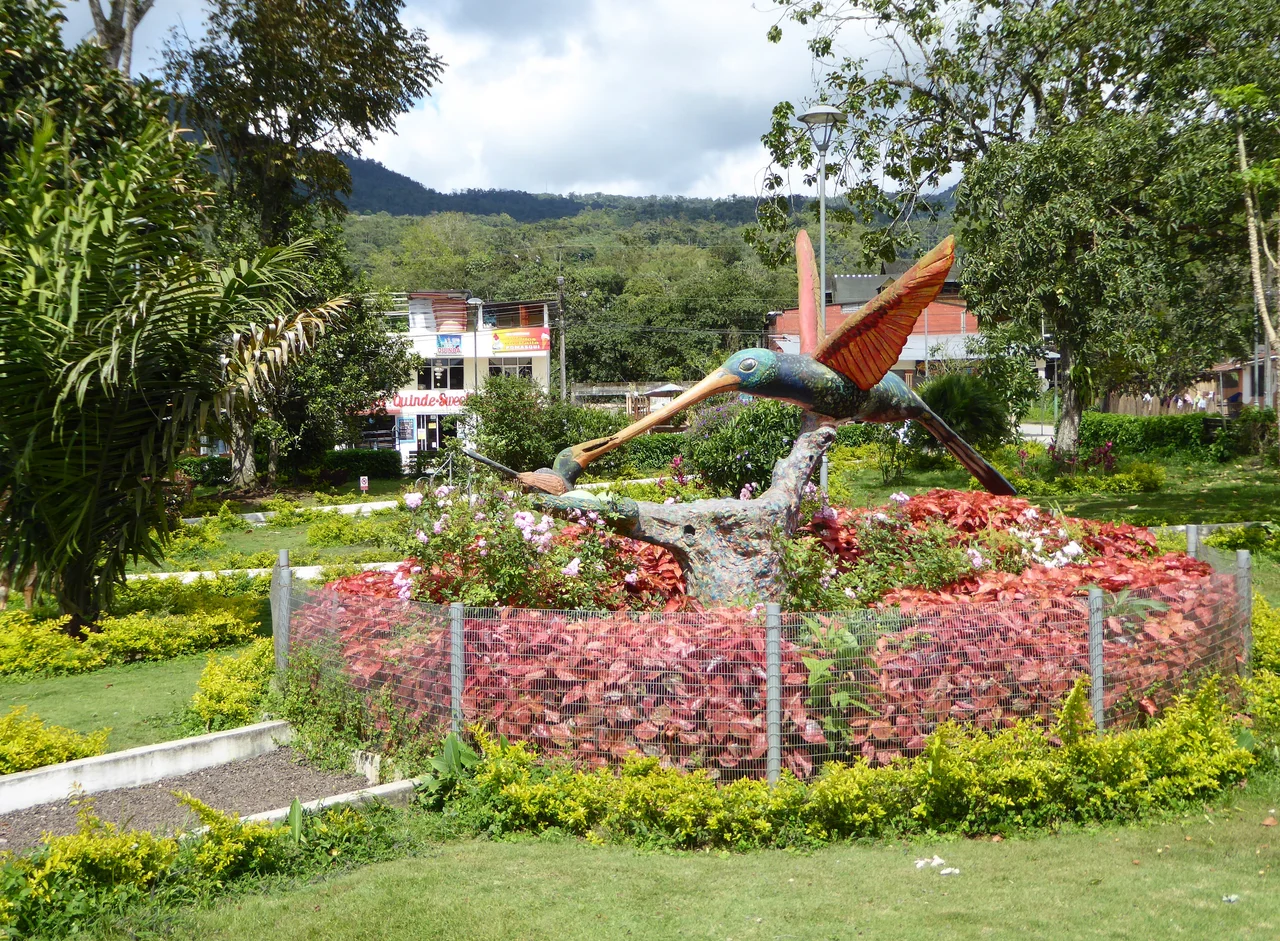

Mindo
A hummingbird weighs less than a penny. At feeders in Mindo, dozens of them hover at once, so close you can hear their wings beating, their iridescent throats catching sunlight at angles that briefly turn them to chips of emerald and ruby. The town sits in the Andean foothills about two hours northwest of Quito, entirely surrounded by the Mindo-Nambillo Cloud Forest. Mindo itself has about 3,000 residents. The forest around it has 450 documented bird species. That math is roughly one bird species per seven humans, a ratio that helps explain why birdwatchers from around the world make the trip here, often as the anchor stop of longer Ecuadorian trips.
The Cloud Forest Effect
Cloud forest is a specific ecological category, distinct from the rainforest everyone pictures. Here, moisture arrives not primarily as rain but as fog that drifts through the forest day and night, condensing on every leaf and dripping steadily to the ground. Epiphytes thrive in this environment: orchids, bromeliads, ferns, and mosses that grow on branches rather than in soil, pulling water directly from the air. The result is a forest where every horizontal surface is its own hanging garden, and where the biodiversity concentrates in vertical layers that a traveler walking the ground rarely sees in full. Mindo-Nambillo protects one of the more accessible examples of this ecosystem, and the town has built its tourism economy around making the forest visible to visitors willing to look up.
Birds and the 450 Number
The bird list is what draws the serious naturalists. Over 450 species have been recorded in the Mindo area, including some of the most sought-after birds in the Neotropics. The Andean Cock-of-the-Rock, a neon-orange male with an outrageous crest, performs its lek displays in known locations that guides can find reliably. The Long-wattled Umbrellabird, with its dangling throat pouch, lives in the forest understory. Hummingbirds by the dozen visit feeders at ecolodges and roadside cafes, their iridescent throats changing color with every shift of the light. The Toucan Barbet, the Plate-billed Mountain Toucan, and the Crimson-rumped Toucanet all appear in the canopy. The signs along the Cunuco road point birders toward 5 to 6 kilometers of surefire sightings accessible on foot for free, which is a remarkable statement about a forest that elsewhere would require expensive guides and permits.
Waterfalls and the Tarabita
Mindo's second-most photographed attraction is the series of waterfalls just outside town. Reaching them requires a short hike, a cable car crossing, or both. The tarabita, the aerial tram that carries visitors across a river gorge to the trailhead, costs about five dollars and gives a view of the forest canopy from above. On the other side, trails branch to several cascades, some close and easy to reach, others requiring a full day of hiking. One of the waterfalls is accompanied by a natural water slide that locals will help visitors use safely. The adventurous sometimes leap from the top of one fall when the river height is right, though this is not an officially sanctioned activity and guides discourage the uninformed. Most visitors settle for swimming in the pools at the bottom and drying off in the filtered sun.
Chocolate from the Bean
Ecuador produces some of the world's finest cacao, the cocoa variety called Nacional that has been cultivated in the country for at least 5,000 years. Mindo has become one of the places visitors can see the full chain of chocolate production from pod to bar. El Quetzal de Mindo, a combined hotel and chocolate factory in the center of town, runs tours that start in the cacao orchard and end with tasting samples. The factory also brews beer, making a chocolate stout that uses the same beans in a genuinely unusual combination. El Quetzal malts its own barley. The whole operation exists on a scale small enough that visitors can talk to the owners, and it represents a model of small-scale agricultural tourism that has spread to other Ecuadorian towns since. Freshly roasted local coffee and handcrafted Ecuadorian crafts round out what the shop offers.
Getting There From Quito
Mindo is a two-hour bus ride from Quito, a trip that winds through dramatic Andean landscapes as the road drops from the high plateau into the cloud forest foothills. The Flor de Valle and Cayambe companies run services from Terminal Terrestre Norte at La Ofelia, with more buses on weekends than weekdays. The fare is a few dollars. For travelers who have time for only one side trip from Quito, Mindo often wins the internal debate: the biodiversity is exceptional, the elevation is low enough to let visitors escape altitude fatigue, and the mix of wildlife watching, adventure sports, and small-town walking makes the trip worthwhile for almost any kind of traveler. Tubing down the Mindo River, ziplining through the canopy, butterfly gardens where tropical species will feed from visitors' hands: the activities are many, and the quiet hummingbird feeder is still the one most people remember longest.
From the Air
Mindo is located at 0.03 degrees south, 78.80 degrees west, in the western Andean foothills of Ecuador about 80 kilometers northwest of Quito. Mariscal Sucre International Airport (ICAO: SEQM) at Quito is the nearest major airport. From altitude the area appears as a dense green cloud forest dropping steeply from the Andean ridgeline, often obscured by the cloud layer that gives the ecosystem its name. Recommended viewing altitude 10,000 to 14,000 feet for clear views above the typical cloud deck.
Nearby Stories
- HCJB - The Voice of the Andes 5.3 km away
- Otavalo 16 km away
- Quinindé Canton 17 km away
- Illiniza 42 km away
- History of Ecuador (1830-1860) 46 km away
- Jatun Sacha Foundation 57 km away
- Baeza 58 km away
- Western Ecuador Moist Forests 60 km away