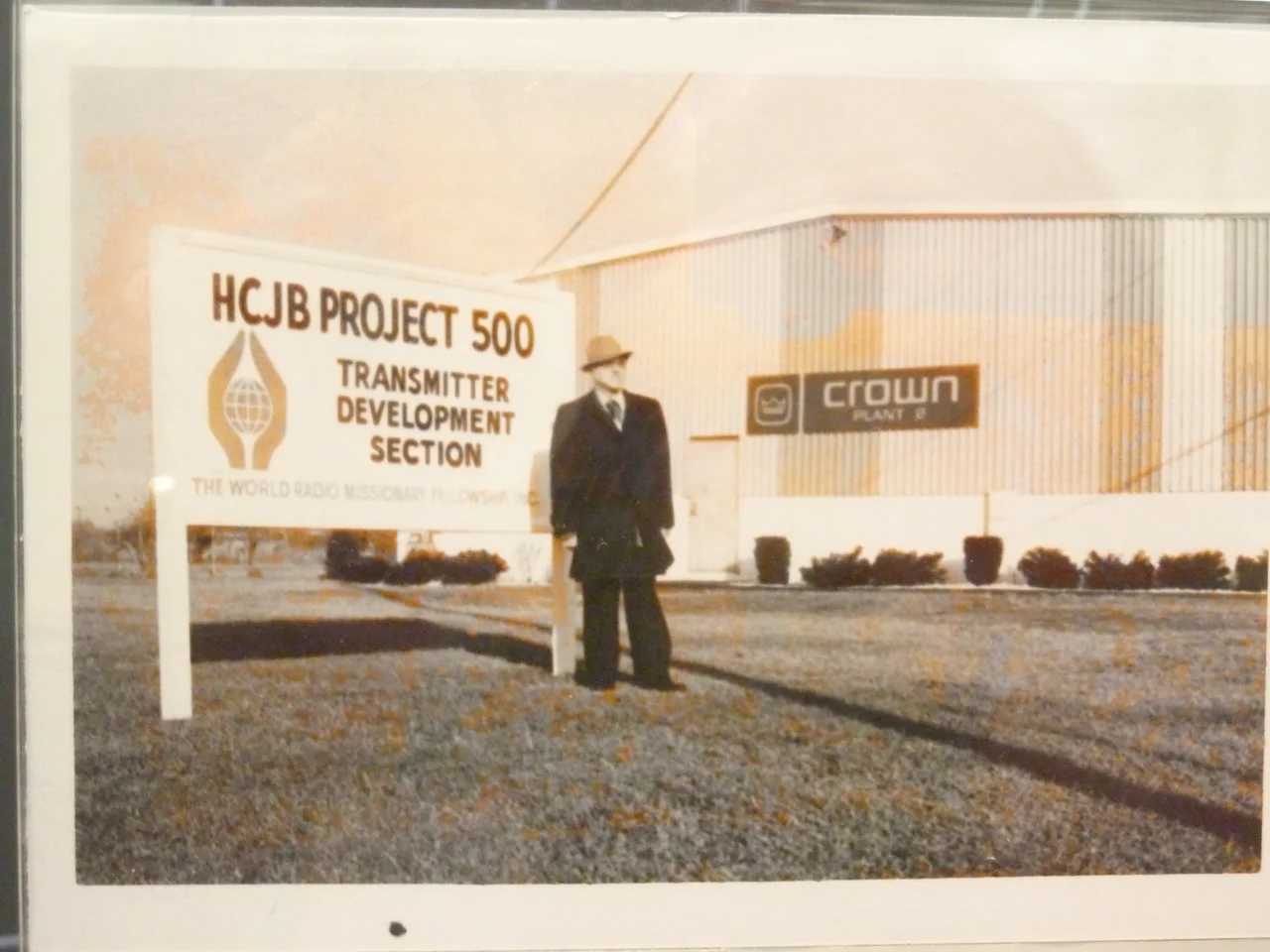

HCJB - The Voice of the Andes
On Christmas Day 1931, a 200-watt transmitter in a house in Quito clicked on, a single wire strung between two makeshift telephone poles started radiating radio waves, and for thirty minutes the voice of an American missionary named Clarence Jones spoke in English and Spanish to whoever happened to be listening. Almost no one was. Ecuador had no commercial radio stations yet - HCJB was the country's first. The Joneses were broadcasting from their own living room, powered by equipment they had largely built themselves. The call letters stood, by one popular explanation, for Hoy Cristo Jesus Bendice - Today Christ Jesus Blesses. It was the beginning of the world's first Christian shortwave station, and the first serious attempt to turn a radio signal into a missionary.
The Vision From Chicago
Clarence Wesley Jones was a Salvation Army minister's son who had graduated from Moody Bible Institute in Chicago, played trombone in evangelist Paul Rader's tabernacle, and helped run Rader's weekly radio ministry - a program called WJBT, short for Where Jesus Blesses Thousands. Jones had watched a microphone reach audiences a preacher's voice could never touch. In 1928, he spent seven weeks traveling Venezuela, Colombia, Panama, and Cuba trying to convince a government to let him build a missionary radio station. Every one refused. It was Ecuador that finally said yes. Jones arrived in Quito with Reuben Larson and D. Stuart Clark, built their first transmitter themselves, and got it broadcasting at more than 9,000 feet above sea level - altitude that gave their signal remarkable reach.
Fourteen Languages and a Quad Antenna
By 1941 the station was broadcasting in Russian, Swedish, and Quichua. By 1944, programming ran in fourteen languages, including Czech, Dutch, French, and German. Arabic, Italian, and Hebrew programs arrived on acetate-coated aluminum transcription discs shipped from elsewhere. In 1940, HCJB engineer Clarence Moore invented the quad antenna - a design different from today's cubical quad but critical at the time - and later patented it. In 1951, the mission acquired 45 acres of land near Pifo, east of Quito, and began building the transmitter farm that would let them reach the world. In 1961, HCJB launched the first television station in Ecuador. By 1990, their own engineers had designed and built a 100-kilowatt shortwave transmitter called the HC-100, and similar rigs were operating in Swaziland (now Eswatini) and Australia.
The Listeners Who Didn't Care About Religion
For shortwave enthusiasts around the world - known as DXers, the X standing for distance - HCJB became something more complicated than a missionary station. It was a signal from the Andes, a QSL card with a mountain on it, proof of reception at the edge of what was possible with a wire and a receiver. Many listeners had no interest in the religious content and tuned in purely for the hobby of catching a far signal. HCJB started printing its own QSL cards in 1932. In 1974, radio engineer Clayton Howard founded the Andes DXers International club, which eventually grew to thousands of members worldwide. Howard and his wife Helen hosted DX-Partyline for more than forty years - a weekly program that read listener mail, recommended antennas, and reviewed equipment. For Latin America's shortwave audience, it was the only show of its kind.
The End of the Signal
In 2009, HCJB turned off its shortwave transmitters. The Ecuadorian government had demanded the removal of the Pifo transmitter station to make way for the new Quito airport, which opened in 2013. But the deeper reason was simpler: people no longer listened to shortwave. The mission - renamed Reach Beyond in 2014 - shifted to what it called radio planting, helping local Christian communities start their own FM stations in their own languages. Some of the transmitter equipment moved to Kununurra in northern Australia to serve Asia. A small 5-kilowatt signal from Ecuador lingered for a few years before being replaced in 2017 by a 1-kilowatt solid state unit. HCJB today broadcasts on FM across Ecuador at 89.3, 92.5, 96.1, and 98.3 megahertz, with AM programming at 690. The wire between the telephone poles is long gone. What remains is the idea that started in a Quito living room: a voice carries further than a preacher can walk.
From the Air
Located at 0.11 degrees S, 78.36 degrees W in Quito, Ecuador. The historical transmitter farm sat near Pifo, east of the city. Quito itself sits at approximately 2,850 m (9,350 ft) elevation, which gave HCJB's shortwave signals a natural propagation advantage. Mariscal Sucre International Airport (SEQM) is nearby - its 2013 opening is what ultimately forced the shortwave shutdown. The surrounding Andes peaks include Pichincha Volcano (4,784 m) and Cotopaxi (5,897 m) to the south. Best visibility is in the morning before afternoon cloud buildup. Listen on 89.3 FM if flying over Pichincha province.
Nearby Stories
- Otavalo 8.1 km away
- Mindo 8.2 km away
- Sumaco Napo-Galeras National Park 17 km away
- Baeza 39 km away
- Quilotoa Loop 58 km away
- San Miguel (Ecuador) 66 km away
- Sanctuary of Las Lajas 71 km away
- Ecuadorian Amazon 119 km away