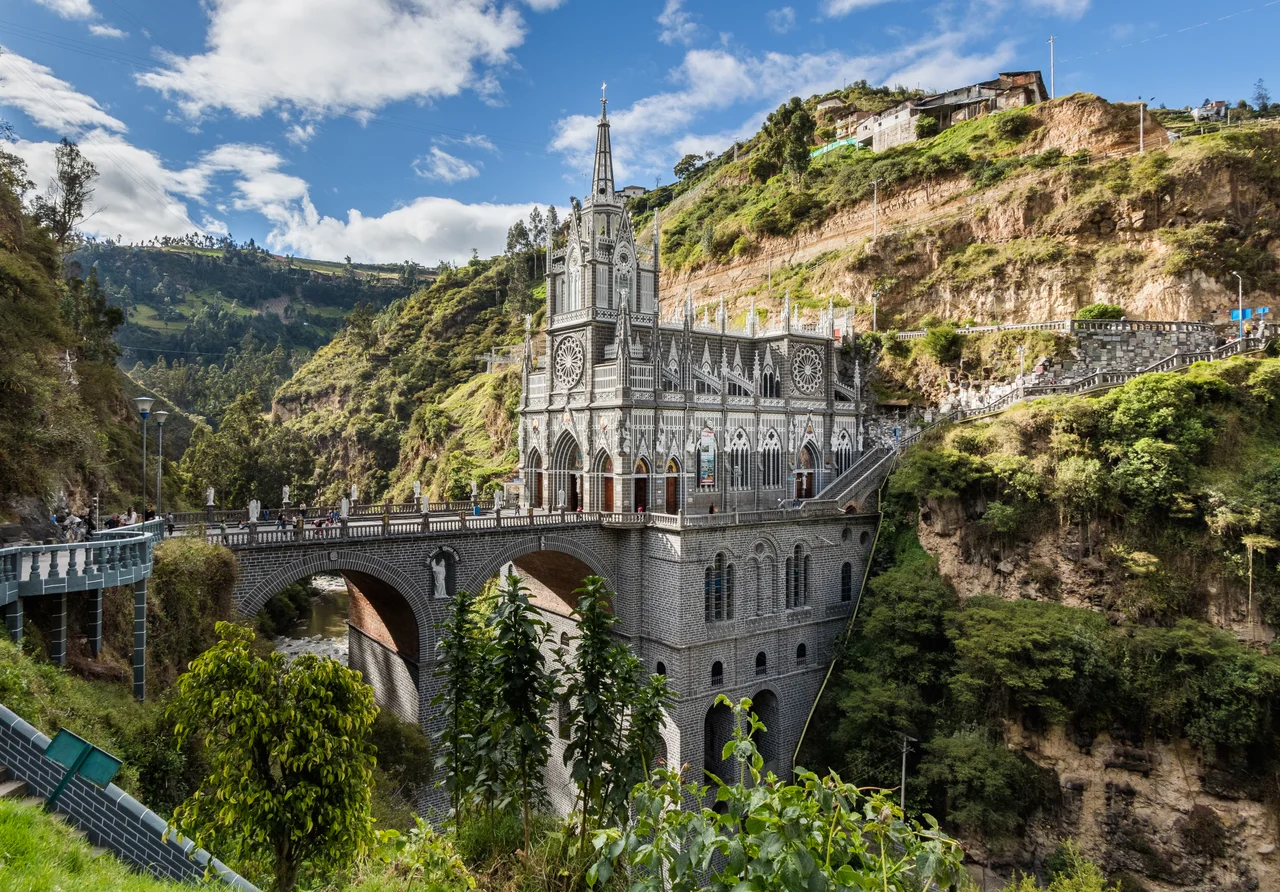

Sanctuary of Las Lajas
The church grows directly out of the canyon wall. Approached from the road, only its spires are visible above the rim - three Gothic points rising from what looks like empty air. Then the path descends, and the Sanctuary of Las Lajas reveals its trick: it is not built on the ground at all. It bridges the Guáitara River fifty meters below, spanning the gorge on stone arches, the back wall of its sanctuary fused to the living rock of the cliff face. And on that rock, behind the altar, is the image that brought everything else into being.
A Storm in 1754
The story that pilgrims tell begins with bad weather. Around 1754, an Indigenous woman named Maria Mueses de Quiñones was caught in a violent storm above the Guáitara canyon, walking with her daughter Rosa, who was deaf and mute. They sheltered between the slabs of stone - the lajas - that give the place its name. Then Rosa, who had never spoken, called out to her mother: the Mestiza is calling me. She was pointing at a silhouette on the rock, lit by lightning. Mueses kept the story to herself until, according to local belief, Rosa later died and was miraculously revived at the same spot. At that point the secret broke. A Franciscan friar, Juan de Santa Gertrudis, documented the shrine during his travels through the New Kingdom of Granada between 1756 and 1764, making it possibly the oldest written reference to the site.
Three Churches, Each Larger Than the Last
The first shrine was straw and wood, built in the middle of the eighteenth century. In 1795 or 1796 it became a brick chapel seven meters long. A larger shrine went up in 1802, and by the second half of the nineteenth century worshipers had spanned the canyon with the first of the bridges. The current basilica - neo-Gothic, three stories of pale and gray stone, designed by the architect Lucindo María Espinosa Medina - was built with donations from local churchgoers between 1 January 1916 and 20 August 1949. The church rises high from the bottom of the canyon and connects to the opposite side by a bridge tall enough that walking across it feels like crossing between clouds. Less than eleven kilometers south, the border with Ecuador marks where this canyon's traffic goes: pilgrims arrive from both countries, making Las Lajas one of the great Marian shrines of the northern Andes.
The Image That Was Not Painted
Behind the altar, on the rock wall that forms the sanctuary's back, there is an image of the Virgin Mary holding the Christ child, flanked by Saint Dominic and Saint Francis. The colors are vivid. Devotees say the image is not paint but the rock itself - that the pigments extend several feet into the stone. No one knows who made it, or when, and believers have always insisted that no one did - that it appeared. The scientific testing that would settle the question has never been done to universal satisfaction. Pope Pius XII granted the image a canonical coronation on 16 September 1952, after issuing the Pontifical Decree Sancta Virgo de Rupe - Holy Virgin of the Rock - on 31 May 1951. In 1954 his decree Templum per Decorum raised the shrine to the status of a Minor Basilica. In 1965 Pope Paul VI formally declared Our Lady of the Holy Rosary of Las Lajas the Principal Patroness of the Diocese of Ipiales.
The Second Most Visited
By some counts, Las Lajas is the second most popular pilgrimage destination in Colombia, trailing only Our Lady of the Rosary of Chiquinquirá in the country's north. Thousands of votive plaques line the approach stairs, each one a thank-you for a prayer answered - a child born, an illness lifted, a journey survived. The plaques accumulate like sedimentary layers of hope. Many are left by Ecuadorans who cross the border specifically to pray here, and many more by travelers from across South America and beyond. The mists that rise from the Guáitara in the evening fill the canyon and make the basilica float. On clear mornings, the light comes at the rock image through eight tall stained glass windows and makes the painted stone seem to breathe.
Why Here
Southern Nariño, Colombia's borderland department, is a country of canyons and volcanoes. The Guáitara cuts sharp channels through soft sedimentary rock - the same flat rock, laja, that lends its name to flagstones throughout the Spanish-speaking world. Before anything was built here, the gorge was already a place of scale and drama, the sort of landscape where storms are loud and shelter between slabs of stone is the only shelter there is. Whatever one believes about what Maria Mueses and her daughter saw that day in 1754, the sanctuary that stands here now is genuinely the work of human hands stretching across generations, finishing a project a century and a half after it was begun, on a scale that would look audacious even on flat ground.
From the Air
Located at 0.81°N, 77.59°W in the Guáitara River canyon, Nariño Department, Colombia, about 10 km from the Ecuadoran border. San Luis Airport (IPI) at Ipiales is 7 km northwest; Mariscal Sucre International (UIO) in Quito is 130 km south. Best viewed from 2,000-4,000 feet AGL - the canyon itself is too narrow for safe low approach. Morning mist often fills the gorge until mid-morning; clear afternoons show the basilica's three spires and arched bridge dramatically.
Nearby Stories
- Northwestern Andean Montane Forests 18 km away
- Inca-Caranqui 24 km away
- Otavalo 89 km away
- Tumaco 116 km away
- San Agustín culture 123 km away
- Cuyabeno Wildlife Reserve 147 km away
- Mira River 178 km away