
San Agustín culture
A Mallorcan friar named Juan de Santa Gertrudis walked up onto the green ridges near the headwaters of the Magdalena River in 1756 and saw stone men staring back at him. His travelogue sat unpublished in Palma de Mallorca for two centuries before a copy reached Colombia in 1956. By the time anyone read what he had written, archaeologists had already confirmed it: more than 300 monolithic statues, some four meters high and weighing several tons, had been carved into place by a civilization that flowered between roughly the 8th century BC and the 1st century BC - and then, inexplicably, walked away.
Earlier Than You Expect
The oldest radiocarbon date from the Lavapatas site - 3300 ± 120 BC - places the beginnings of San Agustín culture in the thirty-third century BC. That makes this one of the deepest continuous cultural sequences in South America. Archaeologists divide it into four periods: Archaic (before 1000 BC), Formative (1000-600 BC), Regional Classic (1-900 AD), and Recent (900-1350 AD). During the Archaic, groups of 15 to 25 people moved seasonally through the mountains using wild crops and stone tools similar to those of the Calima Valley and Popayán. By 1000-600 BC sedentary villages had grown along the fertile slopes. Ceramics appeared. The dead were already being buried in shaft tombs near their houses. The real flowering - the megaliths and the gold - came later.
The Lithic Flowering
The peak of San Agustín culture appears to have fallen between the 8th and 1st centuries BC, though monumental statues continue into the Regional Classic Period (1-900 AD). In that long window, carvers quarried volcanic tuff and andesite from the Colombian Massif and dragged blocks weighing several tons up onto ridges of the Magdalena headwaters. Large earthen mounds, some 30 meters across and 5 meters tall, were raised over dolmen tombs of slab-walled chambers. The statues that stand guard at the entrances are called caryatids because they once supported the heavy stone ceilings of the great tombs at Mesitas A and B. The tomb offerings are sparse - these cultures spent their wealth on the statues themselves and on elaborate gold work that contrasts strangely with the rough pottery.
The Fuente de Lavapatas
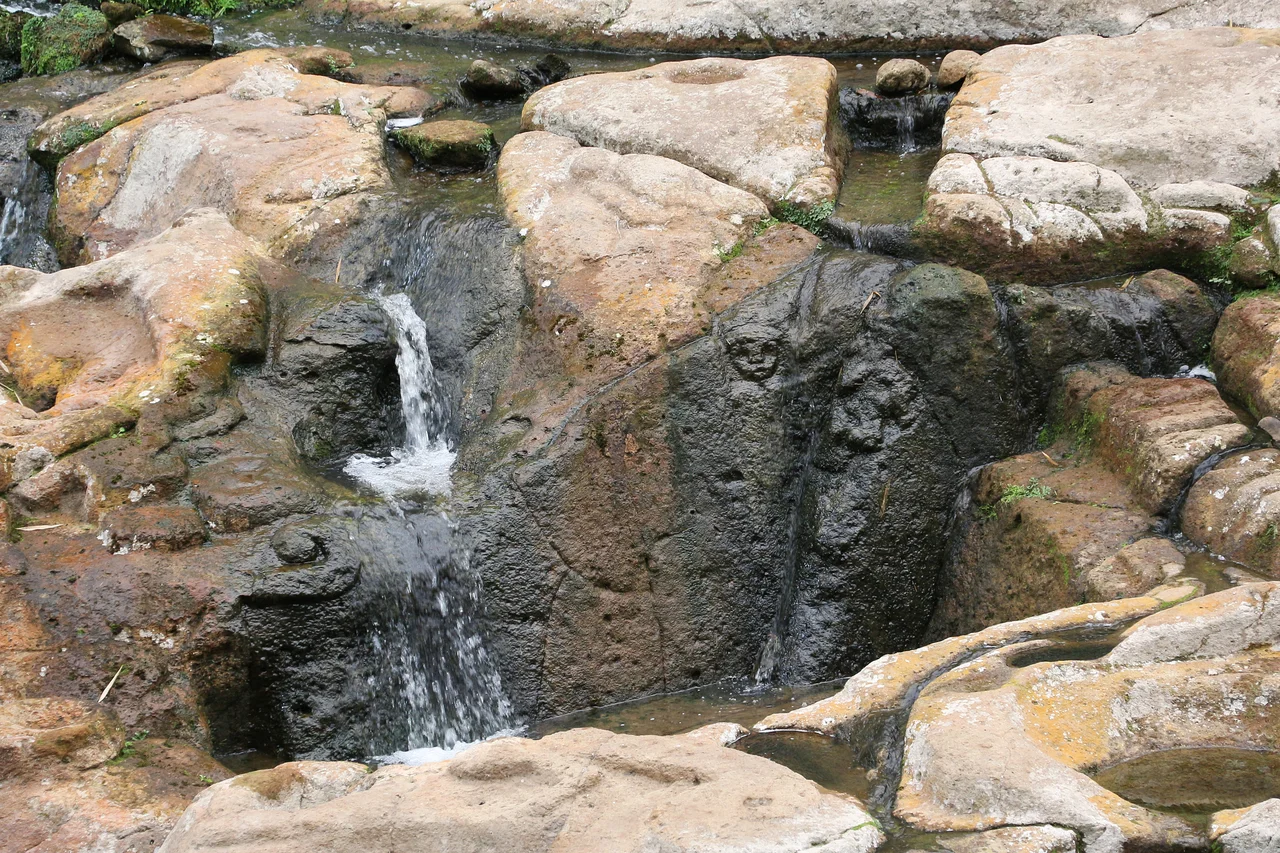
In a rocky ravine bed, water still runs over the most remarkable single work of the San Agustín carvers: the Fuente de Lavapatas, a ceremonial fountain carved directly into the bedrock. Three pools step down the channel. Between and around them, serpentine and frog-like figures in low relief writhe through a web of tiny water channels. When the river runs normally, water flows over all of it - through the mouths of the creatures, into the pools, between the relief figures. Archaeologists interpret the site as dedicated to aquatic deities and healing ceremonies. It is one of the few places in the Americas where a culture carved a permanent interactive artwork directly into living rock - a piece meant to be seen running, not still.
Jaguar, Sun, and Moon
The religious imagery of San Agustín is consistent across a thousand years of carving. The sun, moon, lightning, and rain appear repeatedly in anthropo-zoomorphic form, deities personified as part-human, part-animal figures closely tied to mortuary rites. The most common single motif is the feline mouth - the fanged, snarling upper lip that archaeologists call the jaguar mouth. It is not unique to this culture; the cult of the jaguar is among the oldest and most widespread religious motifs in the Andean and Amazonian world, and it persists today among indigenous peoples of the Amazon. But at San Agustín the feline mouth dominates the sculptural record, appearing on warrior statues, mortuary guardians, and smaller reliefs. The deities carved here were born of a theology that predates writing in South America.
The Disappearance
By the 14th or 15th century AD - just before the Spanish arrived - the people who had built these monuments had left. The Recent Period saw population growth, intensified agriculture, drainage channels, and retaining walls. Then, without evident catastrophe, the statue-builders stopped building. The tombs stopped receiving new burials. Small family groups, linked by religious ties, may have been the social unit all along; archaeologists suspect that a loose confederation of such groups, possibly led by shaman-chieftains practicing what some writers call mohánismo, held the whole system together. When that web unraveled, the stone figures stayed where they had been placed, the ceremonial fountain kept running water through the carved mouths of its serpents, and the forest closed in. A sister culture at Tierradentro, to the west, followed a related path. In 1995 UNESCO recognized the San Agustín Archaeological Park as a World Heritage Site. More than 300 of the stone figures now stand protected in the parks at San Agustín, Isnos, and Saladoblanco in Huila Department - a congregation of lithic warriors, jaguars, priests, and mothers, still waiting, still arranged as their makers left them.
From the Air
The San Agustín archaeological region centers on 1.90°N, 76.28°W in the Colombian Massif of Huila Department, at roughly 1,800 m (5,900 ft) elevation. The nearest airport is Neiva's Benito Salas (SKNV) about 150 km north-northeast; Pitalito's Contador Airport (SKPI) is closer for small aircraft. From altitude, the region reads as undulating green hills cut by the deep canyons of the Magdalena, Bordones, Mazamorras, and Sombrerillos rivers, backed by the snow peaks of the Massif to the south. The three main park areas - San Agustín proper, Alto de los Ídolos at Isnos, and Saladoblanco - lie within about 15 km of each other. Cloud forest makes the surrounding mountains often hazy; morning flights offer the best visibility.
Nearby Stories
- Popayán 67 km away
- San Vicente del Caguán 91 km away
- Sanctuary of Las Lajas 136 km away
- Guandera Biological Station 183 km away
- Cuyabeno Wildlife Reserve 191 km away
- Isla Gorgona 196 km away
- La Macarena 203 km away
- Nuevo Rocafuerte 281 km away