_(16695914613).jpg)
Nuevo Rocafuerte
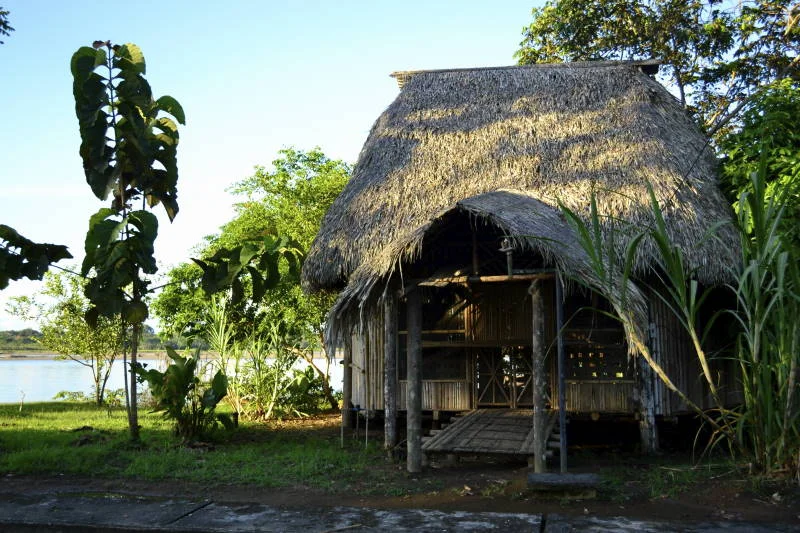
No road reaches Nuevo Rocafuerte. To get there you take a speedboat down the Rio Napo from Coca - an eight-hour trip in a 60-passenger canoe with a canvas roof, leaving before dawn, stopping for lunch halfway at Panacocha, arriving by early afternoon in a dusty frontier settlement on the Ecuadorian side of the border with Peru. The town itself is not the attraction. Two hotels, a few shops near the boat piers, a handful of eateries serving rice and chicken. What makes people come here is what lies just beyond - Yasuni National Park, one of the last large tracts of truly uncut Amazon rainforest anywhere on Earth.
A Border Town at the End of a River
Nuevo Rocafuerte sits at 0.93 degrees south of the equator, on the north bank of the Rio Napo just before the river crosses into Peru. The town exists because of that border - it houses Ecuador's immigration post for travelers moving between the two countries by river. Stamping a passport here can take time. The office is not always attended, and if you wait too long the officials may ask you to return tomorrow. You can also get the passport stamped back in Coca, where the schedule is more reliable. The town's name honors Vicente Rocafuerte, the early-nineteenth-century president of Ecuador whose brief administration attempted to establish the first national museum. The nuevo, the new, distinguishes it from an older settlement that flooded.
The Boat to Peru
Across the border, the Rio Napo continues into Peru and eventually joins the Amazon near Iquitos. From Nuevo Rocafuerte, travelers arrange passage to Pantoja, the first Peruvian town downstream. Private boats cost ten to twenty-five dollars depending on negotiation and availability - more if the boatman senses urgency, less if travelers are willing to wait for company. About once a month a scheduled speedboat runs the route at 6 in the morning for ten dollars per passenger. Nuevo Rocafuerte has four local guides licensed to work in Yasuni. None of them speaks English. Multi-day trips into the park cost sixty to one hundred dollars per person per day, substantially less than similar tours booked from Coca or Quito. The arrangement is informal. You ask around, find a guide, agree on a price, and go.
What the Forest Is Like
Yasuni National Park covers nearly one million hectares of western Amazonian rainforest, protecting part of what scientists have identified as one of the most biologically diverse places on Earth. A single hectare of Yasuni can contain more tree species than all of North America combined. Jaguars hunt here. Pink river dolphins surface in the oxbow lakes. Giant otters fish cooperatively along the tributaries. Thirteen primate species, including the white-bellied spider monkey and the Venezuelan red howler, move through the canopy. Visitors must travel by river - there are no long-distance trails, and the rainforest is too dense to walk through outside cleared areas. The park entrance is via the Rio Yasuni, which joins the Napo a short distance downstream from Nuevo Rocafuerte. A guardaparque station sits at the river mouth. Every visitor must register, which is why a licensed guide is essentially mandatory.
Still Unspoiled, For Now
Ecuador's oil industry has expanded aggressively into the Amazon over the past half century, but the area around Nuevo Rocafuerte has remained comparatively unaffected. No major roads have reached it. Commercial logging for tropical hardwoods - a scourge across much of the Amazon - has not penetrated here the way it has in Peru or Brazil. The forest looks, to the extent any traveler can judge, roughly as it did a hundred years ago. This is in part because the Huaorani Ethnic Reserve abuts Yasuni, and within those combined territories live the Tagaeri and Taromenane, clans of the Huaorani who have chosen not to contact the outside world. They still defend their territory. Oil workers and loggers who have entered uninvited have been killed with spears. Their isolation is not accidental. It is a choice being actively maintained.
Two Hotels and a Bakery
The town itself is small enough to cross in fifteen minutes on foot. Two hotels sit about a hundred meters from the boat piers. Hostal Yurag Wasi offers bright, clean, air-conditioned singles and doubles for twelve to twenty-five dollars per night - the air conditioning being genuinely useful in the oppressive heat and humidity of the equatorial lowlands. Hostal Chimborazo is cheaper and simpler, with fan-cooled rooms. The shops near the piers stock basic goods - rice, dried beans, canned fish, soap, batteries - and a local bakery produces fresh bread each morning. Several small eateries serve the usual river-town menu of rice with chicken or fish, sometimes with fried plantain. There are no internet cafes. Hotel wifi works, most of the time. A single card phone hangs on a wall along the main street, a relic that still functions when the line is up. You come here not for amenities but for what lies beyond the final dock.
From the Air
Located at 0.93 degrees S, 75.40 degrees W on the Rio Napo, about 300 meters elevation. The nearest airport with commercial service is Francisco de Orellana (SECO) at Coca, roughly 300 km upriver to the west. From altitude, the surrounding Yasuni landscape appears as unbroken canopy with the meandering Napo cutting through it. The Ecuador-Peru border runs just east of town but is invisible on the ground. No runway at Nuevo Rocafuerte itself. River access only.
Nearby Stories
- Yasuní National Park 28 km away
- Cuyabeno Wildlife Reserve 80 km away
- Napo moist forests 150 km away
- Puyo 231 km away
- San Vicente del Caguán 314 km away
- Department of Loreto 314 km away
- Iquitos 357 km away