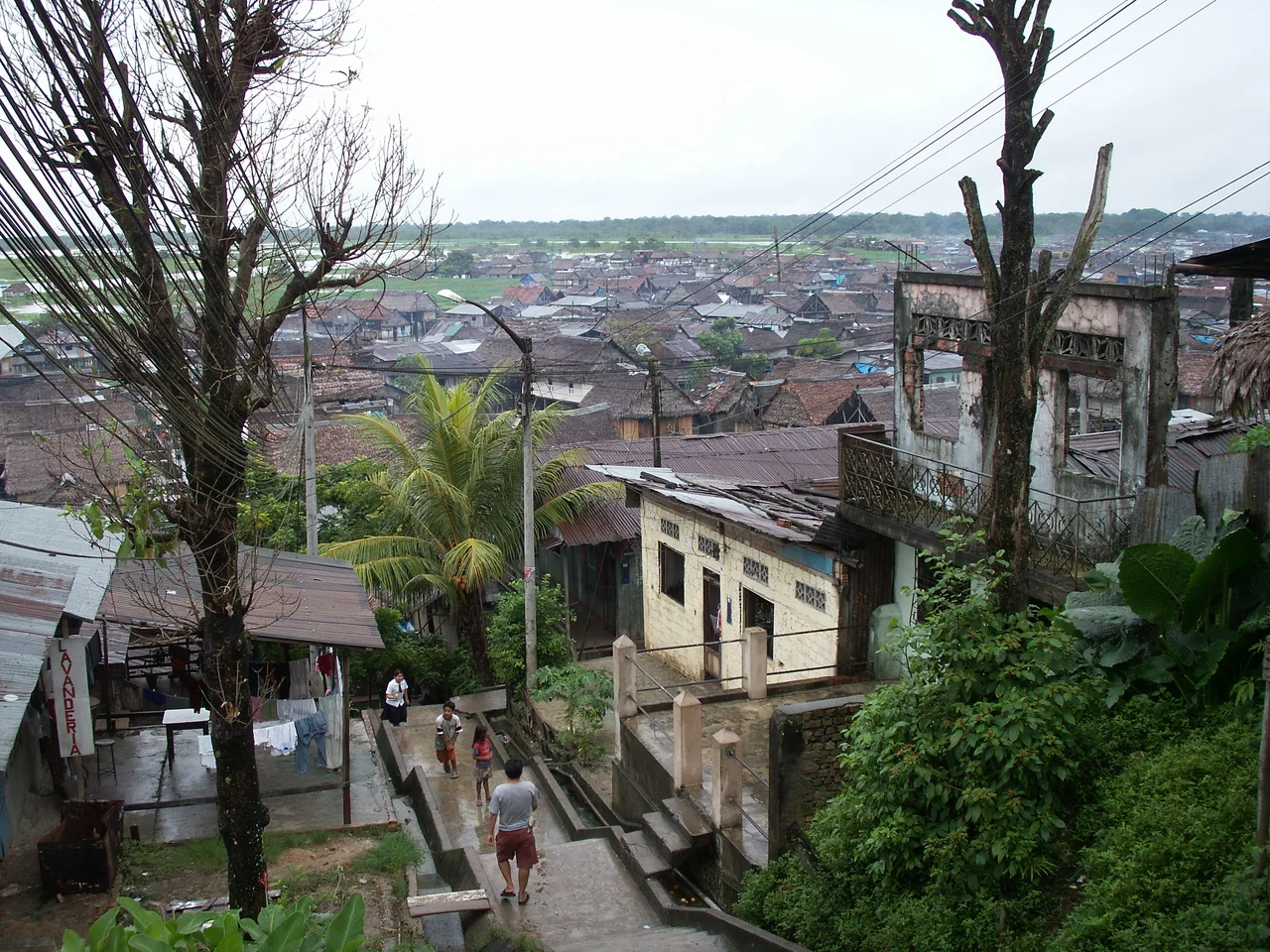

Iquitos
Iquitos is the largest city on Earth that you cannot drive to. No road connects its 380,000 residents to the rest of Peru or the rest of South America. What arrives comes by river or by airplane, and the three-wheeled motorcycle taxis called motocars - or mototaxis, depending on who you ask - swarm the streets in numbers that locals stop trying to count. The Plaza de Armas sits a block from the river. At the right time of year, you can stand at the edge of the waterfront walk and watch the Amazon retreat eleven meters below where it had been the season before, exposing raw brown mud and the bones of last year's boats.
The Rubber Years
Iquitos had two great booms. The first, and the one the architecture remembers, was rubber. In the late nineteenth century, demand for rubber from Amazonian trees turned isolated Peruvian river ports into some of the wealthiest cities in South America. Money poured in. No expense, no eccentricity, no luxury was denied. The rubber barons imported Italian mosaic tiles, French mansards, European architects. The Casa de Fierro - the Iron House - was designed by Gustave Eiffel, shipped from Paris in metal sheets, and reassembled on the Plaza de Armas after being carried in pieces through the jungle by hundreds of men. The Morey and Cohen houses on Prospero Street still stand. Then someone smuggled rubber seeds out of the country to British Malaysia, the Malaysian plantations began producing at lower cost, and the boom collapsed. The mansions became offices. The boom became memory.
The City That Runs on Motorcycles
Walk any street within the central district and two or three empty motocars will pass you in any given minute, the drivers making eye contact in hopes you want a ride. Most destinations cost around two and a half or three soles. A drive out to the Belen district might run three soles or more. Not all motocars are the same - the older ones transmit the engine's vibration straight into the passenger cabin, while newer maintained ones glide. As of 2010, drivers typically rented their taxis for ten soles per hour or twenty-five to thirty per day, which means most of what they earn each day goes back to the owner. A sub-industry has developed around guarding parked motorcycles while the owners shop, complete with cardboard rectangles placed on seats to keep vinyl from baking in the sun.
Ayahuasca and the Shamanism Economy
In the past two decades, Iquitos has become one of the world's primary destinations for ayahuasca tourism. The hallucinogenic brew - made from the Banisteriopsis caapi vine, often combined with the chacruna plant - has drawn visitors from Europe, North America, Australia, and increasingly Asia, many of them searching for spiritual experience or personal transformation. Peruvian law now recognizes ayahuasca as part of the national cultural heritage. Shamans, however, are not regulated. There are no licensing bodies, no credentials, no required training. Most of the ceremonies advertised in the streets are run by people with varying degrees of actual traditional knowledge. Deaths are rare but have happened. If you come for this reason, local authorities recommend using only established retreat centers that can document their lineage and medical protocols, and avoiding any shaman who approaches you on the street.
The Reserves That Make the Trip
The city itself is interesting. The reserves around it are why most people come. The Allpahuayo-Mishana National Reserve holds endemic bird species found nowhere else on Earth, a consequence of its unusual white-sand soils. The Pacaya-Samiria National Reserve - the largest protected tract of flooded forest in the upper Amazon basin - covers 20,000 square kilometers where giant arrau turtles nest, jabiru storks stalk the shallows, and black caimans up to four meters long watch from the banks. The Area de Conservacion Reserva Comunal Tamshiyacu-Tahuayo holds the world record for monkey diversity in a single reserve: sixteen species. Getting into any of these requires a licensed guide - iPeru, the government tourism service, maintains a list of legitimate operators. The freelance guides who approach tourists in the streets are almost all unlicensed and often scammers. Pay more, use the list, see the jungle.
Belen and the Markets
Belen is the poorest district in Iquitos, home to roughly 60,000 people living along the river in houses that rise on stilts during the flood and then sit in mud when the water recedes. The Belen market is extraordinary and dangerous. Tropical fruits, river fish, jungle medicines, street food, and in some alleyways, illegal trade in endangered species - jaguar teeth necklaces, caiman skin ornaments, harpy eagle feathers, giant anteater claws. All of it is illegal to buy, own, or take across borders. The market has police, but many of them take kickbacks from the illegal vendors. Hire a guide to walk you through. The same caution applies at the Iquitos waterfront restaurants that offer caiman, tapir, and turtle meat - there are no breeding farms, so every plate comes from wild animals taken from protected ecosystems.
From the Air
Located at 3.73 degrees S, 73.25 degrees W in the Peruvian Amazon. Iquitos sits at about 120 m (394 ft) elevation on the left bank of the Amazon River, with the Itaya and Nanay rivers converging nearby. Coronel FAP Francisco Secada Vignetta International Airport (SPQT) is the main access point; as of 2012, international flights resumed after a long gap. Boat access comes via the Napo River from Coca, Ecuador (8+ days), Yurimaguas, Peru (2-2.5 days), Pucallpa (4 days), or the Leticia/Tabatinga tri-border (3 days cargo, 9-10 hours fast boat). Annual river level fluctuates up to 11 m. Expect heavy rain and tropical climate year-round, but floods peak March-May.
Nearby Stories
- Tamshiyacu Tahuayo Regional Conservation Area 29 km away
- Department of Loreto 60 km away
- Iquitos Varzea 162 km away
- Napo moist forests 169 km away
- Solimoes-Japura Moist Forests 239 km away
- Puerto Nariño 268 km away
- Murder of Bruno Pereira and Dom Phillips 283 km away
- Nuevo Rocafuerte 370 km away