.jpg)
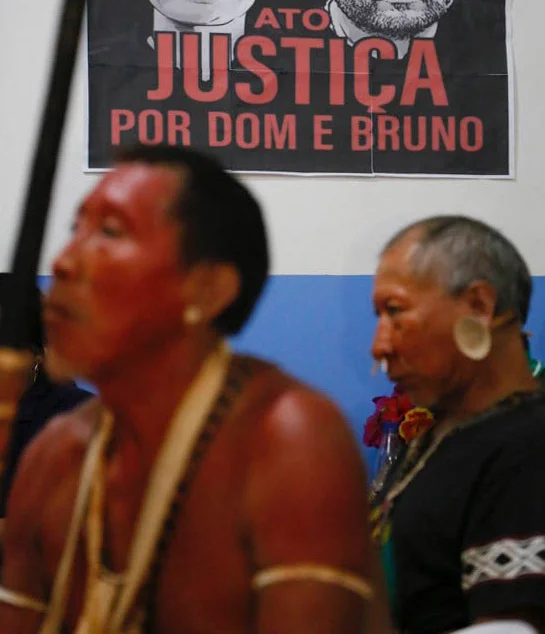
Murder of Bruno Pereira and Dom Phillips
Bruno Pereira had spent his career defending people who did not want to be found. The Javari Valley holds more uncontacted indigenous groups than anywhere else on Earth - peoples who have made an active choice to remain apart from the outside world, and whose survival depends on being left that way. On the morning of June 5, 2022, Pereira and British journalist Dom Phillips set out by boat through this territory, documenting the illegal fishing and mining networks that were pushing ever deeper into lands where they had no right to be. They never came home. What happened to them, and why, is a story about the Amazon that Brazil would rather not tell.
A Valley Most People Will Never See
The Vale do Javari covers an area larger than Austria - 85,000 square kilometers of rainforest in western Amazonas state, bordering Peru. It is the second-largest indigenous territory in Brazil. Within its borders live at least sixteen distinct indigenous peoples who have been contacted by the outside world, and an estimated ten to fourteen groups who have not. These are the povos isolados, the isolated peoples, whose demographic history in the twentieth century taught them something the rest of the world has refused to learn: contact with outsiders routinely kills most of them. Diseases they have no immunity against, followed by land theft, sexual violence, and cultural collapse. Brazilian law, since the constitution of 1988, has recognized their right to be left alone. That recognition is enforced, when it is enforced at all, by a federal agency called FUNAI - the Fundacao Nacional dos Povos Indigenas.
Bruno Pereira
Bruno Araujo Pereira was born in Recife in 1981 and spent two decades working with indigenous peoples in the Amazon. He became one of Brazil's leading experts on the isolated groups of the Javari Valley. In 2019 he led the largest FUNAI expedition to contact isolated peoples in twenty years - work undertaken because certain groups had been pressed so hard by invasions that contact had become a matter of survival. Later that year, under pressure from agribusiness allies of President Jair Bolsonaro, Pereira was removed from his coordinating role at FUNAI. He took leave from the agency and began working directly with UNIVAJA, the Union of Indigenous Peoples of the Javari Valley, training indigenous monitors to patrol their own territory. Pereira received death threats. Gold miners and illegal fishermen had reason to want him gone. He kept going.
Dom Phillips
Dominic Mark Phillips was born in Bebington in Cheshire on July 23, 1964. A music journalist in the 1990s, he moved to Brazil in 2007 and began covering the country for The Guardian, The Financial Times, The New York Times, and The Washington Post. He lived in Salvador with his Brazilian wife, Alessandra Sampaio. At the time of his death he was researching a book with the working title How to Save the Amazon, exploring what sustainable futures might look like for the forest and its peoples. Phillips had traveled with Pereira to the Javari before. The trip in June 2022 was for interviews with indigenous patrols. Together they went to the Sao Rafael community on the Itacoai River to meet a riverside fisherman who was expected to discuss collaboration between indigenous and non-indigenous communities on forest surveillance. The fisherman was not there. His wife spoke with them. The two men continued on.
What Was Taken, and From Whom
On the return journey on June 5, Pereira and Phillips were intercepted on the Itacoai. Pereira was shot three times, one of the bullets in the back. Phillips was killed because he was a witness. The men who pulled the triggers were local fishermen working an illegal pirarucu network that extended across the Brazil-Peru-Colombia border. Amarildo da Costa Oliveira, known as Pelado, confessed after his arrest and led investigators to where he had buried the bodies on June 15. The Federal Police charged his brother Oseney, and a third accomplice, Jefferson da Silva Lima. Later the alleged mastermind was identified as Ruben Dario da Silva Villar, a Colombian fish trafficker running the regional operation. In 2023, police indicted a former FUNAI official for failing to act on information that could have prevented the killings. The murder was not random violence. It was the organized response of a criminal economy to two men who were documenting its crimes.
The Indigenous Patrols Continue
The Javari peoples did not wait for the Brazilian state to respond. UNIVAJA, the union Pereira had been training, continued its work. Indigenous monitors continued patrolling their territory, armed often only with GPS devices and cameras, documenting incursions that federal agencies had been too slow or too unwilling to stop. Under the Lula government that took office in January 2023, FUNAI regained funding and authority. New indigenous patrol bases were established in the Javari. The Matis, the Marubo, the Kanamari, the Tsohom-Djapa, and the isolated peoples whose names outsiders do not know continue to live in the forest Pereira gave his life trying to defend. Dom Phillips's unfinished book was completed by a team of journalists and indigenous collaborators who picked up his research. It was published in 2025 as How to Save the Amazon - the title he had chosen, the question he was still trying to answer.
From the Air
Located at 4.45 degrees S, 70.25 degrees W, in the western Vale do Javari. The nearest airstrip is at Atalaia do Norte, the municipal seat, on the Javari River. Tabatinga International Airport (SBTT) at the triple frontier is the largest airport in the region. The Javari Valley is a vast, roadless expanse of rainforest visible as unbroken canopy at altitude. The Itacoai and Itui rivers wind through it in tight meanders. The Brazil-Peru border runs through the territory but is invisible on the ground.
Nearby Stories
- Leticia, Amazonas 22 km away
- Cujubim Sustainable Development Reserve 104 km away
- Ticuna language 157 km away
- Solimoes-Japura Moist Forests 203 km away
- Eirunepé 215 km away
- Central Amazon Ecological Corridor 227 km away
- Tamshiyacu Tahuayo Regional Conservation Area 286 km away
- Matsés National Reserve 320 km away