
Ticuna language
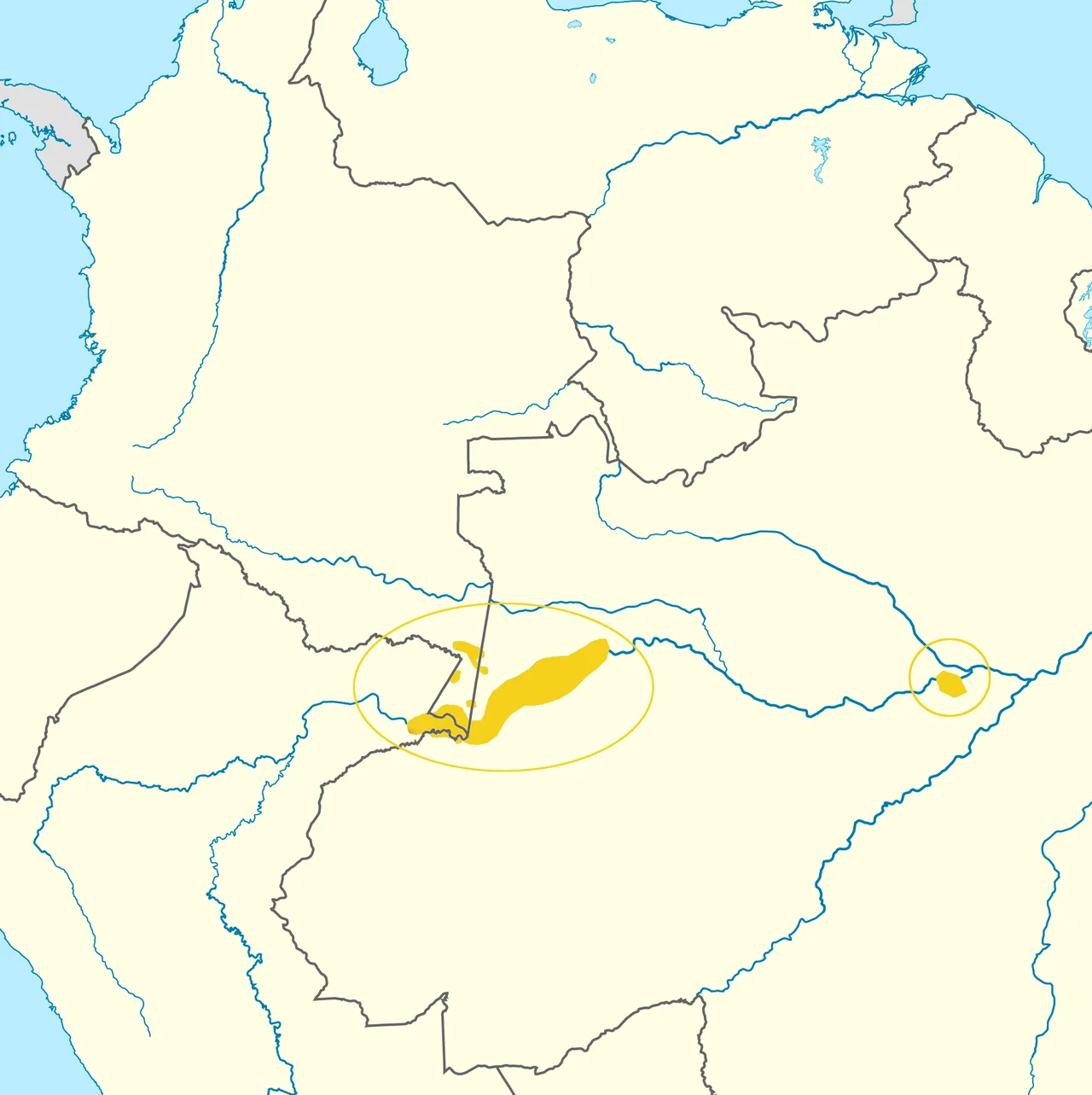
Say the word wrong and it changes meaning. Change the pitch and it changes again. Ticuna has somewhere between 8 and 12 phonemic tones depending on the dialect, one of the largest tone inventories ever documented in a single language, and this in a part of the world where tonal languages are rare. When linguists began studying why isolated tonal languages cluster in humid, warm regions, Ticuna became one of their primary case studies. The theory is mechanical: vocal cords produce unstable tones in cold, dry air. Ticuna, spoken across the Amazon borderlands where Brazil, Peru, and Colombia meet, lives in some of the wettest and warmest air on the planet, and its speakers have built a tone system to match.
An Island in the Linguistic Map
Roughly 50,000 people speak Ticuna, making it the most widely spoken indigenous language in Brazil. It is also called Tikuna, Tucuna, Tukuna, Magta, Maguta, and Tukna depending on who is talking. Ethnologue lists it as stable, meaning it is being passed from parents to children and is not in immediate danger. But where it comes from linguistically is a mystery. Ticuna has no clear relatives. Early classifications tentatively linked it to Macro-Arawakan or Macro-Tucanoan stocks, but both proposals collapsed under scrutiny. A more recent hypothesis places Ticuna with the Saliban and Hoti languages in a proposed Duho stock, which remains speculative. The only relative Ticuna definitively had was Yuri, and Yuri is extinct. So Ticuna in its present form is generally classified as a language isolate, a tree with no other branches, though there are also intriguing similarities with Carabayo, the language spoken by an uncontacted group in the Colombian Amazon.
Tones You Cannot Write Down
Ticuna uses mostly contour tones, meaning the pitch rises or falls across a syllable rather than staying flat. Mastering the system takes a lifetime of hearing it. The orthography only marks tones with diacritics when confusion would otherwise be likely, which means most written Ticuna is heavily dependent on context. Six vowels, some nasalized, some laryngealized, some both. A sixth vowel spelled u with an umlaut. Diphthongs that carry a single tone, contrasting with vowel sequences that carry two. Consonants that can be glottalized. The glottal stop gets its own letter, x. Scholars at the Summer Institute of Linguistics have published dictionaries and conversational guides, and phonetic writing systems were adapted in Brazil and Peru using Portuguese-like conventions. But the essential point remains: Ticuna is a language built for the ear, not the page.
Brazil's Indigenous Champion
More than half of all Ticuna speakers live in Brazil. Until recently, the Brazilian government invested little in Ticuna-language education, but FUNAI, the National Foundation for the Indian, and the Ministry of Education have since funded native teacher training, bilingual textbooks, and a large-scale project recording traditional oral narratives in written form. Ticuna education is part of a broader policy to teach Brazilian minorities in their own languages. In 2012, the government launched the first-ever public health campaign in an indigenous language in Brazil, focused on AIDS prevention and violence against women, conducted entirely in Ticuna. That moment marked a shift in how the Brazilian state saw its Ticuna citizens: not as subjects of Portuguese instruction but as speakers of a language worth addressing directly.
Three Countries, Three Experiences
In Peru, Ticuna-language education has existed since the 1960s, using a writing system that reportedly became the basis for the Brazilian adaptation. Most classroom literature is standard textbook material. In Colombia, the experience has been thinner. Ticuna children there are generally taught in Spanish, and access to schooling is uneven. Some Colombian Ticunas now travel across the border to attend Ticuna schools in Brazil. Christian missionaries have added another layer: Bible translations into Ticuna exist, and Latin American Ministries operates a weekday radio broadcast carrying programs in Ticuna, Portuguese, and Spanish. What each country has done with Ticuna education reflects how it approaches its indigenous citizens generally. Brazil has invested most heavily. Colombia the least. Peru sits in between.
A Base-Five Counting Habit
Ticuna word order is unusual for an isolating language. Most words consist of a single morpheme, similar to Vietnamese, but sentence structure can vary in ways Vietnamese does not allow. Transitive verbs tend toward Subject-Object-Verb order. Unaccusative verbs prefer Verb-Subject. The numerals suggest a base-five counting system: the word for five is literally one-hand, and the numbers six through nine all begin with naixmixwa ru, followed by the values for one through four. Loukotka's 1968 classification of South American languages recorded this system along with the rest of the basic vocabulary. It is the kind of detail that slips past casual observation but tells you something about how Ticuna speakers look at quantity. Five is where you stop counting fingers on one hand and start again. The language remembers that.
From the Air
Coordinates 3.25 degrees S, 68.58 degrees W mark the approximate center of the Ticuna-speaking region, near the triple border of Brazil, Peru, and Colombia along the Amazon River. Nearest airports include Leticia (SKLT) in Colombia and Iquitos (SPQT) in Peru. The language area follows the Amazon and its tributaries across flat rainforest terrain. Best aerial viewing at 5,000-15,000 feet; the triple frontier region shows distinct river patterns but few urban markers aside from Leticia, Tabatinga, and riverine villages.
Nearby Stories
- Central Amazon Ecological Corridor 33 km away
- Tonantins 46 km away
- Leticia 108 km away
- Leticia, Amazonas 131 km away
- Tabatinga 157 km away
- Solimoes-Japura Moist Forests 196 km away
- Juruá-Purus Moist Forests 254 km away