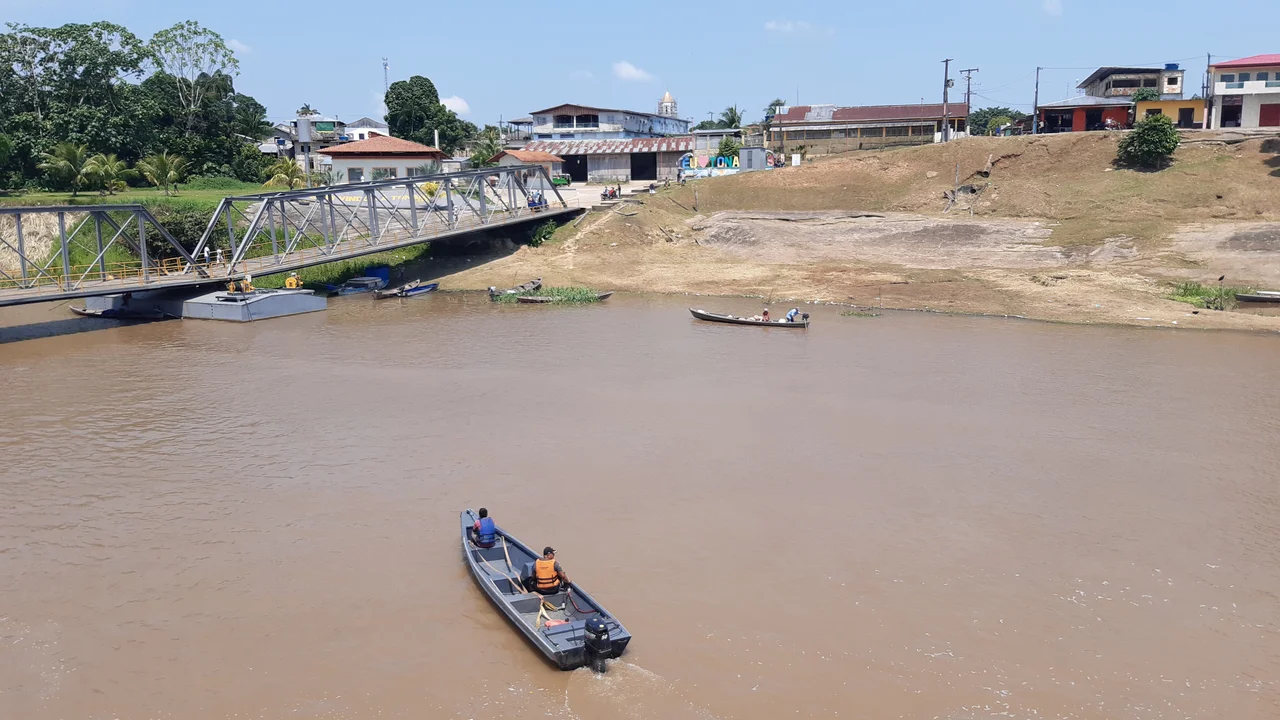

Tonantins
There are no roads to Tonantins. Flights reach Manaus, Tefe, or Tabatinga, and from any of those you climb onto a boat. The slow boat from Manaus takes about four days. The fast boat takes 24 hours. The Solimoes river, which is what Brazilians call the upper Amazon, keeps flowing whether you have arrived or not. Tonantins sits 867 kilometers west of Manaus by water, a town of just under 19,000 people that most travelers pass through rather than pause at. But for anyone making the voyage along the Amazon, Tonantins offers what you cannot get on the deck of a riverboat: a walk through an actual Amazonian river town, the kind of place river travel is about.
A Town Named for Its Rivals
The oral history runs strangely. The first village on this site was founded by the Carmelite missionary Frei Matias Diniz, who settled Caiuvicenas people there. He was killed by a rival indigenous group called the Tonantins, and the name of those rivals stuck to the place that rose on its ashes. The district of Sao Francisco within Tonantins marks the original site. Around 1774-1775, a figure known as Lord Sampaio gathered Caiuvicenas, Passes, and Tikuna families and rebuilt the settlement. Churches and a school followed. The permanent settlement that exists today dates to 1814, when a church was established on the riverbank that became the town's anchor. Tonantins bounced between administrative jurisdictions through the twentieth century, folded into Sao Paulo de Olivenca in 1938, Santo Antonio do Ica in 1955, and finally granted its own municipal status on July 2, 1985.
Fish That Feeds a Festival
The pirarucu, Arapaima gigas, is among the largest freshwater fish in the world. Individuals can exceed three meters and weigh 200 kilograms. In Tonantins, they are also central to economy and cuisine, and for several weeks in late November and early December the town hosts the Pirarucu Festival. Thousands of visitors arrive from across Amazonas state. Hotels book out weeks in advance. Music, food, and dance run through the town center, and for a few days Tonantins transforms from a quiet river stop into a regional gathering. A smaller Folkloric Festival in July brings concerts and dance performances from surrounding towns. Patron saint festivals round out the calendar: Nossa Senhora do Guadalupe in December, Nossa Senhora das Dores on September 15, Nossa Senhora de Lurdes on February 11.
Choose Your Boat
Fast boats from Manaus cost up to R$380 and reach Tonantins in about 24 hours. The Madame Crys departs Thursday mornings. Gloria de Deus III and Sagrado Coracao de Jesus both depart Friday mornings. Crystal I leaves Tuesday. They all stop at Codajas, Coari, Tefe, Fonte Boa, Jutai, Tonantins, Santo Antonio do Ica, Amatura, Sao Paulo de Olivenca, and Benjamin Constant on their way to Tabatinga at the Peruvian and Colombian triple border. The slow boat costs roughly R$275 and takes about four days, with hammock space as the standard accommodation. From Tabatinga south, fast boats run R$170-200 to reach Tonantins heading back downstream. Boat schedules do drift; travelers should verify before committing to a specific departure.
Half an Hour End to End
The main district where the port and town hall sit is small enough to cross on foot in about half an hour. Walking from the port to the western district takes about an hour. Taxis and moto-taxis circulate but few travelers need them. There are no major tourism infrastructure signs, no lodges announcing themselves, no English menus. Tonantins is a working town whose economy runs on subsistence agriculture, cassava mostly, with beans, rice, and corn. What there is to see is the town itself: Amazon architecture of wood and tin, fishermen handling pirarucu and tambaqui and piranha at the riverfront, children playing soccer on dirt streets, and the steady traffic of smaller boats running between Tonantins and the villages hidden further up the tributaries.
Where the River Goes Next
Downstream, all boats eventually reach Manaus, the Amazon metropolis where the Rio Negro meets the Solimoes and the waters run dark and light side by side for kilometers before mixing. Upstream, the route leads to Tabatinga on the Brazilian side of the triple frontier. Cross into Colombia at Leticia, continue up into Peru, and Iquitos becomes reachable. Tonantins is not a destination for most travelers, but for anyone working their way through the world's largest river network, the town is a waypoint that teaches how Amazon travel actually works. You move with the boats. You sleep where the schedule drops you. You notice what each place looks like from the water, because for weeks that is the geography you live in.
From the Air
Located at 2.87 degrees S, 67.80 degrees W, on the north bank of the Solimoes River in western Amazonas state, Brazil. No airport; access by river only. Nearest airports are Tefe (SBTF) about 400km downstream and Tabatinga (SBTT) at the triple frontier upstream. Surrounding terrain is flat rainforest threaded with rivers and the Jutai-Solimoes Ecological Station overlapping the municipality's west. Best aerial viewing at 5,000-15,000 feet; rivers are the dominant visual features, settlements tiny against the green.
Nearby Stories
- Central Amazon Ecological Corridor 33 km away
- Ticuna language 43 km away
- Purus Varzea 126 km away
- Mamirauá Sustainable Development Reserve 178 km away
- Juruá-Purus Moist Forests 210 km away
- Leticia 239 km away
- Sao Gabriel da Cachoeira 286 km away
- Solimoes-Japura Moist Forests 303 km away