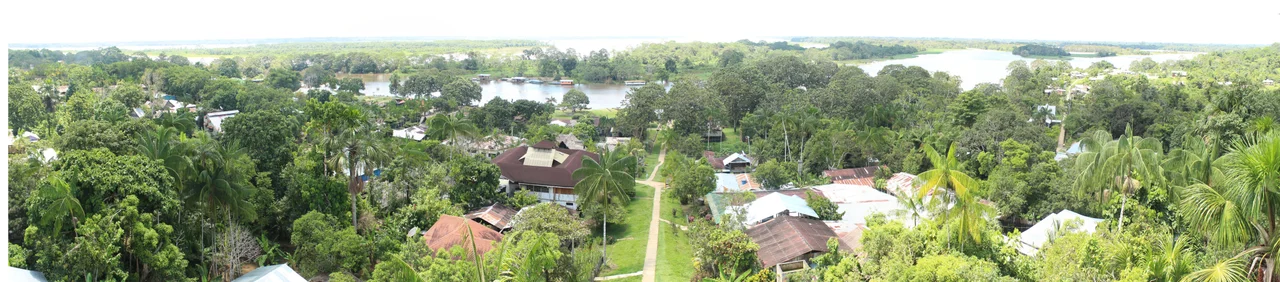

Puerto Nariño
There are no cars in Puerto Nariño. Not broken down, not being repaired, not hidden in garages. The Colombian town of about 2,000 people, eighty-five kilometers upriver from Leticia along the Amazon, has never built the roads a car would need. Everyone walks. Between villages, everyone takes boats. It is one of the very few towns in the world where internal combustion engines are not part of daily life, and the absence is felt immediately. The sound of Puerto Nariño is birds, river, footsteps, and conversations in Ticuna, Cocama, and Yagua - the three indigenous languages spoken by 95 percent of residents. Colombia declared Puerto Nariño its first carbon-neutral town in 2012. But the town is older than that designation suggests, and its character is older still.
Arriving by Rapido
The only way into Puerto Nariño is by boat. From Leticia - Colombia's southernmost town, tucked into the tri-border corner where Colombia, Peru, and Brazil meet at the Amazon - fast boats called rapidos leave at 7 AM, 10 AM, and 1:30 PM. The trip takes about two hours upriver. Tickets cost around 32,000 Colombian pesos one-way and the ticket office is a marketplace along the waterfront. Several companies share the service, so buyers need to identify the correct line for the day they are traveling. ID is required at purchase. The 7 AM boat sells out regularly; advance booking is advised. Along the way, the rapido stops at Isla de Los Micos and Parque Natural Nacional Amacayacu, and flags down anyone along shore who waves. The ride itself is the first lesson in how transportation works along this stretch of river - informal, scheduled, and fundamentally dependent on water.
Life Between the Rivers
The town sits at the confluence of the Amazon and the Loretoyacu rivers. The Loretoyacu is smaller, darker, and leads north to Lago Tarapoto, a flooded forest where pink river dolphins - the Amazon's distinctive bosutos - surface in the early morning and late afternoon. For 60,000 pesos a small boat carrying four passengers and two guides will take you to look for them. The water lilies in Tarapoto are enormous. Herons and kingfishers work the shallows. A local Ticuna guide named Ismael, found through Malocas Napu hostel on calle 4, leads three-to-four-hour jungle walks for groups for about 60,000 pesos total. Rubber boots rent for 3,000 pesos per person. The Fundacion Natutama runs an interpretive trail called The World Below the Water, explaining river ecology to visitors. Guides are essential for entering the forest; the ecosystem is complex and the margins of error thin.
Ticuna, Cocama, Yagua
About 95 percent of Puerto Nariño's residents belong to one of three indigenous nations: the Ticuna, who have lived along this stretch of the Amazon for millennia and whose language remains the community's primary tongue; the Cocama, whose ancestral territory extends into Peru and Brazil; and the Yagua, whose smaller population maintains distinctive traditions. The Town Anniversary Festival at the end of March brings parades, music, dancing, and sporting competitions over two days. The Asociación Artesanal Mowacha on calle 7 sells Ticuna crafts: jewelry, bags, dolls, wood carvings. Prices are reasonable and the work is the community's own. Upstairs from Mowacha there is a very simple dorm room, or visitors can sleep in a hammock in the Ticuna community classroom for 10,000 pesos a night. There is no sign. You ask at the store.
Towers, Trails, and a Tiger's Mouth
Mirador Naipata is one of several wooden observation towers where visitors can climb for views across the treetops to the Amazon itself. Admission is 5,000 pesos for adults, 3,000 for minors. The entrance is through the big carved mouth of a tiger. If the gate is locked, the caretaker lives at the house down the hill and can be summoned. Visitors with time can take a boat to El Chorro and walk the forty minutes back to town on a paved red walking road - or walk first and catch a boat back, though that requires waiting. An ecological trail leads to the Reserva Wachile, a garden where paiche fish, boa constrictors, caimans, and giant water lilies can be seen for 10,000 pesos. There are no ATMs in Puerto Nariño. Card payment is accepted almost nowhere. The Hiper Airuwe supermarket will give cash-back for a 3 percent fee, and withdrawals over 500,000 pesos need to be scheduled in advance. This is a town that functions on cash, slow boats, and attention to the river - and it has chosen to keep it that way.
From the Air
Located at 3.78°S, 70.36°W on the Amazon River in Colombia's extreme south, near the tri-border with Peru and Brazil. Elevation ~80m. Puerto Nariño sits at the confluence of the Amazon and Loretoyacu rivers, 85km upriver from Leticia. Viewing altitude 3,000m reveals dense Amazon rainforest threaded by the dark ribbon of the Loretoyacu joining the lighter Amazon main channel. The town appears as a small clearing on the north bank of the Loretoyacu. Nearest airport: Alfredo Vásquez Cobo International (SKLT) at Leticia, 45nm downstream, handling limited commercial traffic from Bogotá. No road access exists. From altitude, look for the characteristic pattern of meandering white-water Amazon tributaries in otherwise unbroken green canopy.
Nearby Stories
- Leticia, Amazonas 19 km away
- Murder of Bruno Pereira and Dom Phillips 52 km away
- Tabatinga 53 km away
- Solimoes-Japura Moist Forests 132 km away
- Ticuna language 156 km away
- Maynas province 248 km away
- Tamshiyacu Tahuayo Regional Conservation Area 248 km away
- Napo moist forests 452 km away