
Popayán
At 11:15 on the morning of March 31, 1983 - Maundy Thursday, with the city already gathering for Holy Week processions - the ground under Popayán shifted for eighteen seconds. When it stopped, baroque facades that had stood for four centuries lay in the street, and the clock in the tower locals called "the nose of Popayán" had stopped forever. Colombia's first seismic design code was written in response. The processions, in a city that had carried them every night of Holy Week since 1558, resumed that same week.
The White City Between Ranges
Popayán sits in the Pubenza Valley at 1,760 meters, wedged between the Western and Central ranges of the Colombian Andes, where the climate holds steady near 18 °C all year. The colonial core is painted almost entirely white - the lime wash gives the place its nickname, la ciudad blanca - and the whiteness makes the city legible from a distance, a pale grid carved into green mountains. San Francisco, San José, Belén, Santo Domingo, San Agustín, and the Catedral Basílica de Nuestra Señora de la Asunción rise above the low houses. Seventeen Colombian presidents were born here. So were the poets Guillermo Valencia and Rafael Maya, the scientist Francisco José de Caldas, and the independence martyr Camilo Torres Tenorio. For a city of about 318,000 people, the list of native sons is startling.
A Viceroyalty Crossroads
The Spanish conquistador Sebastián de Belalcázar arrived on January 13, 1537, but people had lived here long before him. El Morro del Tulcán, a truncated pyramid on the city's edge, was built between roughly 500 and 1600 - the upper-class burials inside it were already ancient when the Spanish found the mound abandoned. Under Spain, Popayán held an enviable position on the route between Lima, Quito, and Cartagena. Gold and silver from Andean mines flowed through its streets on the way to Seville, and the local mint stamped escudos and reales from 1760 until 1819 - then kept stamping them, now for the new Republic, after 1826. The University of Cauca, founded by decree of Francisco de Paula Santander in 1827, made the place a scholarly town as well as a wealthy one.
The Clock That Stopped
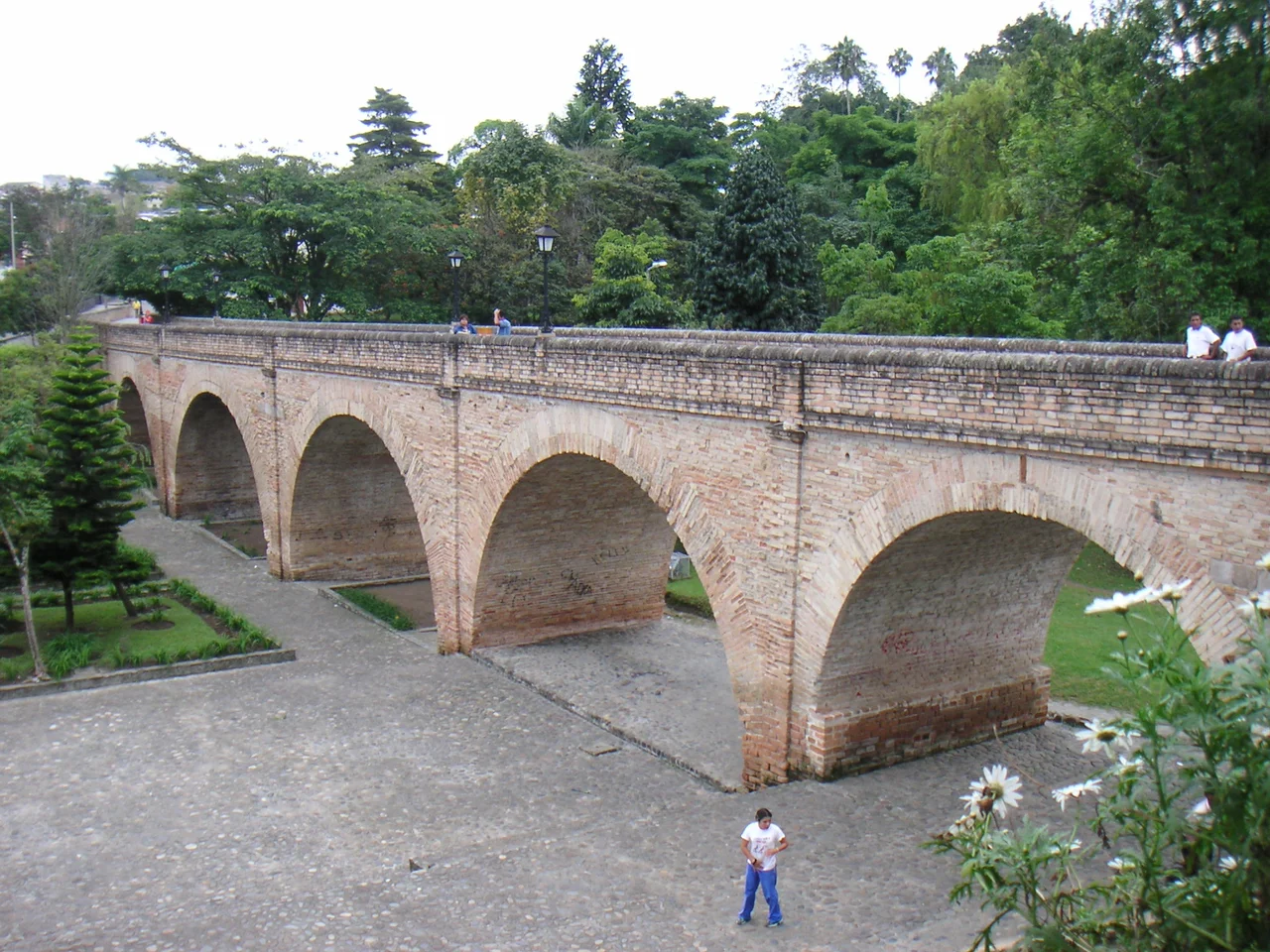
Between 1673 and 1682, masons set 96,000 bricks to build the clock tower beside the cathedral. The clockwork itself came from England in 1737, driven by two lead weights. In 1814, when Antonio Nariño needed ammunition for the independence fight, he melted down those weights and replaced them with stones. The tower kept time through civil wars and earthquakes until 1983, when the English company that had made the mechanism came back to restore it. It has since fallen silent again. Near the tower stands the Humilladero Bridge, built in 1873 over a ravine that had once been so steep pedestrians crossed it on their knees - hence the name, humilladero, the place of humbling. The Italian friar Fray Serafín Barbetti designed it with a German engineer whose mummified remains rest today in the Archdiocesan Museum.
Eighteen Seconds
The 1983 earthquake has a magnitude listed as Mw 5.5 - modest on paper, catastrophic in reality. Popayán sits directly over the Rosas-Julumito fault, a strand of the larger Romeral fault system. The quake flattened much of the old center and killed hundreds of people gathered for the Holy Week observances they had kept since the mid-sixteenth century. The great 40-meter dome of the cathedral came down; the altar of San Agustín, carved in wood and sheathed in gold, had to be restored for a second time (the first restoration followed a 1736 quake). Empty lots still punctuate the center like missing teeth. What survived was the city's habit: the processions of Holy Week - the Passion stations carried on wooden platforms by cargueros who bear them on their shoulders through the main churches in a cross-shaped route - resumed, and in 2009 UNESCO added them to its Intangible Cultural Heritage list.
City of Gastronomy
In 2005 UNESCO named Popayán the first City of Gastronomy in the world - an acknowledgment that the recipes of the Cauca Department had been passed down by voice, unwritten, for generations. Pipián, the peanut-based filling of local tamales and empanadas, is a mestizo invention built from indigenous chiles, peanut, and potato with Spanish-introduced pork. Ullucos, arracacha cakes, sancocho, and the elaborate Christmas Eve plate of rosquillas, manjar blanco, and natillas hold the middle ground where Spain and the Andes met and did not quite separate. The National Gastronomy Congress has been held here every September since 2003. Popayán has also produced, year after year, a certain kind of citizen who left for Bogotá and ran the country - seventeen presidents by count, plus the Mosquera dynasty whose patriarch Bolívar called the only man he would choose as a second father. The coincidence of faith, food, and politics in one small white city is unusual enough that it still surprises the people who live there.
From the Air
Popayán sits at 2.45°N, 76.61°W in the Cauca Valley between two Andean ranges, 1,760 m elevation. The nearest airport is Guillermo León Valencia (SKPP), served by Avianca and Easyfly from Bogotá and Cali. From altitude, look for the small white grid of the colonial center set against green mountains; the cathedral dome and clock tower are the most recognizable features. Weather is mild and cloud-cover frequent year-round; the surrounding Puracé volcanic complex east of the city is visible in clear conditions. Cali (SKCL) lies about 110 km north; Neiva (SKNV) is over the Central Range to the east.
Nearby Stories
- San Agustín culture 31 km away
- San Vicente del Caguán 133 km away
- Isla Gorgona 137 km away
- Valle del Cauca Department 144 km away
- Gorgona Island 148 km away
- Sanctuary of Las Lajas 159 km away
- Tolima Department 175 km away
- Cuyabeno Wildlife Reserve 248 km away