
Gorgona Island
Francisco Pizarro called it *inferno*. He arrived on this small Pacific island in 1527 with thirteen men, fleeing another island where the locals had made it clear he was not welcome. Gorgona was supposed to be a rest stop on the way to conquer Peru. It turned out to be something else entirely. The snakes were everywhere - fer-de-lances, coral snakes, creatures that took Spaniards down one by one over seven months of waiting for a supply ship that was slow to arrive. Pizarro named the island after Medusa, the Gorgon of Greek myth whose hair was living snakes. The name stuck. Five centuries later, the snakes are still here. So are komatiites from the age of dinosaurs, the only all-blue anole lizard in the world, a humpback whale nursery, and the ghost of a prison that Colombians called their Alcatraz.
The Island Before the Spaniards
Long before Pizarro, Gorgona was inhabited. Archaeological remains dating to about 1300 AD mark it as a seat of the Guna people - expert sailors and goldsmiths whose descendants still live in Panama's Guna Yala region and parts of coastal Colombia. They fished, farmed, and worked stone and gold. Other settlements came and went. Diego de Almagro was the first European ashore in 1524 and named the island San Felipe, a name that did not stick. Pizarro's Gorgona did. After the Spanish conquest, an indigenous cacique named Yundigua lived on the island, probably a member of the Sindagua people who inhabited the coast between Narino and Cauca. The English pirate Bartholomew Sharp seized the island in 1679 after sacking Guayaquil and briefly renamed it Captain Sharp's Island. The privateers Woodes Rogers and William Dampier resupplied here in 1709. Ships moving between Panama and Peru used Gorgona's streams and timber for centuries.
Colombia's Alcatraz
In 1959 the Colombian government converted the island into a high-security prison. The reasoning was unimaginative: surrounded by shark-patrolled water, crawling with venomous snakes, Gorgona looked like a place from which escape was impossible. The prison was built, according to official Colombian descriptions, following the model of Nazi concentration camps. Inmates slept on bare frames - no mattresses, no pillows. The bathrooms were pit toilets with walls lowered so guards could watch prisoners at all times. Violence among prisoners was constant. Disease and snake bites killed many. The island held Colombia's most violent offenders, men convicted of murder and rape, and conditions were designed to be punitive rather than rehabilitative. The prisoners lived through this for twenty-five years.
The Escape of September 1984
One man escaped. Daniel Camargo Barbosa - a serial rapist and murderer serving a life sentence - had studied the Pacific currents from the beach for years. On September 24, 1984, during the feast of the Virgin of Mercy when the guards' routines shifted, he hid in the brush and built a small raft from logs tied with jungle vines. A day later, he reached the mainland. The authorities assumed he had drowned or been taken by sharks. The press reported he had been eaten. He was alive. From that September through February 1986, Camargo moved through Ecuador killing and raping girls - the confirmed count ranges from 72 to 180 victims. He was finally captured in Quito after murdering a nine-year-old. Sentenced to 16 years in an Ecuadorian prison, he was killed by a fellow inmate in November 1994. The penal colony on Gorgona closed on June 25, 1984 - three months before Camargo's escape, though some transfers were still in progress. The last prisoners were moved to mainland facilities that same year.
Komatiites and the Chicxulub Glass
Gorgona is a geological oddity on a planetary scale. The island contains the youngest known komatiites on Earth - silica-poor lava flows that normally only occur in Archean rocks over 2.5 billion years old, when the planet's interior was much hotter. Gorgona's komatiites formed during the Cretaceous, about 90 million years ago. Geologists have spent decades arguing about how this was possible. On the southern tip of neighboring Gorgonilla, a thin layer of marine sediment marks the Cretaceous-Paleogene boundary - the moment the Chicxulub asteroid struck the Yucatan and ended the dinosaurs. The layer contains glass spherules blasted from the impact site and flung across the Pacific, preserved in Gorgonilla's mudstone almost perfectly. Standing on that beach, you can put your hand on sediment that records the exact moment a rock from space killed most of the life on Earth.
The Blue Anole and the Humpbacks
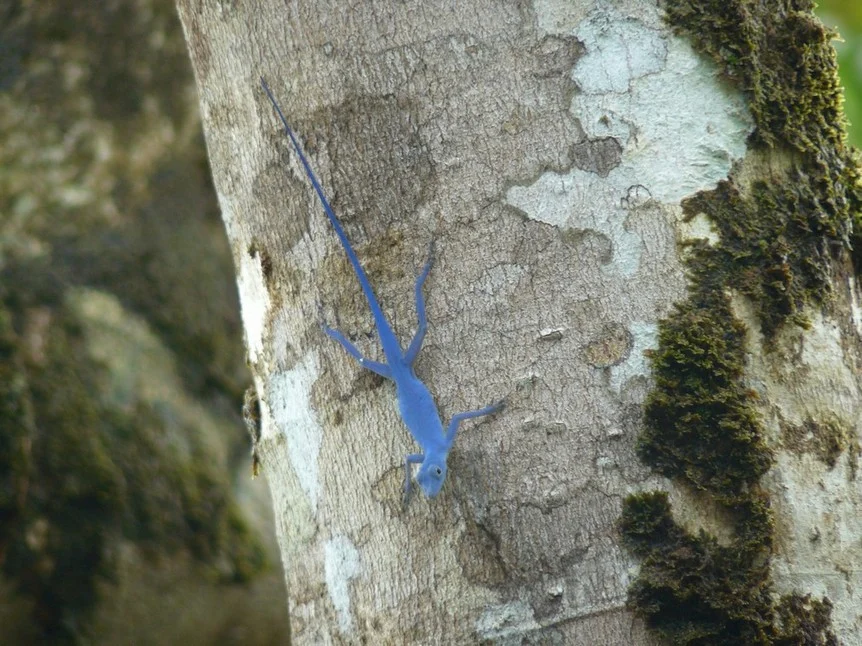
Gorgona became a National Natural Park in 1984, and the jungle has largely reclaimed the prison buildings. Visitors need permission to come ashore. No more than 80 people can stay at a time. Camping is forbidden. Every visitor is assigned a guide - not for tourism, but because the snakes are still everywhere, and you are not allowed to walk off the beach without boots and supervision. The endemic blue anole, *Anolis gorgonae*, is unique in the world: the only all-blue anole species, a lizard whose entire body gleams the color of a Pacific twilight. It is endangered, struggling against habitat loss and the introduced western basilisk. Offshore, from August through October, humpback whales arrive to give birth. Hammerheads and whale sharks cruise the reefs. Brown boobies nest on the cliffs at *Sula leucogaster etesiaca* densities found nowhere else in the world. Gorgona's cloud, said to hang permanently over the summit, catches the afternoon rain and drops it back into the forest. The island is doing what islands do when left alone. It is being itself.
From the Air
Gorgona Island lies at approximately 2.97 degrees N, 78.18 degrees W, about 35 km off the Pacific coast of Colombia, in the Department of Cauca. The island is 9 km long by 2.5 km wide, with a maximum elevation of 338 m at Cerro La Trinidad. Administratively it is part of Guapi municipality; the nearest mainland airport is Guapi (SKGP). Expect persistent cloud cover and high humidity (~90%) - annual rainfall exceeds 6,900 mm. The mainland cities of Cali (SKCL) and Buenaventura offer the primary staging points for visitors, who must secure National Parks permission before arrival.
Nearby Stories
- Tumaco 92 km away
- Popayán 122 km away
- Mira River 141 km away
- Valle del Cauca Department 156 km away
- 1906 Ecuador–Colombia earthquake 188 km away
- San Agustín culture 192 km away
- Malpelo Plate 276 km away
- San José del Palmar 293 km away