
Tumaco
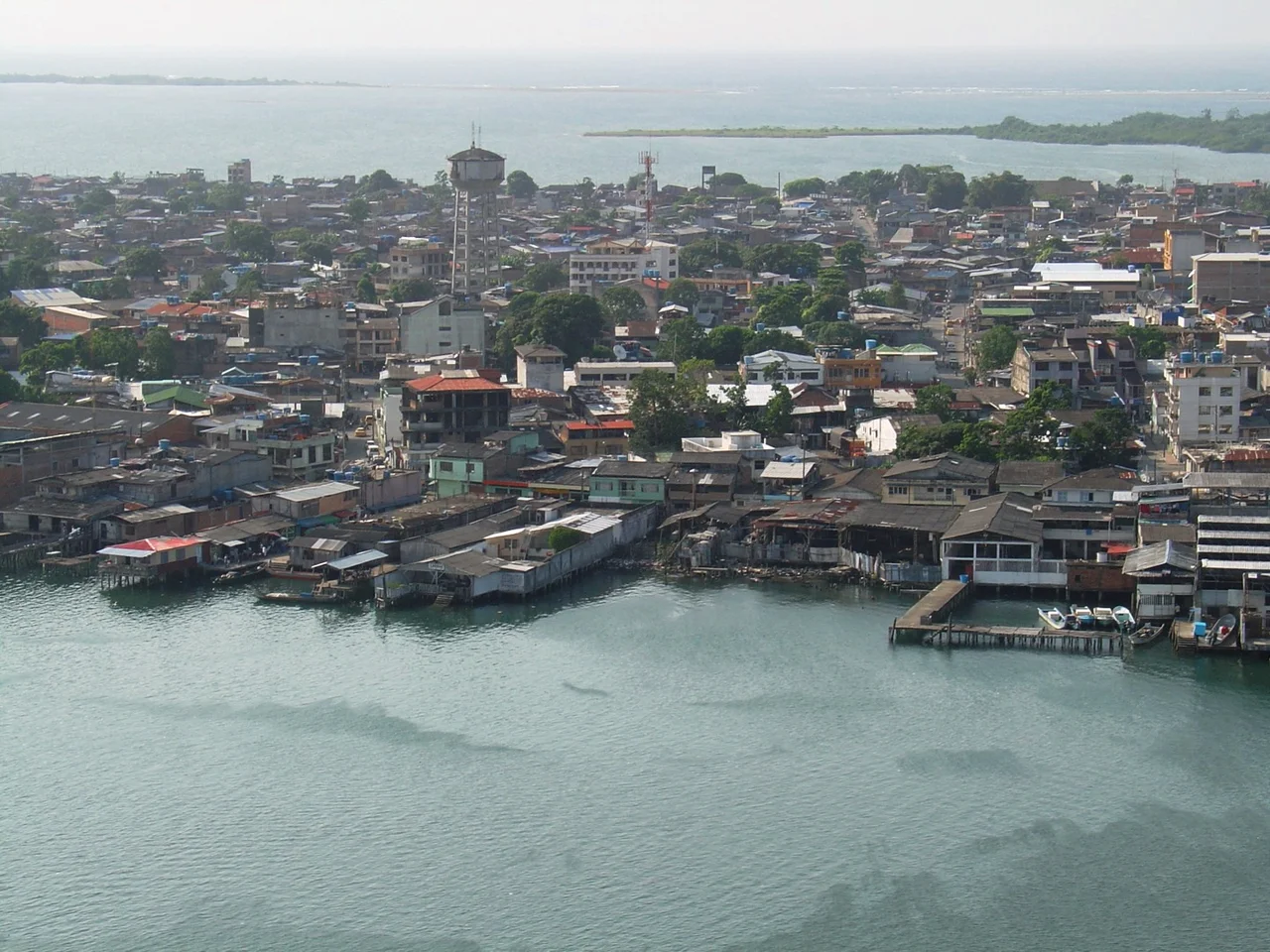
From the air, Tumaco looks like it is leaning into the Pacific. The stilt-house neighbourhoods step out over the water on forests of wooden posts; fishing boats trace thin lines of wake toward the mouth of the Mira River. The city sits in Colombia's southwestern corner, a short stretch of rainforest away from the Ecuadorian border, and its people are overwhelmingly Afro-Colombian — descendants of enslaved Africans brought to the Pacific coast, who built a culture, a cuisine, and a musical language here that the rest of Colombia still catches up to.
La Perla del Pacifico
Tumaco calls itself the Pearl of the Pacific, and the name is earned. Beaches curl around El Morro, Bocagrande, and El Bajito; the Playas de Milagros — the Beaches of Miracles — run toward the mouth of the Mira. On a clear morning the water reads in shades nobody has quite named: jade where the mangroves drain into it, pewter further out. The city is Colombia's second-largest Pacific port, after Buenaventura, and the main Pacific terminus for oil flowing through pipelines from the Andean fields, including Ecuadorian crude. But it is also the jumping-off point for reaching dozens of coastal villages that have no roads at all — the port is not a convenience but a necessity, because the Pacific coast still belongs more to rivers than to highways.
A Culture Shaped by Water
Tumaco is inhabited mainly by Afro-descendants, with smaller Indigenous communities nearby. Artisanal fishing remains one of the pillars of daily life; shrimp farming is among the region's strengths, and the coastal lowlands grow African palm, cocoa, and the hard, white tagua nut — the vegetable ivory that carvers have worked here for generations. Filmmaker Samuel Córdoba set out to document the city's stilt-house neighbourhoods in his 2009 documentary "Tumaco Pacífico," which won first place at the Festival de Cine Latinoamericano de Bordeaux in France. He got the idea from a single panoramic photograph in a book about the city: rows of wooden houses standing above the tide on stilts, lit from behind by a Pacific sunset. The image captures something real about how Tumaco lives — with the sea, not beside it.
A City That Produces Stars
Ask any Colombian about Tumaco and the conversation turns to football. The list of international players born in this one coastal municipality is remarkable: Willington Ortiz, the legendary winger of the 1970s and 80s; Pablo Armero, who represented Colombia at the 2014 World Cup; Víctor Bonilla, Darwin Quintero, Víctor Ibarbo, Harold Preciado, Mauricio Casierra, and dozens more who have pulled on the national shirt. Heptathlete Martha Araújo competed for Colombia at the 2024 Paris Olympics. Yesenia Olaya, an anthropologist from the city, has served as Colombia's Minister of Science, Technology and Innovation. Tumaco exports crude oil to the world, but its more surprising export is talent — kids who learn to move on uneven wooden planks above the water and later move across grass fields in front of television cameras.
Rain, and What the Rain Brings
The climate is what Köppen calls Af — tropical rainforest, hot and humid year-round. By Colombian Pacific standards, though, Tumaco is comparatively dry: annual rainfall totals around 2,600 millimetres, against 6,900 at Buenaventura to the north and a staggering 8,130 at Quibdó. The wettest months run from January to June, with a pronounced trough in August — the opposite rhythm to northern Colombia. The same rains that soak the stilt houses also feed the cocoa and African palm fields inland, where small peasant plots of pancoger crops — yuca, plantains, corn, whatever the family will eat — share the landscape with industrial plantations and seven palm-oil extraction plants.
Living with Difficulty
Tumaco has also borne the weight of Colombia's armed conflict more heavily than most cities. FARC-EP guerrillas, paramilitary groups, and narcotraffickers all sought control of its coast, its river mouths, and the cocaine routes running north. Attacks in 2011 killed soldiers, civilians, and a local politician, and the area around the city has lived with displacement and violence through much of the modern period. Residents — fishermen, cocoa farmers, shop owners, church workers — have carried on, organised, rebuilt. Tourism is growing slowly; the beaches at El Morro and Bocagrande draw weekenders from Cali and abroad. Tumaco's story is not a simple one, and the city would not want it told as if it were. What the aerial view cannot show, the daily life does: a people whose roots in this ground are older than Colombia itself, still shaping what comes next.
From the Air
Tumaco sits at approximately 1.81°N, 78.76°W, on the Pacific coast of Colombia near the Ecuadorian border. La Florida Airport (SKCO) serves the city with flights from Cali's Alfonso Bonilla Aragón International (SKCL). From altitude, look for the distinctive stilt-house districts reaching into the bay, the dark mangrove channels fanning out from the mouth of the Mira River, and the broad Pacific roadstead used by oil tankers. Expect low stratus and frequent rain; visibility can drop quickly in afternoon showers. The coastline here is low and indistinct from high cruise; the brightest landmark is the white sand arc of El Morro island just offshore.
Nearby Stories
- 1906 Ecuador–Colombia earthquake 62 km away
- 1958 Ecuador–Colombia earthquake 64 km away
- Northwestern Andean Montane Forests 79 km away
- San Miguel (Ecuador) 93 km away
- Isla Gorgona 98 km away
- Gorgona Island 126 km away
- Sanctuary of Las Lajas 147 km away
- Malpelo Plate 234 km away