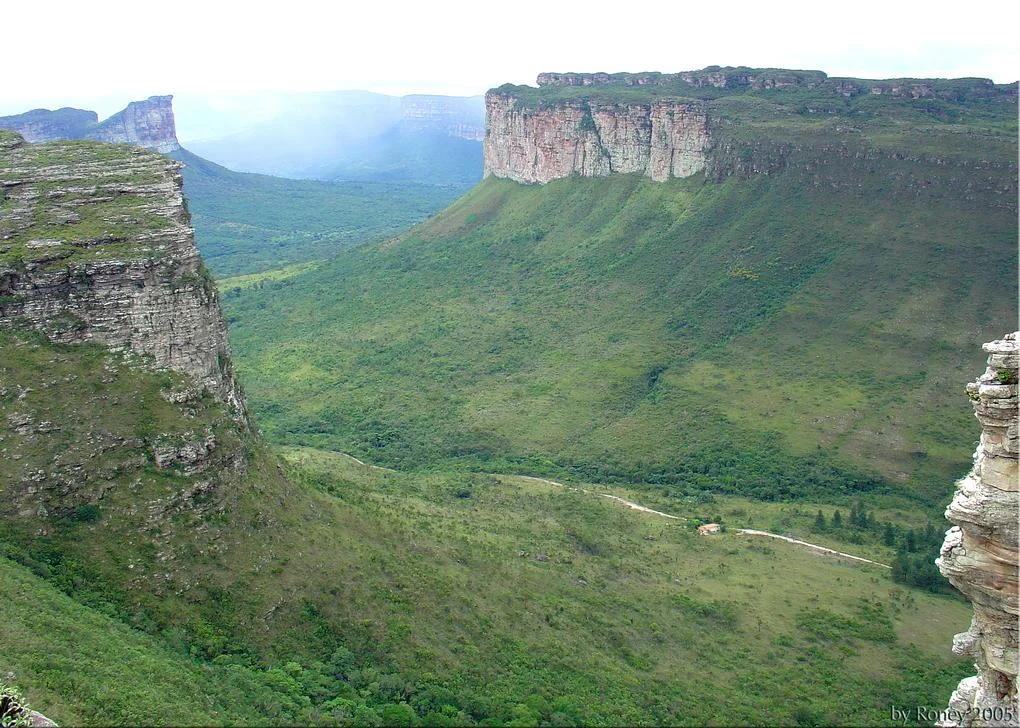

Atlantic dry forests
The tree that gave this forest its signature species is called the barriguda - the pot-bellied one. Its scientific name is Cavanillesia arborea, but nobody who has seen one uses the Latin. The trunk swells out in the middle like an inverted gourd, sometimes more than 1.5 meters across at the widest point, storing water for the dry months when rain simply stops. The rest of the canopy reaches thirty meters into the air. The barriguda stands there looking both graceful and absurd, a tree with a belly, holding life together in one of Brazil's least-protected ecoregions. Welcome to the Atlantic dry forests - 115,100 square kilometers of deciduous and semi-deciduous woodland squeezed between the Cerrado savannas to the west and the Caatinga shrublands to the east.
A Forest Between Worlds
The Atlantic dry forests stretch from northern Minas Gerais state across western Bahia into central Piauí, tracing the upper São Francisco River and spilling into the basin of the Gurguéia River farther north. A large enclave lies on the Chapada Diamantina in east-central Bahia, where altitude creates microclimates strange enough to support the forest's unusual mix of species. The climate is tropical with a dry season lasting about five months. Rainfall runs between 850 and 1,000 millimeters a year - enough to grow tall trees, not enough to sustain the dripping green density of the true Atlantic rainforest to the east. The soil is eutrophic, derived from Bambuí limestone, and in places the landscape opens into caves where a specialized cave biota has evolved in total darkness for millennia.
Barbara Brown's Titi
High in the canopy, a small primate fights to survive. Callicebus barbarabrownae - Barbara Brown's titi - is a critically endangered monkey found nowhere else on Earth. Only about 260 individuals remain in the wild, scattered across a handful of forest fragments that grow more isolated every year. The titis are agile climbers and jumpers, foraging for fruit in the treetops and often reaching it before the parrots do. The dry forest is not an easy home for an arboreal primate. Trees are shorter than in the wet forest. Open patches of shrubland and grassland interrupt the canopy. During the dry season, when the trees shed their leaves, the titis lose their cover and become visible to predators from below. Two hundred and sixty monkeys are all that stand between this species and extinction. Every fragment matters.
The Birds of the Dry Season
The forest breathes with seasonal rhythms that shape its animal life. At least twenty species of birds migrate north during the dry months, returning to breed when the rains come. Among the notable species that use this landscape are some of Brazil's most spectacular and most threatened birds - the hyacinth macaw with its deep cobalt feathers, the vinaceous-breasted amazon, the golden-capped parakeet, the moustached woodcreeper, the great xenops, and the Minas Gerais tyrannulet, named for the state where it was first described. Biologists suspect the ecoregion holds far more endemic species than currently documented, because so little of it has been rigorously surveyed. The presence of so many endemic birds points to high endemism across other groups. We simply do not know what we are losing.
Seventy Percent Gone
Approximately 70 percent of the original forest has been cleared. The reasons are straightforward - agricultural expansion for crops and cattle, and charcoal production to feed Brazil's steel and pig iron industries. The most biologically rich forests, the ones on flat rich soils, have been almost entirely removed. What remains is largely confined to slopes and plateaus where the terrain made farming uneconomic. The central portion of the ecoregion, between Manga in Minas Gerais and Ibotirama in Bahia, remains largely unprotected. Protected areas like Peruaçu and Serra das Confusões sit at the edges of the dry forest, useful but insufficient. Conservation biologists have drawn up priorities for the next decade - expand protected areas in the core region, limit further land conversion, restore dry forest on flat ground where it historically grew.
Limestone and Silence
Walking into a patch of intact Atlantic dry forest is walking into a place that feels both alive and precarious. The canopy thins overhead. The barriguda trees stand like quiet monuments. Tabebuia trees - the ones Brazilians call ipê - flower in yellow and pink bursts when the rains return, visible across great distances. Brazilian cedarwood and Araracanga grow alongside them. The ground is scattered with limestone outcrops that hide caves and sinkholes. Patches of Cerrado vegetation and Caatinga scrub appear where soil or topography changes just enough to favor them, and where they appear, the ecosystem mixes. This is borderland. It is also what most of interior Brazil used to look like before the soybeans, before the charcoal kilns, before the highways. What survives here survives against long odds. The barriguda knows how to wait out a drought. Whether it can wait out an industrial century remains an open question.
From the Air
Ecoregion centered approximately at 14°S, 44°W in western Bahia and northern Minas Gerais, spanning 115,100 km². Recommended viewing altitude: 5,000-8,000 feet for a clear view of the transitional landscape between the Cerrado to the west and the Caatinga to the east. Nearest airports include Barreiras (SBRR) and Bom Jesus da Lapa (SBLP). Visual landmarks include the upper São Francisco River corridor and the plateau-slope forest remnants visible as darker vegetation on higher terrain. Expect hot, dry conditions with limited afternoon convective activity outside the rainy season.
Nearby Stories
- São João das Missões 72 km away
- Caminho dos Gerais State Park 106 km away
- Mambaí 160 km away
- Barreiras 177 km away
- Posse, Goiás 186 km away
- 1798 Revolt of the Alfaiates 190 km away
- Janaúba 206 km away
- São Domingos, Goiás 240 km away