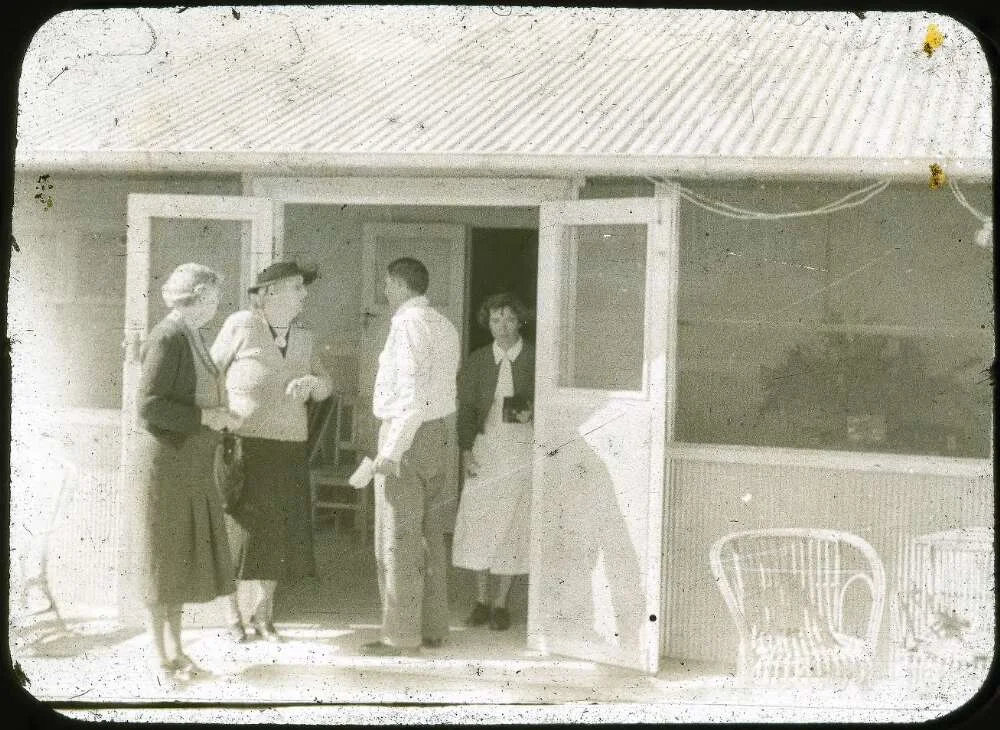

Australian Inland Mission Hospital, Birdsville
In August 1929, a strange contraption arrived at the mission hostel in Birdsville: a radio you powered by pedalling, like a bicycle going nowhere. It was one of six experimental sets that Alf Traeger installed across the outback, and it changed everything. For the first time, a station hand bleeding out a hundred miles from anywhere could tap a message into the dark and have a doctor answer. The pedal radio was the missing piece of a vision the Reverend John Flynn had been chasing for years - a 'mantle of safety' woven from wireless and aircraft, thrown over the people of inland Australia. The little hospital on Adelaide Street was where that mantle touched the ground.
A Mantle of Safety
John Flynn never accepted that distance should be a death sentence. As superintendent of the Presbyterian Church's Australian Inland Mission, he spent the 1910s and 1920s building a chain of bush nursing homes across the continent's emptiest reaches. Birdsville's came in 1923, set up in the old Royal Hotel - the first AIM hostel in Queensland and the seventh in Australia. Flynn's genius was to see the parts as one machine. A nurse in a remote hostel was good; a nurse with a pedal radio who could summon a flying doctor was revolutionary. The Aerial Medical Service he launched in 1928, based at Cloncurry, grew into the Royal Flying Doctor Service. Birdsville, with its hostel and its radio aerial, became one of the points where the whole improbable system proved it could work.
Two Thousand Miles of Iron
Fire took the original hospital in November 1951, and the replacement is a story in itself. The Mission ordered a prefabricated steel building from the Sidney Williams factory in Sydney, then hauled it overland by truck - through Broken Hill, up to Marree, and along the corrugations of the Birdsville Track - a journey of some 2,000 miles. The Reverend Les McKay spent a year on site helping piece it together. Everything about the design fought the desert. The ceilings sit low and heavily insulated, trapping a buffer of air beneath the iron roof; vents in the gables breathe out the heat; a cellar under the kitchen kept food cool, and underground tanks held rain water for drinking when the river or the bore ran foul. It opened in 1953, filmed by Fox Movietone for a newsreel called Diamantina Drama.
The Ward at the Back
Behind the main building, near the south-east fence, stands a smaller iron structure: the former Aboriginal ward. Its presence is a quiet, uncomfortable record of how medicine was segregated in remote Queensland for much of the twentieth century, and it deserves to be read honestly. Aboriginal patients - including Wangkangurru and Yarluyandi people whose country this is - were treated apart from white patients, in a separate building with corrugated-iron shutters over the windows. The ward survives today as part of the heritage site, not as decoration but as evidence. The same hospital that extended a mantle of safety across the inland also drew lines through it. Both things are true, and the building keeps the memory of both.
Fifty-Two Years of Service
From 1953 until 2005, the hospital did what it was built to do. After the churches merged in the 1970s, Frontier Services took over its operation; through floods and dust storms and the brutal arithmetic of a town where the nearest large hospital is a flight away, the nurses stayed. When it finally closed after fifty-two years, the Diamantina Shire Council took up the work in a modern clinic next door, and the old building reopened as a museum - the 'Old Birdsville Hospital' display. Walk its enclosed verandahs now and the design still makes sense: cool, low, deliberate. It is a monument to an idea that sounded impossible when Flynn first spoke it, and turned out to be one of the great humane inventions of the Australian outback.
From the Air
The former hospital sits at the eastern end of Birdsville's Adelaide Street, at roughly 25.898°S, 139.355°E, a few hundred metres east of the Birdsville Hotel and the town centre. The nearest airfield is Birdsville Airport (ICAO YBDV, IATA BVI), elevation about 159 ft, immediately west of town with a single sealed runway 14/32. The broader district is served by Windorah (YWDH) to the east and Boulia (YBOU) to the north. Visual approach is straightforward in clear weather, but this is one of Australia's hottest, driest regions: expect summer surface temperatures above 45°C, dust haze, and few alternates. Look for the cluster of corrugated-iron heritage buildings strung along the single main street where the red gibber plains meet the dunes of the Simpson Desert.
Nearby Stories
- Annandale Station 3.4 km away
- Eromanga Sea 11 km away
- Carcory Homestead Ruin 50 km away
- Koonchera Point Massacre 56 km away
- Munga-Thirri National Park 86 km away
- Cordillo Downs 90 km away
- Munga-Thirri–Simpson Desert National Park 99 km away
- Currawilla 154 km away