
Awe Hydro-Electric Scheme
In 1957, the North of Scotland Hydro-Electric Board published Constructional Scheme No. 28 - the Awe Hydro-Electric Scheme. It promised something Britain had never seen at full scale: a giant pumped storage power station built inside a mountain, with a reservoir perched in a corrie a thousand feet above and turbines spinning in a hall the size of a cathedral, hollowed out of solid rock. The mountain was Ben Cruachan. The hall would house four 100-megawatt turbines. The excavation called for 300,000 cubic yards of fine-grained granite to come out. Then the workers hit a crush zone - a diagonal fault line of fractured rock running straight through the chamber - and the whole engineering plan had to be rewritten in mid-tunnel.
Tom Johnston's Vision
The Hydro Board itself was an explicitly social project. Created by the Hydro-electric Development (Scotland) Act 1943 - a measure championed by Tom Johnston when he was wartime Secretary of State for Scotland - it was meant to electrify the Highlands. Johnston's idea was that the Board would sell bulk power to the Lowlands at a profit, then use the money to fund "the economic development and social improvement of the North of Scotland." Rural consumers would get cheap electricity. The price would not reflect the actual cost of stringing wires to a remote crofting township. After 1943, hydro engineers ranged across the Highlands looking for valleys deep enough and rainfall heavy enough to dam. By 1957 they had built the Loch Sloy scheme, the Tummel-Garry scheme, and the Shira scheme - which included a small pumped-storage power station at Sron Mor, Britain's first.
Pumped Storage At Industrial Scale
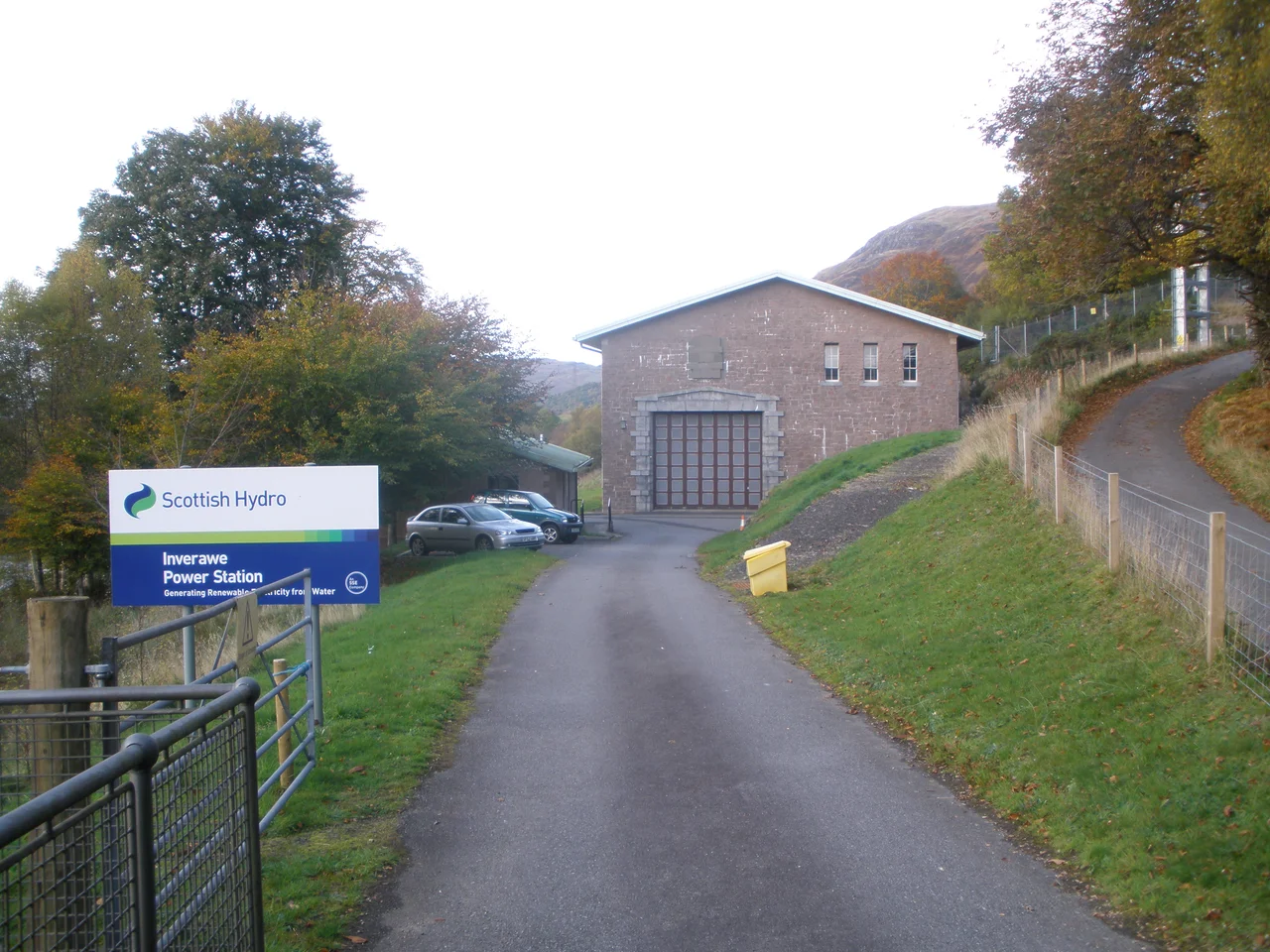
Sir Edward MacColl had first proposed a "reversible hydraulic station" at Sloy back in 1936, when he was working for the Central Electricity Board. The idea was rejected as uneconomic. Two decades later, with nuclear power coming and demand patterns shifting, the maths had changed. Angus Fulton - who took over as Hydro Board chief executive in 1955 - was a true believer. By the late 1950s he was ready to push for a full-scale pumped storage scheme, and the Awe scheme would deliver it. The plan called for three power stations on Loch Awe and its drainage: a 25 MW conventional station at Inverawe, taking water from Loch Awe and sending it down through the River Awe to Loch Etive; another conventional station at Nant, using Loch Nant; and Cruachan, the pumped storage giant, with four turbines totalling 400 MW.
The Hollow Mountain
Cruachan's machine hall would be cut into Ben Cruachan itself, fed from an upper reservoir built in a corrie 1,198 feet above Loch Awe. The buttress dam holding back that reservoir is 1,037 feet long, with eleven buttresses - five west of a central gravity block, six east. The block houses the intakes and outlet pipes. A catchment of 8.9 square miles feeds the reservoir, augmented by twelve miles of tunnels engineered to capture the headwaters of nearby streams. Then came the hard part. The machine hall excavation was supposed to be straightforward fine-grained granite. Instead the crew found a crush zone running diagonally through the chamber - fractured, weak rock that needed extra roof support and a fundamentally different excavation sequence. The four 100-MW turbines came from two suppliers, Boving and English Electric, subcontracted to John Brown of Clydebank and Harland and Wolff. The tailrace into Loch Awe was its own ordeal, fighting steep banks and rock layered with gravel and boulders.
The Barrage At The Pass
Downstream, the Pass of Brander - the narrow gorge through which the River Awe escapes Loch Awe - had to be dammed. The Awe Barrage went up in the pass itself, much to the displeasure of the Amenity Committee, which asked whether it could be moved upstream to preserve the beauty of the gorge. The Board said no. The barrage had to handle flood discharges from Loch Awe, and a narrower upstream site could not pass the volume of water required without risking failure. Moving it would have cost an estimated £475,000 in extra tunnelling. Both Inverawe and Nant were commissioned in 1963. The Cruachan station opened in 1965. The whole Awe scheme became the second-to-last project of the Hydro Board's golden age, completed just as the era of large-scale Highland hydro construction was drawing to a close.
Salmon Freshets And A Borland Lift
Operating a major dam on a salmon river requires extraordinary care. The River Awe is a famous salmon river, and the Awe Barrage carries both a Borland fish pass - which lifts adult salmon back up to Loch Awe - and an elaborate schedule of freshet releases that mimic natural flood flows. In 2023 the schedule called for three freshets of 300 megalitres in April and May, two 500-megalitre releases in summer, a 600-megalitre release in September, then six big 2,100-megalitre, 72-hour freshets between October and December. There is also a separate smolt freshet released when juvenile salmon build up above the barrage and need help getting out to sea. The Borland lift cycles four times a day in the salmon season. Each cycle takes an hour to fill, lift, and discharge. The fish, presumably, do not care about the engineering. They just want to get upstream.
From the Air
The Awe Hydro-Electric Scheme is centred at 56.3937 N, 5.1138 W, on the eastern shore of Loch Awe at the entrance to the Pass of Brander, with Ben Cruachan rising directly above. From cruising altitude the scheme is easily traced: the Cruachan reservoir sits in a corrie at 1,198 feet on the south flank of Ben Cruachan; the visitor centre and tailrace works are on the north shore of Loch Awe; the Awe Barrage is in the gorge just west, on the River Awe; the Inverawe power station sits beside the river above its confluence with Loch Etive. Oban Airport (EGEO) at Connel is 8 nm west-north-west. Loch Awe runs south-west to north-east beneath you. Ben Cruachan itself reaches 3,694 feet and is unmistakable - a steep twin-peaked massif that often catches cloud when the surrounding hills are clear.
Nearby Stories
- Easdale 5.5 km away
- Buchanan Castle 6.2 km away
- Cowal 6.8 km away
- Clachaig Inn 7.4 km away
- Loch Katrine 9.9 km away
- Lochaber 23 km away
- Ben Alder 25 km away
- Jura Distillery 34 km away