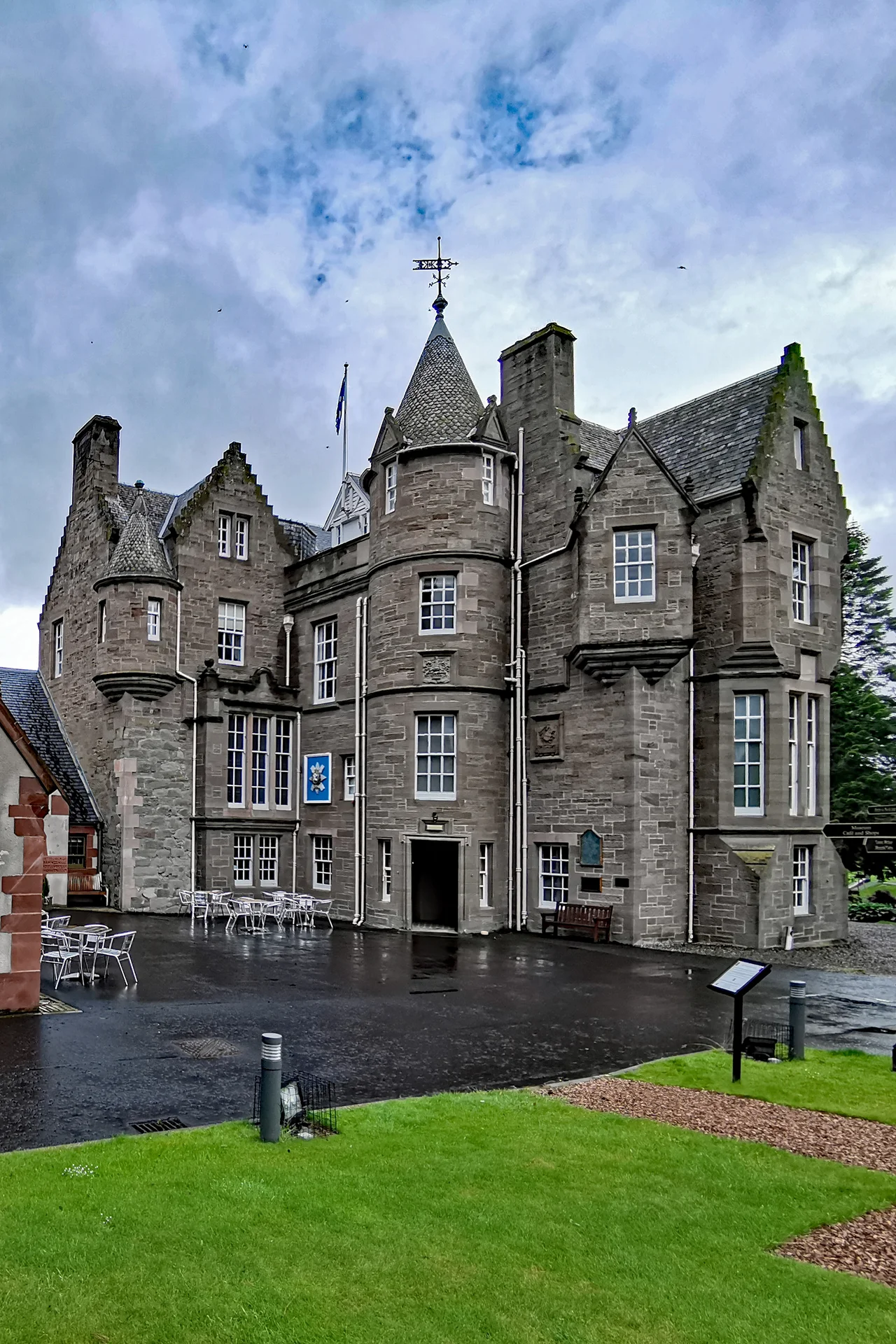

Balhousie Castle
Walk north along the Tay through the parkland of the North Inch and a turreted silhouette rises behind the trees. Balhousie Castle looks like every storybook idea of a Scottish stronghold: pointed turrets, crow-stepped gables, a tower with conical caps, sandstone walls weathered to a soft grey. Almost none of it is original. The castle began in 1631 as the seat of the Earls of Kinnoull, fell into ruin in the early nineteenth century, and was virtually rebuilt between 1862 and 1864 in the high Scottish Baronial style by the Perth architect David Smart. What stands today is a Victorian fantasy of a medieval Scottish house - and since 2009, the regimental home of the Black Watch.
The Earls of Kinnoull
The first castle on this terrace overlooking the North Inch was built in 1631, though local tradition holds that the site had been occupied for three centuries before that. As the seat of the Earls of Kinnoull, it sat within a walled enclosure with orchards, outbuildings, and a garden, looking south toward the medieval town of Perth on the bank of the Tay. By the early nineteenth century it had been neglected for so long that the Romantic painters of the period were treating it as a picturesque ruin. The Pre-Raphaelite painter John Everett Millais came here in or before 1858 and used a wall of the ruin as the model for his painting The Love of James the First, of Scotland. A reference photograph survives showing a model dropping a love letter from the castle window.
Rebuilding the Past
Between 1862 and 1864 the castle was rebuilt - 'restored' in the language of the era, though almost nothing was preserved. The architect David Smart, working in the Scottish Baronial style then fashionable thanks to Queen Victoria's enthusiasm for Balmoral, gave the castle the romantic skyline visitors see today. Pointed turrets bristle from the corners. The walls climb in stages. Only fragments of the original rubble walling on the east side survive from the seventeenth-century house. The castle was built to look ancient rather than be ancient, and it has done so with such conviction that most visitors do not realize the medieval-looking pile they are admiring is younger than the American Civil War.
Home of the Black Watch
In January 2009, the Regimental Trustees of the Black Watch bought Balhousie Castle to house the museum and archive of the regiment - one of the most storied units in the British Army, raised in 1739 from independent companies of Highlanders who had been recruited to watch the Highlands themselves. The name comes from the dark tartan they wore on patrol, distinguishing them from the redcoated regular troops. The Heritage Appeal launched that September raised more than 3.2 million pounds to develop the castle into a permanent home for the regiment's history. Inside today, the displays trace the Black Watch from its eighteenth-century origins through Waterloo, the Crimea, the world wars, and into the modern era when it was eventually merged into the Royal Regiment of Scotland in 2006.
No Surrender
Among the paintings inside the castle is one called No Surrender by the Swiss-born artist Frank Feller, who lived from 1848 to 1908. It depicts the aftermath of the Battle of Magersfontein on 11 December 1899, an early and disastrous engagement of the Second Boer War in which the Highland Brigade - including the Black Watch - was caught in the open by entrenched Boer riflemen and cut to pieces. The painting captures a regiment in the worst day of its long history. Feller painted it not as a celebration but as a refusal: the title insists on the dignity of soldiers who had lost everything but their colours. For the museum that now occupies the rebuilt castle, it is a fitting centrepiece - a Victorian painting in a Victorian castle, remembering Highland soldiers who paid the full price of a war that most Britons would rather have forgotten.
From the Air
Balhousie Castle sits at 56.403 north, 3.437 west, on the North Inch of Perth in Scotland. From the air the castle's distinctive turreted silhouette is visible on a low terrace overlooking the broad parkland of the North Inch and the River Tay. The whole of central Perth is laid out to the south, with the Tay curving through the city centre. Best appreciated from 1,500 to 3,000 feet. Dundee Riverside (EGPN) lies roughly 18 nm east-northeast and is the nearest controlled airport. Edinburgh (EGPH) is about 32 nm south, Glasgow (EGPF) 50 nm south-west. The M90 motorway approaches from the south.
Nearby Stories
- Drummond Castle 0.4 km away
- St Andrews 0.8 km away
- Aberfeldy 2.2 km away
- Yellowcraig 2.7 km away
- Fordell Castle 3 km away
- Battle of Sauchieburn 3.2 km away
- Battle of Dun Nechtain 3.3 km away
- Airlie Castle 13 km away