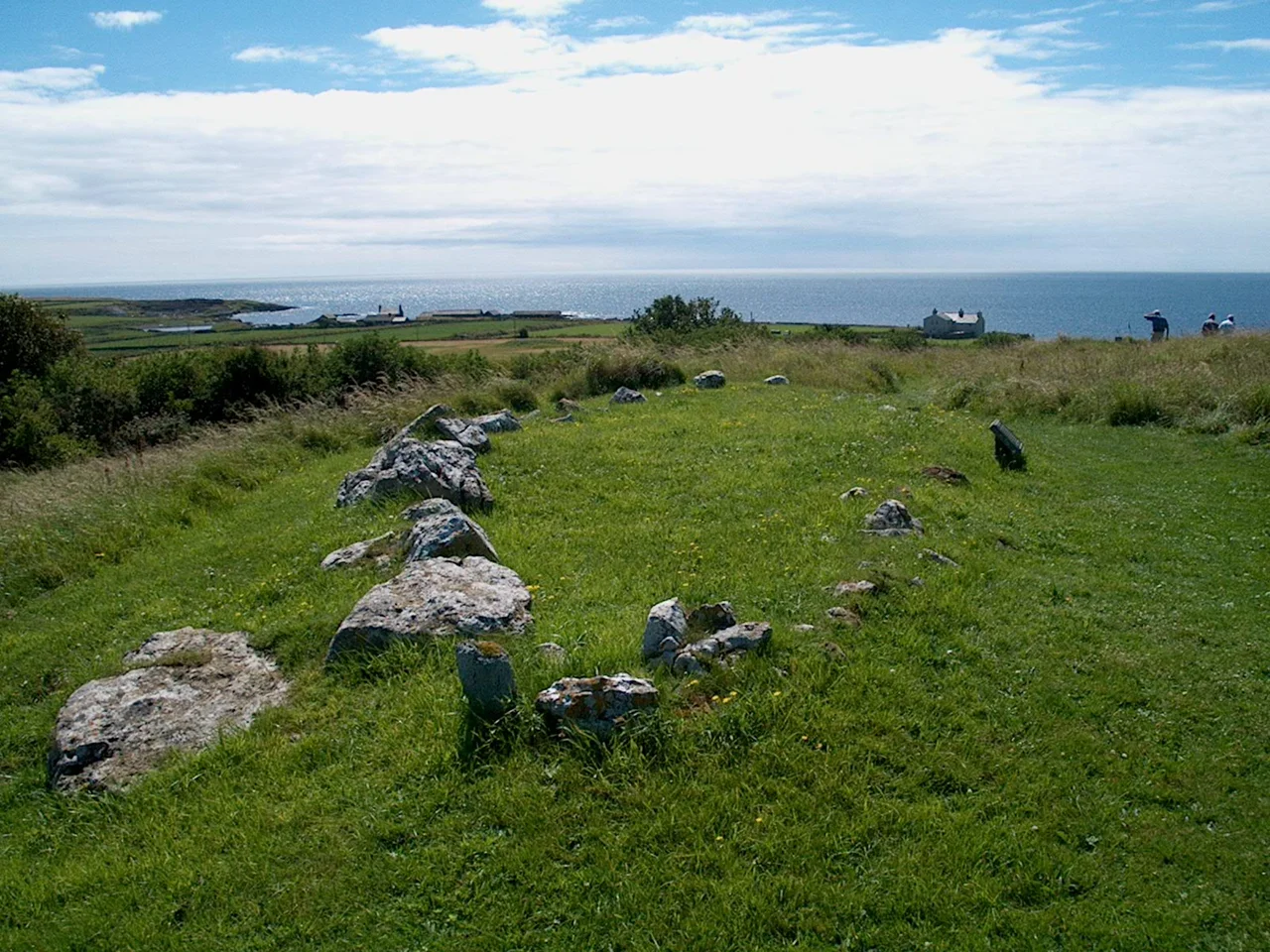

Balladoole
They were digging with trowels because the armed guards would not let them have pickaxes. It was 1944, the war was not yet over, and the men working this small hilltop near Castletown were enemy aliens - German civilians interned on the Isle of Man because Britain was unsure what else to do with them. Their leader, Gerhard Bersu, was one of the finest archaeologists in Europe. He had expected to uncover an Iron Age hill fort. What he found instead was a Viking ship, eleven metres of clinker-built oak laid into the earth a thousand years earlier, and beside the chieftain who had been buried in it, the bones of what the original excavators interpreted as a sacrificed companion - an interpretation that later reassessment has contested.
Eleven Thousand Years on One Hill
Chapel Hill is unremarkable in profile - a low rise on the south coast, looking out toward the Calf of Man. But people have been climbing it and burying their dead here since the Mesolithic, which on the Isle of Man means somewhere around nine thousand years ago. Layer beneath layer, the hill holds a Bronze Age stone cist from roughly 1000 BC, an Iron Age earthwork hillfort whose collapsed walls suggest stone ramparts three metres high, the small stone footprint of an early medieval Christian chapel - a keeill - and the Christian cemetery that gave the place its modern name. The keeill was tiny, only large enough for liturgy rather than congregation. The graves around it had been there for two or three centuries when the Vikings arrived and chose this same hill for one of the most theatrical pagan burials ever performed in the British Isles.
The Boat in the Earth
The man laid in the ship was someone important - a chieftain, a wealthy landowner, perhaps a Norse merchant working the Irish Sea trade routes. His clinker-built oak vessel, eleven metres long, was the kind of trading craft that moved between Dublin, the Hebrides and the Manx coast in the 9th and 10th centuries. Around him lay the grave goods of a man of rank: weapons, riding harness fittings, spurs and stirrups, buckles and a knife. Above all of it had once risen a great mound of earth, which Bersu's team initially mistook for collapsed Iron Age rampart and partly removed before they understood what they were standing on. The ship's timbers had long since rotted away, leaving only the iron rivets in their precise clinker pattern - a ghost hull drawn in rust.
The Second Set of Bones
The original excavators found evidence of a second burial beside the Viking warrior, which they interpreted as a sacrificed woman - a practice attested in other Norse burials of the period, where enslaved women, often Irish or Pictish captives taken in the long raiding history of the Irish Sea, were killed to serve a chieftain in the afterlife. Later reassessment of the skeletal material, however, concluded that the remains were exclusively male, leaving the identity and fate of the second individual unresolved. The archaeology gives them no name, no age, no homeland - only the manner of an ending that placed them here, beside a man who mattered enough to be buried in a ship, on a hill already thick with the dead of other centuries.
Christians Beneath, Vikings Above
The choice of site cannot have been accidental. By placing this elaborate pagan burial directly on top of an existing Christian cemetery, the Norse settlers may have been making a deliberate statement - a slighting of the older graves, a planting of the new religion's flag on the bones of the old. Or perhaps they simply chose a hill already understood to be sacred. The keeill itself survived only as a doorway in the south wall by the time Bersu reached it. The mixing of Christian and pagan iconography on the Isle of Man during the tenth century is one of the great unresolved puzzles of Viking-age Britain, and Balladoole sits in the middle of that conversation.
Excavated in Wartime
The Bersu excavation is itself a strange piece of history. The Isle of Man was used during the Second World War to intern thousands of German and Austrian civilians, most of them refugees who had fled the Nazis. Bersu, one of the foremost prehistorians of his generation, was a Jewish refugee who had been dismissed from his German university post in 1935 and ended up here in 1940. The Manx Museum recognised who he was and arranged for him to work, with a team of fellow internees, on the island's most important archaeological sites - using hand tools because pickaxes were forbidden to enemy aliens. The discovery of the boat burial was an accident; he had been looking for the hill fort. Today the model of the ship sits in the Manx Museum in Douglas, and the hill itself is quiet again, looking out over the Irish Sea.
From the Air
Located at 54.078°N, 4.692°W on the south coast of the Isle of Man, just inland from the shoreline near Poyll Vaaish. The hill is modest - around 30m elevation - and best appreciated at low cruising altitude (1,500-3,000 ft AGL) where the earthwork ring of the Iron Age fort is still visible as a faint oval in the grass. Ronaldsway Airport (EGNS) is 5km east. The Calf of Man and Chicken Rock lighthouse sit on the horizon to the southwest. Castletown lies 3km east-northeast.
Nearby Stories
- RAF Jurby Head 14 km away
- German submarine U-246 16 km away
- German submarine U-1051 17 km away
- Kilclief Castle 18 km away
- Ardglass 31 km away
- St Bees Lighthouse 44 km away
- Trwyn Du Lighthouse 54 km away
- Seascale Lifeboat Station 61 km away