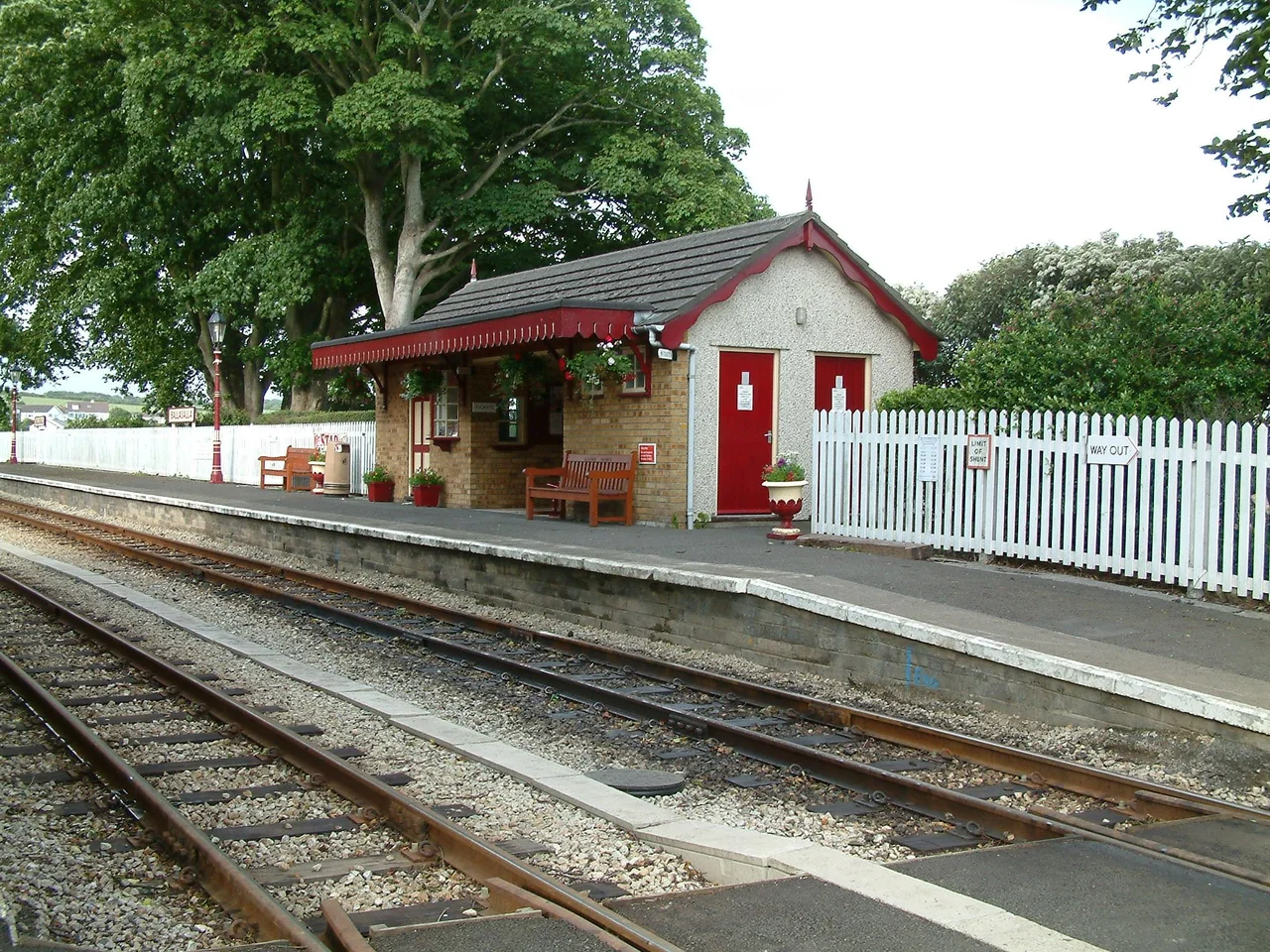

Ballasalla Railway Station
For one summer in 1976, Ballasalla was the end of the line. The Isle of Man Railway, hemorrhaging money and propped up by local campaigning, had been chopped back to a short run between here and Port Erin while everyone argued about whether the whole thing should simply close. It didn't close. The campaigning won, the rest of the line reopened the following year, and the little Manx village station that had nearly become a terminus instead returned to being what it had always been - a country halt on a 46-mile network that, in its prime, had connected every corner of the island - from Douglas to Peel, north to Ramsey, and south through the farming parishes to Port Erin.
Place of Willow
The name comes from Manx Gaelic. Balley Sallagh means 'place of willow', and the trees still cluster along the Silverburn, the little river that runs through the village to the sea at Castletown. The station sits on the eastern edge of the village, close enough to the Isle of Man Airport that arriving passengers can - and sometimes do - walk over to catch a steam train for the novelty of the thing. Three-foot narrow gauge, 1874 vintage, with locomotives older than most of the buildings they pass. The original wooden station building stood here from the line's opening in 1874 until 1985, when it was demolished and the goods yard sold off for an office development. What replaced it is a brick utility box, opened in 1986 by Jack Nivison, the former President of the Legislative Council. The water tower from 1902 still stands, listed as a protected building, with the station name painted on its tank.
Where Two Trains Used to Meet
For most of the line's working life, Ballasalla was the passing loop - the place where the up train and the down train met in the middle of the day, slowed, paused, and slid past each other. Photographers loved it. Two trains in the frame at once, both billowing steam, both crewed by men in waistcoats and caps doing essentially the same job their predecessors had done in 1874. From 2001 to 2012 it was the only crossing place in regular use on the entire surviving line. Then the 2012 timetable added Castletown back into the rotation, and the 2015 schedule moved everything south, leaving Ballasalla's up platform redundant - though the modern bus shelter installed in 2002 still sits there, attracting vandalism and replacement glazing in roughly equal measure.
Goods Sheds and Cattle Docks
This was a working station, not a tourist one - at least originally. Ballasalla served farms, and the weekly mart drew livestock trains and goods wagons. The cattle dock and goods platforms saw heavy use through the early and middle decades of the twentieth century. The goods shed itself had a peculiar provenance: it had been salvaged from the prisoner-of-war camp at Knockaloe near Peel, which during the First World War held more than 23,000 internees. When the camp was demolished, the Isle of Man Railway acquired several of its timber buildings for re-use. The Knockaloe goods shed served Ballasalla until 1985, when redevelopment cleared the site. Other Knockaloe structures still survive at stations down the line, carrying the camp's memory across more than a century.
Silverdale and the Abbey
What draws most modern visitors to Ballasalla isn't the station but what lies a short walk from it. Silverdale Glen, with its water-powered merry-go-round and shallow boating lake, has been a pleasure park since long before pleasure parks were invented as a concept. A wishing well, a tree-lined glen, model boating clubs in the off-season, rowing boats in summer. Beyond it, Rushen Abbey - founded in the twelfth century when Savignac monks arrived from Furness Abbey in Lancashire, later absorbed into the Cistercian order. Dissolved under Henry VIII, marketed as a Victorian tourist attraction served by this very railway, famous for strawberries and cream before the Second World War, briefly an Academy nightclub in the postwar decades, and now a heritage site managed by Manx National Heritage. Signs on Ballasalla's platform direct passengers to it - the abbey is why most rail visitors get off here at all.
A Volunteer Station
Since 2019 a Friends Of group has adopted the station, following the precedent set at Castletown. Floral displays expanded each season, period furniture appearing on the platform, an art installation arriving in 2022. A retired volunteer staffs the place on most operational days, selling postcards from a small table - the kind of working preservation that keeps the human texture of a Victorian railway intact when the economics alone would never sustain it. Trains run seasonally between March and November, all of them powered by the same fleet of small steam locomotives the line has used for a century. They stop at Ballasalla. None of them terminate here any more.
From the Air
Located at 54.096°N, 4.630°W in the south of the Isle of Man, 1km north of Ronaldsway Airport (EGNS, the island's only commercial airport). The station sits beside the A5 road on the eastern edge of Ballasalla village. The narrow-gauge railway runs roughly southwest to Port Erin and northeast to Douglas. Best viewed from low approach altitude (1,000-2,000 ft AGL) - the line is visible as a thin trace through farmland, often with a plume of steam in summer. Castletown is 3km south.
Nearby Stories
- RAF Jurby Head 14 km away
- German submarine U-246 16 km away
- German submarine U-1051 17 km away
- Kilclief Castle 18 km away
- Ardglass 31 km away
- St Bees Lighthouse 44 km away
- Trwyn Du Lighthouse 54 km away
- Seascale Lifeboat Station 61 km away