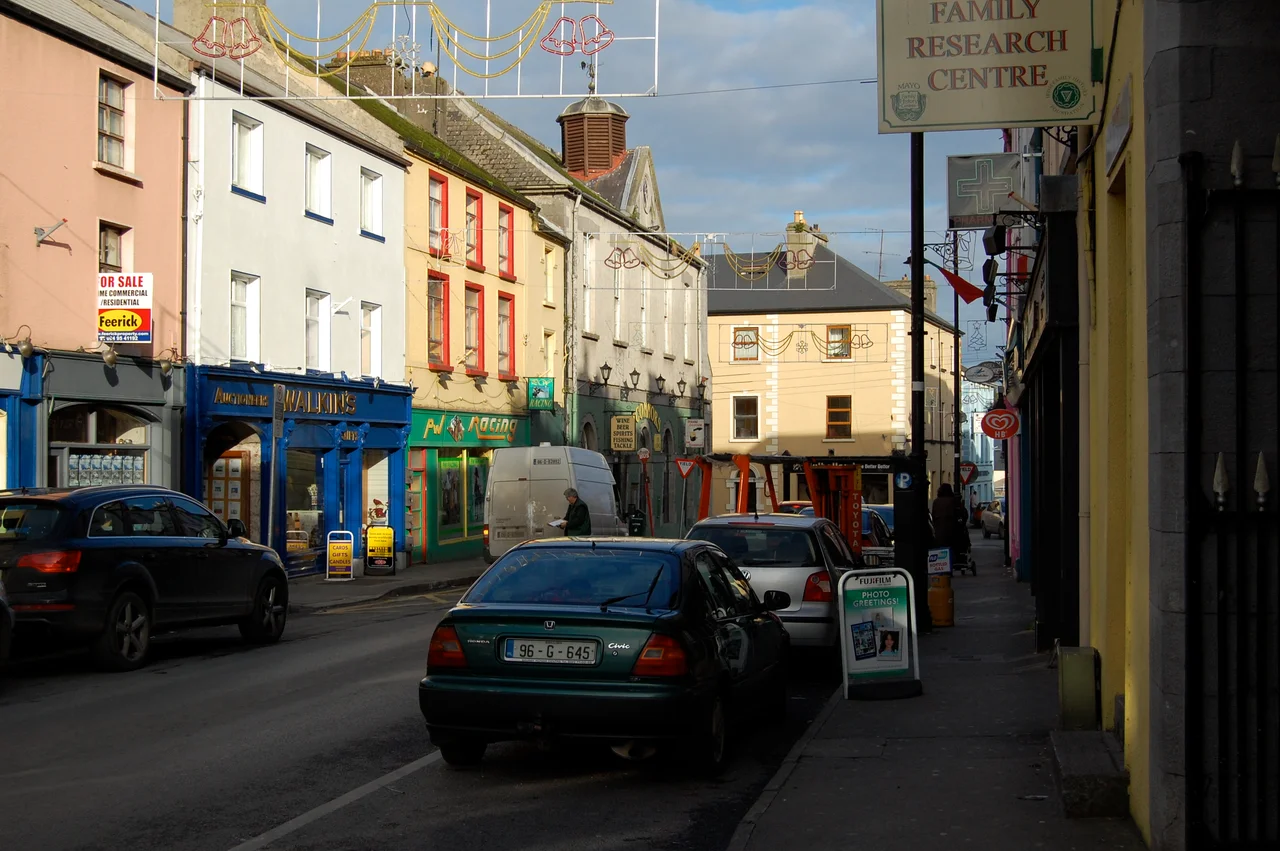

Ballinrobe
In September 1935, exhausted after 23 hours fighting Atlantic weather, the Lithuanian-American pilot Feliksas Vaitkus brought his single-engine, single-seat plane Lituanica II down in an open field at Ballinrobe. Dublin was fogged in. The entire route east to the Baltic Sea was unflyable. He had hoped to reach Kaunas in Lithuania, the homeland of his parents, but his fuel was running out. He spotted Ballinrobe from the air and made the decision to land. The plane was wrecked. Vaitkus walked away uninjured. He became the sixth person to successfully cross the Atlantic solo in a single-engine plane. The townspeople of Ballinrobe found themselves hosting one of the most unusual aviation events in Irish history, and Vaitkus, after being crated up along with his airplane for shipment back to Lithuania, eventually arrived in Kaunas to a hero's welcome.
The Market Town Charter
On 6 December 1606, King James I granted a Royal Patent to the people of Ballinrobe, allowing the town to hold fairs and markets. Obtaining such a charter required a spokesperson with access to royal favour, and the result was the economic foundation that made Ballinrobe the largest town in the area for the next three centuries. Market day was Monday. Each commodity had its assigned spot. Well into the mid-twentieth century, turf, hay, potatoes, turnips, and cabbage were sold on Abbey Street; poultry on Glebe Street; calves on Bridge Street; cloth, flannel, woollen socks, lace, wheat, oats, and barley outside the Market House. Special livestock fairs for pigs, cattle, and sheep ran at different points in the year. The patterns persisted because they worked: people knew where to bring what, and where to buy what. Today's Ballinrobe Livestock Mart, held every Wednesday, is one of only two marts in County Mayo, a direct descendant of the 1606 charter.
The Workhouse in the Famine
In 1839, six years before the Great Famine, the Union Workhouse of Ballinrobe opened. By 1847, with the Famine at its height, the workhouse held 2,000 inmates and was overwhelmed. The Mayo Constitution that March described the building as one horrible charnel house, with paupers, officers, and staff all sick or dying of fever. The master had died of the disease. The matron had died. The clerks had died. The physician had died treating the sick. The Roman Catholic chaplain was dangerously ill of the same epidemic. Ninety-six people died in a single week in April 1849, buried in unmarked shallow graves outside the southwest boundary of the workhouse. The dead in Ballinrobe Workhouse were not statistics but people. They had names. The fever spared no one regardless of position, and the workhouse system that was supposed to be the safety net of last resort instead became a place where the poorest died together, attended in their final days by other people who would soon be dead themselves. In 1922, during the Irish Civil War, much of the structure was burned. The main portion still stands.
Harry Clarke's Windows
Saint Mary's Catholic Church in Ballinrobe holds one of the largest collections of Harry Clarke stained glass in Ireland. Clarke, the great early twentieth-century Irish stained-glass artist, was commissioned by Monsignor d'Alton in autumn 1924 to make nine low-light windows. The first four were installed that year. Twelve more panels followed in 1925, when Clarke himself visited Ballinrobe to see his work in its setting. The windows depict scenes from the lives of Jesus and Mary alongside many Irish saints. Eight of Clarke's signed preparatory drawings for these windows survive, with copies held in Ballinrobe. The windows now form part of the Ballinrobe Heritage Walk, a marked trail covering thirty historic sites in the town. Clarke's glass turns Mayo afternoon light into something liturgical, particularly in the western windows when the sun crosses the meridian.
The Shoe Corner
At the corner of the Neale Road and the Lough Mask Road, a wooden sculpture of a pair of boots stands as a quiet acknowledgement of what life was like for most people in rural Ireland not very long ago. The plaque beside it explains: in the past, people from the countryside walked barefoot to Ballinrobe to save wear on their shoes, putting them on at this corner before entering the town and taking them off again on the way home. Children did not wear shoes until they were sixteen or more. From St. Patrick's Day to October, women often went barefoot. Sometimes a single pair of shoes was shared in rotation among the members of a family. The sculpture was unveiled on 29 November 2019 by Minister for Rural and Community Development Michael Ring. The boots were carved from solid oak by local artist Tommy Kerrigan. The detail is small but exact: a piece of public art that doesn't romanticise rural Ireland but tells the truth about it.
The People Ballinrobe Sent Out
Charles Boycott, the British land agent whose ostracism by the community around Ballinrobe gave the world a new verb, died in 1897. Andrew Boyle, born in Ballinrobe in 1818, eventually made his way to early Los Angeles and became prominent enough that the Boyle Heights neighbourhood still carries his name. Noel Browne, born in Waterford in 1915 but raised partly in Ballinrobe, became the inter-party government's Minister for Health in the late 1940s, and after seeing first-hand the lack of antenatal care and the consequent infant mortality, proposed the Mother and Child Scheme that became one of the defining political battles of post-independence Ireland. Edward Jennings, born in Ballinrobe in 1820, won the Victoria Cross during the Indian Mutiny. John King, from Currabee near Ballinrobe, became one of only 19 sailors in history to receive the Medal of Honor twice. William Joyce, descended from Ballinrobe farmers, became Lord Haw-Haw, the wartime English-language Nazi broadcaster, and was hanged for treason on 3 January 1946, the last person executed for treason in the United Kingdom. Rory O'Neill, performing as Panti Bliss, became one of the most prominent figures in Irish public life during the marriage equality referendum. For a town of just over three thousand people, the international footprint is improbable.
From the Air
Coordinates: 53.633 N, 9.233 W. Ballinrobe sits on the River Robe in south County Mayo, 2 km east of Lough Mask. From the air the town is a clearly defined cluster with the river curving through it. Lough Mask spreads broadly to the west. The town is 48 km north of Galway on the N84 road. Nearest airports: Ireland West Knock (EIKN) about 50 km northeast, Galway (EICM, GA only) about 50 km south. Recommended viewing altitude 2,500 to 4,000 ft to take in the town, the river, and the western lake.
Nearby Stories
- Toombeola 1.6 km away
- Aughnanure Castle 3.7 km away
- Inishbiggle 5.2 km away
- Uggool Beach 7.4 km away
- Ballyhaunis 7.4 km away
- Crossmolina 15 km away
- Ballymote Castle 22 km away
- Ahascragh 31 km away