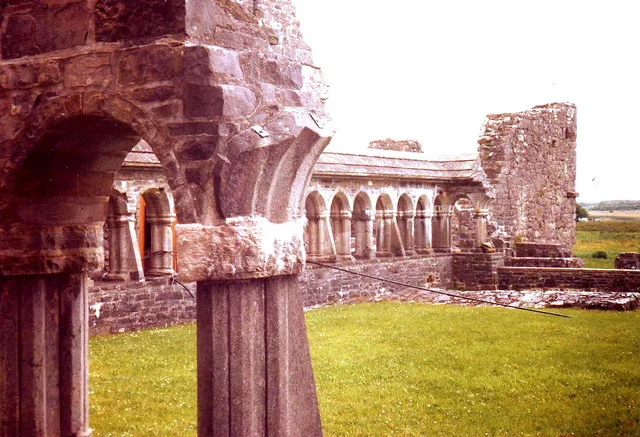

Ballintubber
Most Irish abbeys are ruins. The roofs collapsed centuries ago, the cloisters opened to the rain, the altars overgrown with weeds. Ballintubber is different. The Mass that began here in 1216 has never stopped. Through eight centuries of conquest, dissolution, and persecution, through Cromwell's soldiers and the bounty hunters who tracked priests across these bogs for a price on their heads, the rite has continued. Cathal Crobhdearg, the King of Connacht, founded this church in the same year King John of England signed the Magna Carta. Both events happened in 1216. Only one is still in daily use.
The King Who Built a Promise
Cathal Crobhdearg Ua Conchobair was not a man with time to spare on monuments. He was Chief of the Name of Clan O'Conor and the last great native King of Connacht, fighting a losing war against the Normans pushing west across Ireland. But in 1216, he commissioned this abbey at Ballintubber, on a site where Saint Patrick himself was said to have founded a church after 461 AD. The location mattered. Pilgrims had been coming this way for centuries before Christianity, walking east-to-west on the old druidic road to Croagh Patrick. Cathal built his abbey on that ancient route, the same route Patrick had used when he came to Christianize the west. The king died eight years later. The abbey kept going.
Surviving the Unthinkable
Henry VIII dissolved the Irish monasteries in 1542. Cromwell's troops burned the roof off Ballintubber Abbey in 1653. The Penal Laws of the early 1700s made it a crime for priests to celebrate Mass. None of it stopped what was happening here. Local Catholics simply kept coming, kept praying, kept burying their dead in the abbey grounds while bishops were exiled and priests went on the run. They worshipped under the open sky where the roof had been. They hid the chalice, then brought it back out. For nearly three hundred years, the abbey at Ballintubber was technically illegal and continuously in use, which is exactly the contradiction that defines so much of Irish history.
The Priest Hunter from Home
Among Ballintubber's notable people, alongside footballers and politicians, sits one of the most chilling names in Mayo memory: Seán na Sagart, the priest hunter. Born here in the same parish that protected its illegal abbey, he turned bounty hunter under the Penal Laws, tracking and capturing the very priests his neighbors were trying to hide. He was eventually killed in 1726, ambushed by men whose families he had betrayed. That a village this small produced both the abbey that defied the Penal Laws and the man who profited from them tells you something about how those laws worked: they did not just persecute Catholics from outside. They turned communities against themselves, set neighbor on neighbor, and made survival a daily moral negotiation.
Tochar Phadraig
The old pilgrim road from Ballintubber to the summit of Croagh Patrick is called the Tochar Phadraig, the Causeway of Patrick. It runs roughly thirty kilometres west, crossing bogs, rivers, and the lower slopes of the Partry Mountains, ending at the base of the reek itself. Pilgrims have walked it for over fifteen hundred years. On Reek Sunday in late July, some still set out from Ballintubber before dawn, many of them barefoot, to climb the holy mountain at its end. The path is older than the abbey, older than Christianity in Ireland, older than written history here. It was a route to a sacred place long before anyone bothered to record why. The abbey simply sits at one end of it, the way it has since 1216, marking the start of a pilgrimage that nobody ever quite finished.
What Endures
Ballintubber is a small village. There are no grand visitor centres, no audio guides, no scheduled tours that fill every hour of the day. The Partry Mountains rise gently to the south, dark with bog and heather. The abbey sits in the middle of the village, the roof restored in the 1960s, the medieval stonework patched and re-patched across the centuries. Church records here only commenced formally in 1839, kept now at the South Mayo Family Research Centre in Ballinrobe. The records are a fraction of the story. Most of what has happened at this abbey was never written down, just done, week after week, century after century, by people whose names are gone.
From the Air
Ballintubber sits at 53.73°N, 9.30°W in central County Mayo, just south of Castlebar and east of Westport. The Partry Mountains rise to the south, and Lough Mask lies a short distance further south. Best viewed from 3,000-5,000 ft AGL on approach from the southeast. Ireland West Airport Knock (EIKN) is approximately 35 nm east-northeast; Galway (EICM) is roughly 50 nm south. The abbey is the obvious landmark in the village.
Nearby Stories
- Toombeola 1.6 km away
- Aughnanure Castle 3.7 km away
- Inishbiggle 5.2 km away
- Uggool Beach 7.4 km away
- Ballyhaunis 7.4 km away
- Crossmolina 15 km away
- Ballymote Castle 22 km away
- Ahascragh 31 km away