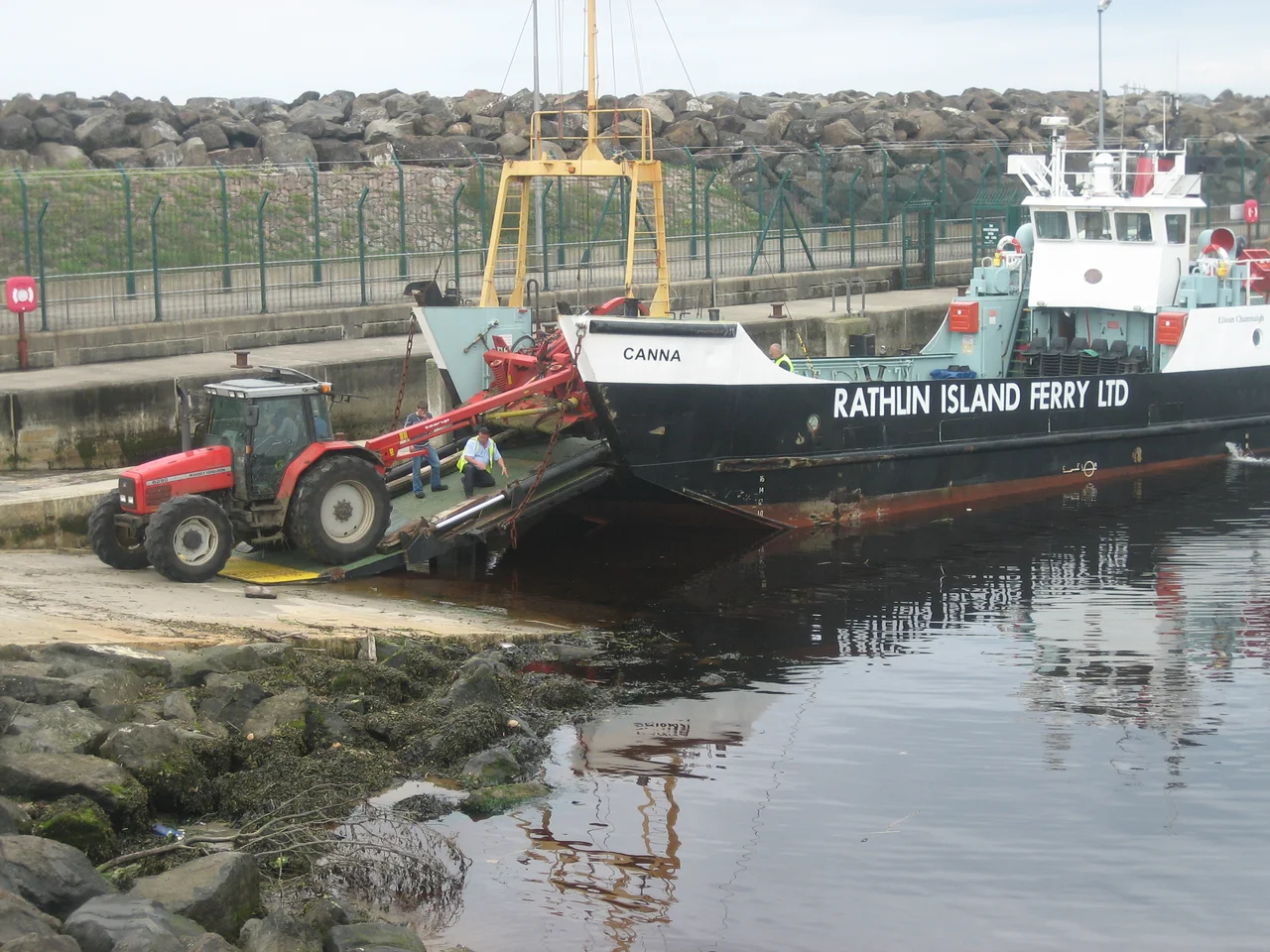

Ballycastle, County Antrim
In 1898, a 24-year-old Italian inventor named Guglielmo Marconi sent a wireless signal from a temporary station in Ballycastle to the East Lighthouse on Rathlin Island, six miles offshore. It was the world's first commercial wireless telegraph transmission, paid for by Lloyd's of London to relay sightings of approaching ships. The aerial mast that made it possible was the new octagonal spire on the Catholic church on Moyle Road. A grey stone monument by the harbour now marks where Marconi stood. Local people still tell visitors that their town was the place radio became a business.
From Three Settlements to One Town
Modern Ballycastle is really three older places knitted together: the settlement around Dunaneeny Castle on the cliffs to the north, the small village that grew up at Bonamargy Friary east of the river, and the medieval castle and its dependents at the spot where The Diamond now stands. The town's name comes from the central castle, Ballycastle Castle, which stood where Holy Trinity Church now sits in The Diamond. It had passed in turn through MacDonnell hands, Scottish hands during the wars of the 1640s, Cromwellian troops, and finally into disrepair. The last fragments of its walls were taken down in the nineteenth century. Today, the centre of The Diamond is Grade A listed and Holy Trinity Church - built by Colonel Hugh Boyd at his own expense in 1756 in a Greek-Italian style with a 100-foot octagonal spire - is the architectural anchor of the town.
Sorley Boy's Country
From the late fourteenth century the area was at the heart of MacDonnell territory in Ireland. The clan's claim to the Glens of Antrim ran back to the 1399 marriage of John Mor MacDonald to the Bisset heiress Margery Bysset. It was Sorley Boy MacDonnell, born around 1505 at Dunaneeny Castle on the cliffs above Ballycastle Bay, who consolidated the family's hold on both the Glens and the western district called the Route. Sorley Boy survived the catastrophic defeat at Glentaisie in 1565 just outside town, spent twenty years rebuilding MacDonnell power, and finally won official recognition of his claim to Ballycastle and the Route in 1586. He lies in a locked vault at Bonamargy Friary on the eastern edge of town, alongside several later Earls of Antrim. The MacDonnells did not leave. They simply moved their seat south to Glenarm and let Ballycastle become a working port.
Lammas and Yellowman
Every year on the last Monday and Tuesday of August, around sixty thousand people pour into a town of fewer than six thousand for the Ould Lammas Fair, one of the oldest surviving fairs in Ireland. The name comes from Lammas, the medieval church harvest festival of loaf-mass on 1 August. The fair began as a working sheep and cattle market and has slowly evolved into a giant street festival of market stalls, busking, food, and music. Two traditional foods still dominate. Dulse is dried red seaweed, salty and chewy, sold in paper twists. Yellowman is a tangy honeycomb toffee made by mixing baking soda with vinegar to froth the sugar, then bashed into irregular lumps with a hammer. An old ballad, still sung at every fair, asks: 'Were you ever at the fair, were you ever ever there, were you ever at the fair in Ballycastle-oh?' If you have not, the question is rhetorical.
The Beach, the Strand, the Birds
The town's beach, the Strand, stretches half a mile east of the river mouth and has long been a Blue Flag beach. At its eastern end, Pans Rocks jut into the sea, the remains of an 18th- and 19th-century iron salt-pan industry that boiled seawater for the crystal trade. Just beyond them sits the Devil's Churn, a small natural sea-cave with steps cut down into the rock and a barrier so seawater trickled in gently for sediment to settle - it may have been used as a Victorian therapeutic dunking pool for the nearby fever hospital. Behind the Strand stands a sculpture of the Children of Lir, the four siblings of Irish myth who were transformed into swans and condemned to spend three hundred years on the Sea of Moyle, the same stretch of water that washes Ballycastle Beach. On a stormy afternoon it is not hard to imagine them out there.
The Troubles Touched Here Too
Ballycastle, like most Northern Irish towns, did not escape the Troubles. On 26 August 1973, loyalist paramilitaries left a car bomb timed to detonate as the congregation of St Patrick's and St Brigid's church on Moyle Road left mass. The service ran late and the bomb exploded inside the parked street, injuring fifty people, three seriously, but causing no deaths because the worshippers were still inside the building. In June 1979 the IRA bombed five seaside hotels including Ballycastle's Marine Hotel; a 65-year-old guest, William Whitten, was seriously injured and died three weeks later. In 1991 an off-duty RUC sergeant named Spence McGarry, aged 46, was killed when a booby trap bomb attached to his car exploded in Castle Street car park. These are not abstract numbers. They are the names a small town carries with it, woven into its memory alongside everything else.
An Astonishing Cast of Sons and Daughters
For a town this size, Ballycastle has produced a remarkable list of people who went on to matter. Sir Roger Casement, the human rights crusader and Irish Republican executed by the British in 1916, was born in Dublin but raised by his Ballycastle father's family. Robert Quigg, a soldier from Bushmills who lived in the area, won the Victoria Cross at the Somme. Helen Megaw, born in 1907, became one of the great crystallographers of the twentieth century and her work on perovskite minerals shaped modern materials science. Keith Cardinal O'Brien served as Archbishop of St Andrews and Edinburgh and effectively led the Catholic Church in Scotland from 2001 until his resignation in 2013. Conleth Hill, the Game of Thrones actor who played Varys, was born here in 1964. And David McWilliams, the folksinger whose 'Days of Pearly Spencer' became an unlikely hit in the 1960s, came from Ballycastle too. Marconi started here. He was not the only one.
From the Air
Ballycastle sits at 55.201 N, 6.251 W, on the north coast of County Antrim where the Sea of Moyle meets the Atlantic. Best viewed from 2,000 to 4,000 feet. From above, look for Ballycastle Bay opening to the north, Knocklayde Mountain rising directly south of the town, Glentaisie and Glenshesk cutting inland to the southwest and south, Fair Head jutting out east, and Rathlin Island sitting six miles offshore. The Mull of Kintyre is clearly visible to the northeast on most days, just 13 nautical miles across the North Channel. Nearest airports: City of Derry (EGAE) about 30 nm west-southwest, Belfast International (EGAA) about 40 nm south. Prestwick (EGPK) on the Scottish coast is about 50 nm northeast.
Nearby Stories
- Dunyvaig Castle 9.8 km away
- North West 200 10 km away
- Glenarm Castle 14 km away
- County Londonderry 16 km away
- Campbeltown 16 km away
- Isle of Arran 25 km away
- Beaufort's Dyke 29 km away
- German submarine U-155 (1941) 61 km away