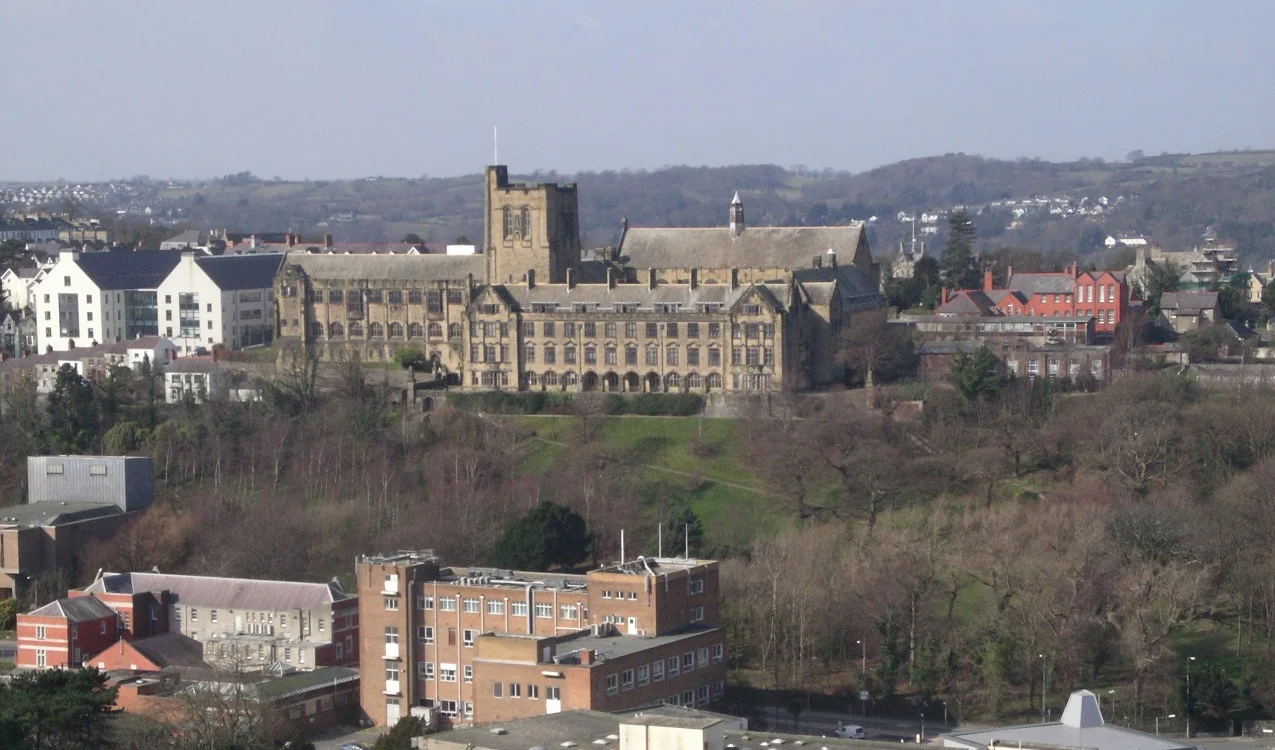

Bangor University
When the University College of North Wales opened its doors in October 1884, much of the start-up money had come from working people - the quarrymen of Penrhyn and Dinorwig, the slate dressers, the smallholders, the chapel ministers, who had given a penny here, a shilling there, to put their language and their children into a university for the first time. The college had no permanent building. It rented the disused Penrhyn Arms Hotel and held its first classes there. Fifty-eight students enrolled. Henry Reichel, a young Anglo-Irish scholar with a degree from Oxford, became the first Principal and stayed for forty-three years. From those origins, Bangor University grew into one of the most distinctive academic institutions in the British Isles.
The First Welsh Chair
Bangor's most distinctive contribution to Welsh life came in 1894, when the university established the first chair in the Welsh language at any university anywhere. Sir John Morris-Jones, scholar, poet and grammarian, was its first holder. Before this, Welsh had been spoken by perhaps a million people but had no formal academic standing. Morris-Jones changed that. His 1913 Welsh Grammar became the foundational text of the language's modern study, and he trained the generation of scholars who would carry Welsh into the twentieth century as a properly described, properly documented academic subject. In 1920 a second chair, in Welsh literature, was established for Ifor Williams. The Welsh-language hall of residence, Neuadd John Morris-Jones, was founded in 1974 and remains a focal point of Welsh-language student life today, alongside its sister hall Neuadd Pantycelyn in Aberystwyth.
Two Mountaineers and a Nobel Laureate
Bangor's third Principal, Charles Evans, was a mountaineer who had served as deputy leader of the 1953 Everest expedition - he and Tom Bourdillon reached within 300 feet of the summit two days before Hillary and Tenzing succeeded. Evans came to Bangor in 1958 and led the college for twenty-six years, during which it grew dramatically. Among the university's other notable graduates, Robert G. Edwards won the 2010 Nobel Prize in Physiology or Medicine for his pioneering work on in vitro fertilisation. Tom Parry Jones developed the first hand-held electronic breathalyser. Stefan Rahmstorf, Professor of Physics of the Oceans at Potsdam University, became one of the world's leading climate scientists. Robert Edwards, Tom Parry Jones, and Charles Evans were all formed by the same modest Welsh college that began life in a converted hotel.
Poets, Politicians, and Bridget Jones
The arts have done at least as well. R. S. Thomas - poet, Anglican priest, and one of the great twentieth-century poets in the English language - studied at Bangor. So did Kate Roberts, often called the Welsh Chekhov for her short stories of Welsh quarrying communities. Gwyn Thomas, the National Poet of Wales, taught Welsh literature there. Among more recent graduates, Danny Boyle, who would later direct Trainspotting, Slumdog Millionaire and the 2012 London Olympics opening ceremony, took English and drama at Bangor. Hamza Yassin, the wildlife cameraman and TV presenter, studied zoology with conservation. Mmusi Maimane, who led South Africa's official opposition Democratic Alliance, studied here. Even Bridget Jones, the fictional everywoman of Helen Fielding's 1996 novel, supposedly attended Bangor - the only fictional alumna who became a literary brand.
The Ffriddoedd Village
Walk west from the city centre and the campus thickens into halls of residence. The Ffriddoedd Village in Upper Bangor takes its name from the Welsh word ffridd, meaning mountain pasture or sheep path; the village currently houses about 2,000 students. Eleven en-suite halls completed in 2009 stand alongside earlier ones from the 1990s, all named after Welsh lakes, rivers and mountains: Cefn y Coed, Glyder, Elidir, Idwal, Llanddwyn, Glaslyn. Neuadd Reichel, the oldest, was built in the 1940s and named for Sir Harry Reichel, that long-serving first Principal. A separate St Mary's Village on Bryn Eithin overlooks the city centre. The Pontio Arts and Innovation Centre, which opened in 2015 after a delayed construction, houses the students' union, a theatre and a cinema, and is the public face of the university to the city around it.
A Gold-Rated University
In 2017 Bangor became the only university in Wales to be rated Gold by the UK government's Teaching Excellence Framework, a designation reserved for institutions providing consistently outstanding teaching, learning and outcomes. In the National Student Survey, the university's students placed it eighth among the UK's non-specialist universities in 2017 - second among Welsh universities. The 2018 WhatUni Student Choice Awards named Bangor Best University in the UK for Clubs and Societies for the second year running, and gave it the award for Best Student Accommodation, which it had originally won in 2016. A small Welsh university founded in a hotel by quarrymen's pennies has, in the 140 years since, made itself a place where Welsh language scholarship, Nobel laureate science, Olympic-ceremony cinema and fictional everywomen all coexist. Bangor is more than its size suggests.
From the Air
Bangor University's main campus stands at 53.229 degrees north, 4.130 degrees west, on a low ridge above the Menai Strait in the centre of Bangor. The Main Arts building and clock tower are visible from the air. Nearest airports: RAF Valley (EGOV) 16 nm west on Anglesey, Caernarfon (EGCK) 6 nm southwest. The Menai Suspension Bridge crosses the Strait immediately to the west of the campus.
Nearby Stories
- Tudweiliog 3.6 km away
- Denbigh Castle and Town Walls 6.4 km away
- Rhoscolyn Lifeboat Station 7.6 km away
- Butlin's Pwllheli 20 km away
- East–West Interconnector 20 km away
- New Brighton Lifeboat Station 31 km away
- Battle of Oswestry 31 km away
- Celtic Array 44 km away