
Bangor
Bangor is the kind of city that surprises visitors who arrive expecting something bigger. With 15,000 residents, it is among the smallest cities in the United Kingdom, and yet it has a Norman cathedral founded in the sixth century, a Victorian university with a Nobel laureate among its graduates, the longest pier in Wales, the longest High Street in Wales, and a position on the railway line that carries travellers from London to the Holyhead ferry for Dublin. The city sits along the Menai Strait, a sliver of green water that separates the mainland from the Isle of Anglesey, and it has been a crossing point for at least 1,500 years.
Watching the Sun Go Down Over the Strait
The Menai Strait at sunset is Bangor's most famous view. From the top of Garth Pier - that 1,500-foot Victorian promenade pier reaching out from the north shore - the water turns gold and the silhouettes of Thomas Telford's Menai Suspension Bridge and Robert Stephenson's Britannia Bridge stand out against the western sky. Telford's bridge, completed in 1826, was the first major suspension bridge in the world; Stephenson's, completed in 1850, carries the railway across in a parallel line. Both still serve their original purpose. The Strait itself is a fast-flowing tidal channel famous among sailors for the Swellies, a stretch of swirling currents and rocks between the two bridges that demands precise timing on a strong tide.
The Cathedral on the Hill
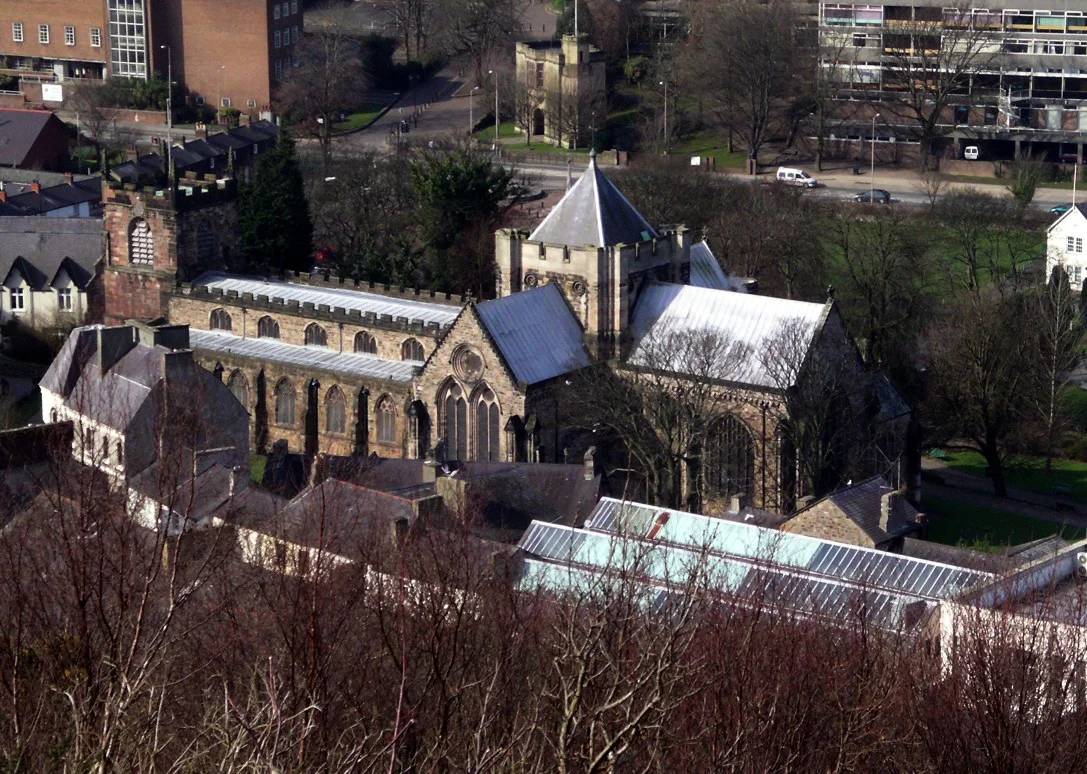
Bangor Cathedral - dedicated to Saint Deiniol, the Welsh missionary who founded the original monastic community here around 525 AD - is one of the oldest cathedral sites in Britain. The present building is mostly twelfth-century, with later additions and a sympathetic Victorian restoration. It sits in a sloping oval churchyard at the foot of the High Street, the focal point of a town that grew up around it. The bishopric of Bangor is one of the oldest in the United Kingdom; the diocese covers most of northwest Wales. Inside, the cathedral is intimate rather than grand. Visitors can attend choral evensong on most weekdays during term - the choristers carry on a tradition stretching back, with breaks, more than a millennium.
Eating in Welsh
The city's restaurants reflect both its Welsh character and its student population. Welsh lamb and beef appear on every traditional menu - the upland pasture above the city has been raising sheep for at least five thousand years. The local seafood is excellent: salmon and brown trout from the rivers, white crab and lobster from the rocks of the Menai Strait and the Anglesey coast just across the water. Organic fruit and vegetable producers in the hinterland supply the better cafes. The High Street, the longest in Wales at 1.265 kilometres, holds most of the eating options - mid-priced bistros, student-friendly cafes, and a handful of more ambitious restaurants making a serious attempt at modern Welsh cuisine.
Going Onward
Bangor's geography makes it a natural base. Buses run southeast into Llanberis, on the shore of Llyn Padarn at the foot of Snowdon, where the Snowdon Mountain Railway begins its hour-long climb to the summit. The whole of Snowdonia opens up from there. To the east, the A55 along the north coast runs to Conwy with its Edwardian castle, and on to Chester. To the west, the Menai Bridges give onto the Isle of Anglesey: Beaumaris with its thirteenth-century castle, the Anglesey Sea Zoo, the butterfly palace at Pili Palas, and the village famous chiefly for having Britain's longest place name - Llanfairpwllgwyngyllgogerychwyrndrobwllllantysiliogogogoch, fifty-eight letters long, mercifully shortened in conversation to Llanfairpwllgwyngyll, or just Llanfair PG. Further west still, Holyhead sits at the end of the line, with two daily ferries to Dublin.
A City That Wears Its Past Lightly
Bangor does not announce itself. Visitors arriving by train notice the cathedral on its hill and the university buildings climbing the slope behind the High Street, and the city itself feels more like a large town. The trick is to give it a few days. Walk the length of the High Street, climb Bangor Mountain for the view over the Strait to Anglesey, drink at the Belle Vue or one of the cathedral-quarter pubs, take the train one stop west onto Anglesey at Llanfairpwllgwyngyll, ride the bus south into Snowdonia. Bangor will turn out to be both smaller and richer than first impressions suggest - a Welsh city that has been doing this for fifteen centuries and still has the energy to surprise people who thought they understood it.
From the Air
Bangor sits at 53.228 degrees north, 4.135 degrees west, on the north coast of Wales above the Menai Strait. Two distinctive bridges - the Menai Suspension Bridge and the Britannia Bridge - cross the Strait to Anglesey immediately west of the city. Garth Pier extends 1,500 ft north into the Strait. Nearest airports: RAF Valley (EGOV) 16 nm west on Anglesey, Caernarfon (EGCK) 6 nm southwest, Hawarden (EGNR) 41 nm east. The Holyhead-Dublin ferry route passes north up the Menai Strait.
Nearby Stories
- Tudweiliog 3.6 km away
- Denbigh Castle and Town Walls 6.4 km away
- Rhoscolyn Lifeboat Station 7.6 km away
- Butlin's Pwllheli 20 km away
- East–West Interconnector 20 km away
- New Brighton Lifeboat Station 31 km away
- Battle of Oswestry 31 km away
- Celtic Array 44 km away