_-_img_04.jpg)
Báo Quốc Temple
A spring rises near the top of a small hill on the southern bank of the Perfume River, just a kilometer west of Huế's old city center. It flows down through the grounds of a temple that has occupied this hill for more than three and a half centuries. Báo Quốc Temple — the name means "Protect the Nation" — was founded in 1670 by a Chinese Buddhist monk named Thích Giác Phong, a teacher in the Thiền tradition who had come to central Vietnam during the era of the Nguyễn lords. It began as one monastery among many. Over the following decades, emperors would visit it, name it, rename it, celebrate birthdays within its walls, and fund its reconstruction. By the time of the Nguyễn dynasty, Báo Quốc was one of only three temples in Huế granted the status of national temple. The designation was more than honorific. It placed the temple inside the spiritual architecture of the empire itself.
Three Centuries of Names
Báo Quốc has been renamed so many times that its history is partly a history of Vietnamese naming conventions. Thích Giác Phong called it Hàm Long Sơn Thiên Thọ Tự when he founded it — a name that referenced the hill it sits on, Hàm Long (Dragon's Jaw). In 1747, the Nguyễn lord Nguyễn Phúc Khoát gave the temple an imperial plaque inscribed with the name Sắc Tứ Báo Quốc Tự. When Emperor Gia Long's wife, Empress Hiếu Khương, patronized a major reconstruction in 1808 — commissioning a triple gate, a large bell, and a gong — the temple's name changed again to Chùa Thiên Thọ. Then in 1824, Emperor Minh Mạng came to visit and restored the name Báo Quốc, the one that has stuck. Six years later, in 1830, Minh Mạng held his own 40th birthday celebration here. For a brief moment, this hillside monastery became the ceremonial center of the Nguyễn court.
The Architecture of Devotion
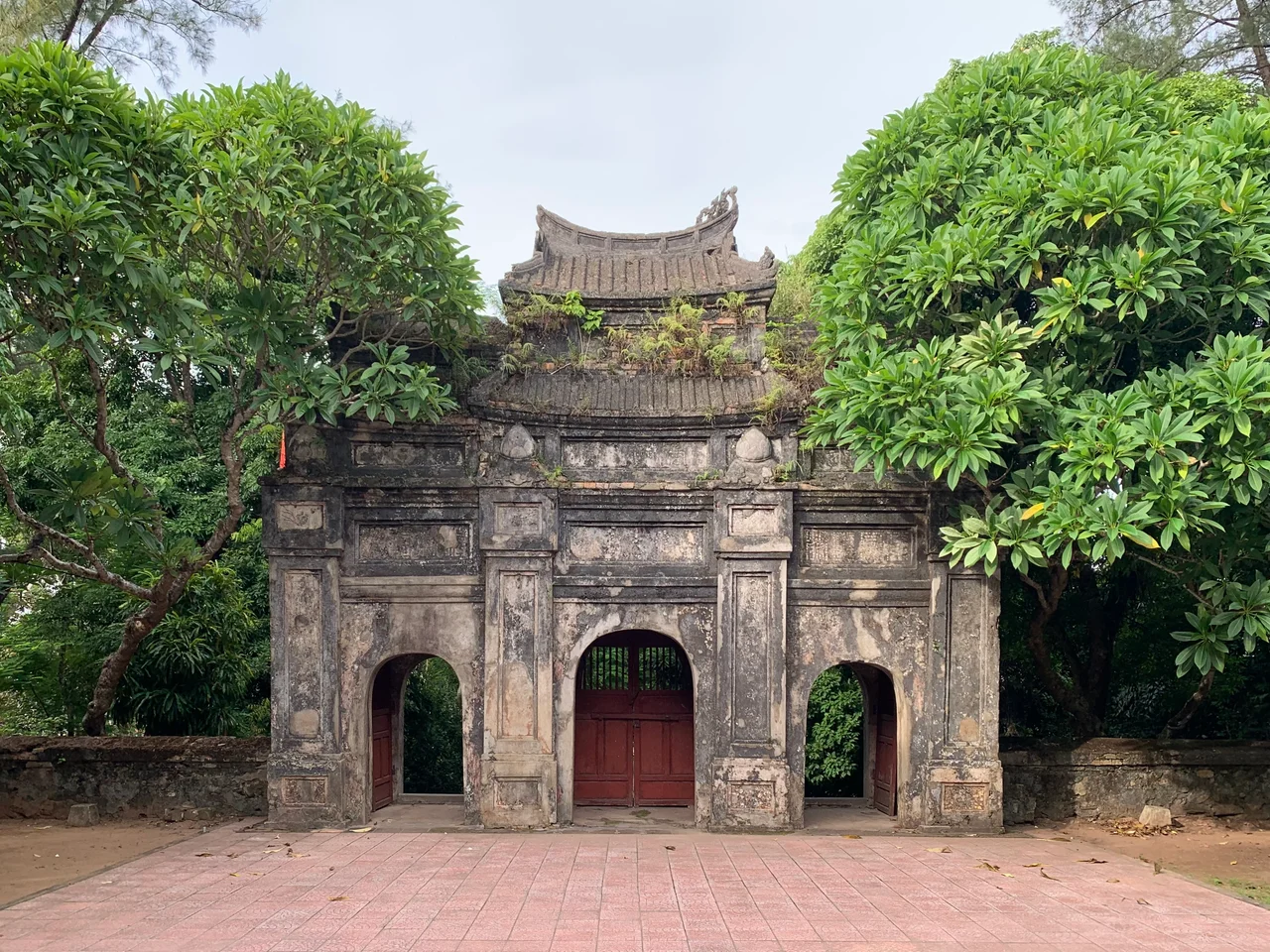
The temple occupies two hectares on Hàm Long hill, entered through a triple gate — the tam quan — that frames a spacious courtyard filled with plant life. On the left as you enter, a row of stupas honors Buddhist patriarchs; the oldest, dedicated to the temple's founder Thích Giác Phong, was built in 1714 and stands 3.30 meters tall. The main temple building rests on four pillars with dragon figures carved onto them. Inside, the largest statue is a triple representation of the Buddha flanked by two sets of Mahayana sutras. In front of this statue, a small stupa holds relics believed to be those of Gautama Buddha himself. Another altar presents the Buddha attended by Ananda and Mahakassapa — his personal attendant and the first patriarch of Buddhism after his death. A third altar houses a copy of the Lotus Sutra, with a ceremonial bell and a wooden fish gong standing on either side. The spring that flows from the hilltop runs through the grounds, giving the place a sound track of moving water beneath the incense smoke.
Revival and Education
In the 1930s, Báo Quốc became a center of something larger than a single temple's renewal: a revival of Buddhist education across Vietnam. A school for teaching Buddhism opened here in 1935. In 1940, the temple added a monastery for training monks — an institution that has operated continuously ever since, which means it survived the French war, survived the American war, survived reunification, survived the decades of state suspicion toward organized religion. By 1957, the monk Thích Trí Thủ, who would become one of the most influential Buddhist leaders in twentieth-century Vietnam, oversaw a major phase of reconstruction. Within the temple grounds, the Ham Long Primary School opened in 1959, eventually expanding to secondary education in the early 1960s. The school was renamed Trường Bồ Đề Hàm Long — Ham Long Bodhi School — and operated until 1975, when the change of government brought its closure. The monastery, however, continued.
The Temple Today
Báo Quốc sits in a part of Huế that most tourists do not reach on their first visit. The city's main draws — the Imperial Citadel, the royal tombs, the Thiên Mụ Pagoda upstream on the Perfume River — pull visitors in other directions. But the temple on Hàm Long hill rewards the detour. Its courtyard is quieter than the major tourist sites, its stupas weathered to a texture that speaks of time rather than renovation. The monk training program established in 1940 means that novice monks are a common presence in the grounds — young men learning the sutras in the same compound where Emperor Minh Mạng once celebrated his birthday. The Perfume River lies a short walk to the north, and the city beyond it. The spring still flows down from the hilltop. The bell Empress Hiếu Khương commissioned in 1808 is long gone, but the act of replacing it — casting metal into devotion — has happened more than once in this place's long history.
From the Air
Báo Quốc Temple is located at 16.4547°N, 107.5804°E on the southern bank of the Perfume River in Huế, approximately 1 km west of the city center. From the air, Huế is recognizable by the broad bend of the Perfume River and the rectangular moat of the Imperial Citadel on its northern bank. The temple itself sits on a small hill (Hàm Long) in the Phường Đúc ward south of the river — from altitude it blends into the city's urban fabric, but the river and citadel are unmistakable navigation references. Phu Bai International Airport (VVPB) is approximately 15 km to the south-southeast. Recommended viewing altitude 2,000–4,000 feet for the urban river context, with the Citadel visible to the northeast and the Thien Mu Pagoda's tower visible upstream to the west.
Nearby Stories
- Battle of Fire Support Base Ripcord 4 km away
- Sơn Trà Mountain 5.8 km away
- Quảng Trị Citadel 7.3 km away
- Battle of Nam Dong 10 km away
- Hội An wreck 56 km away
- Battle of Cua Viet 65 km away
- Saravan 100 km away
- Hainan Island Incident 342 km away