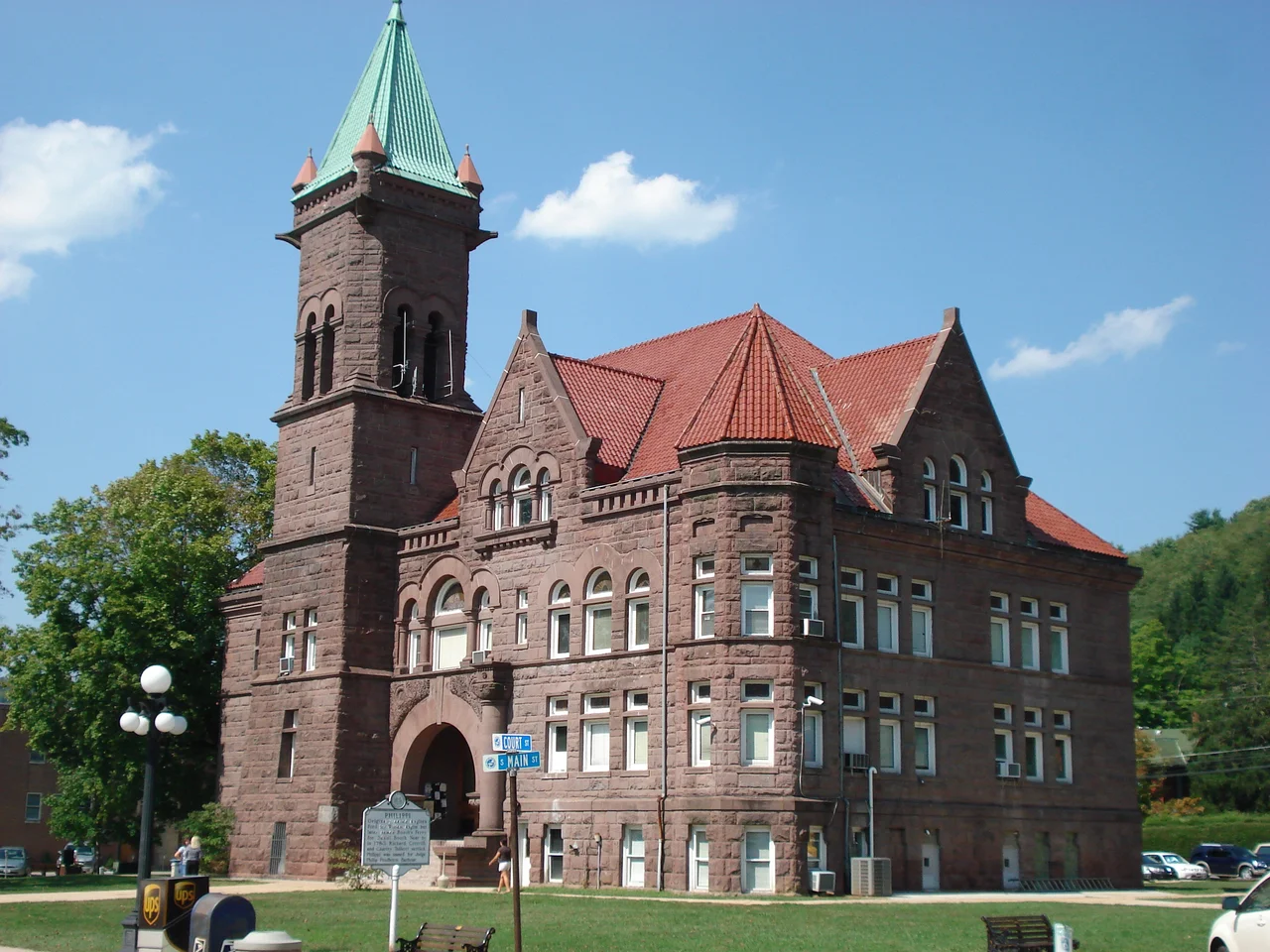

Barbour County, West Virginia
In 1990, private developers offered the citizens of Barbour County, West Virginia between four and six million dollars a year for the next three decades. The deal: accept up to 200,000 tons of out-of-state garbage every month into a county landfill. At the time, Barbour County's entire annual budget was about one million dollars. The voters said no. That decision tells you something important about this small Allegheny Plateau county along the Tygart Valley River: the population, about 15,465 at the 2020 census, has always been willing to forgo money on principle. It is also the kind of county where the Civil War's first land engagement was fought - and where Confederate soldiers, surprised by Union troops at dawn, ran for the hills in their nightclothes.
From Anglin's Ford to Philippi
The first white settlement in present-day Barbour County was made in 1780 by Richard Talbott, his brother Cotteral, and sister Charity - about three miles downriver from the future site of Philippi. The Talbotts left their homestead several times when conflicts with Native Americans threatened, retreating east of the Alleghenies and returning each time. No member of the family was ever killed. The county was formally created in 1843, named for Philip P. Barbour, a Virginia congressman, Speaker of the House, and US Supreme Court Justice. The settlement of Anglin's Ford - also known as Booth's Ferry - was platted, renamed Philippi, and made the county seat the same year. By the 1850s, when the Philippi Covered Bridge was built to serve the Beverly-Fairmont Turnpike, the population was approaching 10,000.
The Philippi Races
On June 3, 1861, two columns of Union forces under Colonels Benjamin Franklin Kelley and Ebenezer Dumont - about 3,000 men total - arrived from Grafton after marching all night through heavy rain. They attacked roughly 800 poorly armed Confederate recruits under Colonel George A. Porterfield. The surprise was complete. The Confederates fired a few shots, broke ranks, and ran south, some still in bed clothes. Newspapers called it the 'Philippi Races,' lampooning the panicked retreat. The skirmish caused few casualties but produced lasting consequences. Major General George B. McClellan got national attention from the victory and was soon given command of all Union armies. The battle also strengthened anti-secession sentiment in western Virginia, leading to the second Wheeling Convention eight days later and, eventually, to the creation of West Virginia. Philippi reenacts the battle every June at the 'Blue and Gray Reunion.'
The College on Battle Hill
For 114 years, from 1909 to 2023, Barbour County's largest employer and cultural anchor was Alderson-Broaddus, the Baptist college that became a university. It occupied Battle Hill above Philippi - the very high ground from which Confederate troops had fled in 1861. In 1968, the school pioneered the nation's first four-year physician assistant program, an innovation that shaped the PA profession across the country. In 2023, after years of mounting financial pressure, the university closed. The county lost its largest employer in a single summer. The campus stands largely intact above the river, waiting for whatever comes next. Whitescarver Hall, the school's oldest building from around 1911, remains on the National Register of Historic Places.
Tygart, Tributaries, and Coal
Most of Barbour County drains through the Tygart Valley River, which traverses the county from south to north and supports its three largest settlements: Philippi, Belington, and Junior. The Buckhannon River, the West Fork River, and various creeks feed in along the way. The west side of the county drains into the Middle Fork River, which carved Audra State Park's swimming holes and the Alum Cave sandstone overhang. Bituminous coal has been mined here for generations - seven times as much from underground as from surface operations. Natural gas, oil, lumber, livestock, dairy, and orchard fruits round out an economy that has always been diversified out of necessity rather than design.
Famous Sons and the Chestnut Ridge People
Barbour County's notable residents make a strange list. Ted Cassidy, born in Pittsburgh in 1932 and raised in Philippi, became Lurch and the disembodied Thing on the 1960s television series The Addams Family. Ann Maria Reeves Jarvis, who lived in the county for several years, co-founded Mother's Day with her daughter Anna Marie Jarvis. Hymn writer Ida Lilliard Reed, born in 1865, kept a homestead at Clemtown. The county is also home, especially in the eastern hills, to the Chestnut Ridge people - a community of mixed African, European, and Native American ancestry whose specific origins are uncertain. Scholars have categorized them among the Melungeons scattered across Appalachia. They are part of the county's quieter history, a reminder that the boundaries between communities in these mountains were never as fixed as census categories pretended.
From the Air
Located at 39.13 degrees north, 80.00 degrees west, in north-central West Virginia. The county covers 343 square miles. Best viewed from 5,000 to 7,500 feet AGL. The Tygart Valley River traverses the county south-to-north as a clear visual reference, with Philippi (county seat), Belington, and Junior strung along its banks. Laurel Mountain marks the eastern boundary. Nearest airports include North Central West Virginia (KCKB) at Clarksburg, Elkins-Randolph County (KEKN), and Grant County (KW99). Look for the Philippi Covered Bridge and Battle Hill above the town as recognizable landmarks.
Nearby Stories
- Weston and Gauley Bridge Turnpike 3.3 km away
- Canaan Valley 6.7 km away
- Spruce Knob-Seneca Rocks National Recreation Area 7.5 km away
- Tygart Valley Homesteads Historic District 10 km away
- Garrett County, Maryland 19 km away
- Salem University 20 km away
- Battle of Fort Necessity 59 km away
- West Virginia Penitentiary 64 km away