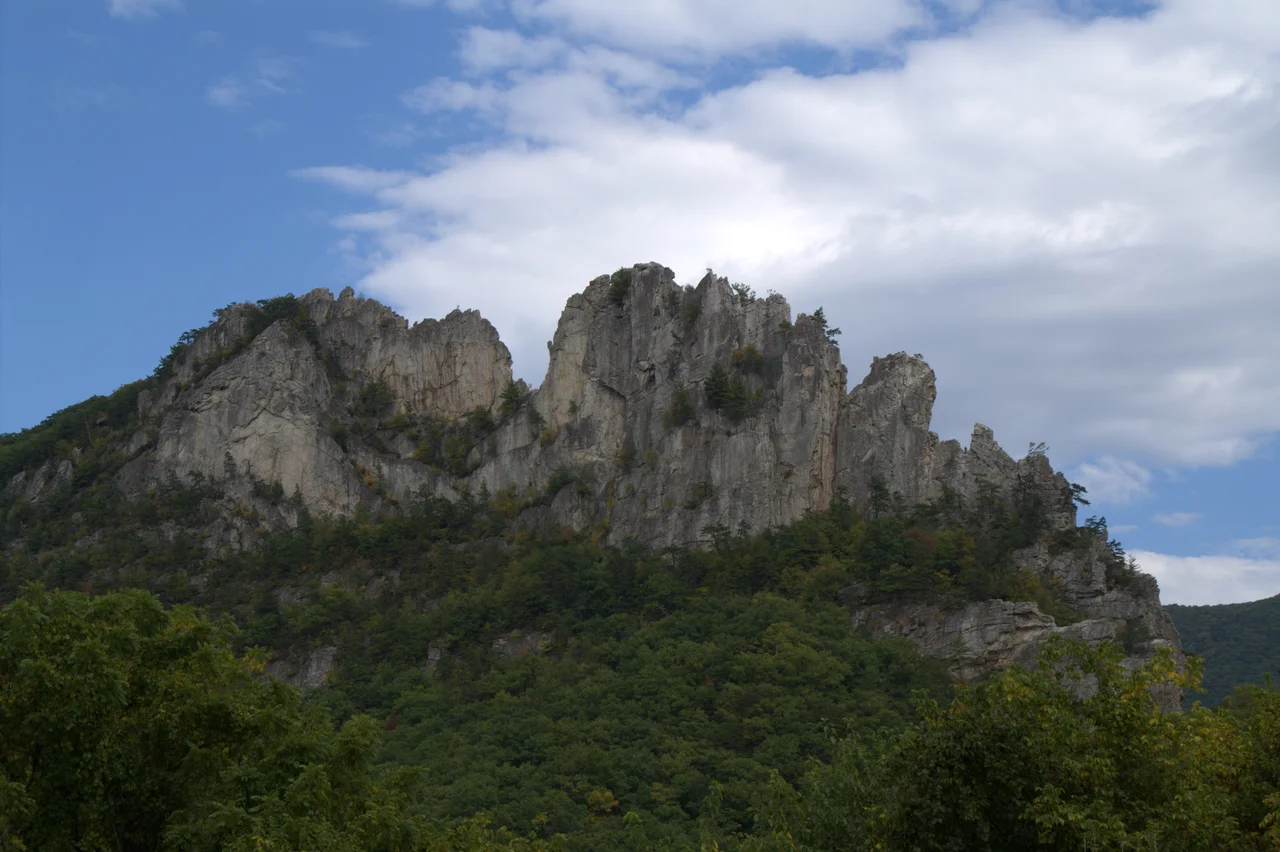

Spruce Knob-Seneca Rocks National Recreation Area
On September 28, 1965, the U.S. Congress did something it had not done before. It established a national recreation area inside an existing national forest. The new designation - Spruce Knob-Seneca Rocks National Recreation Area - was carved out of the Monongahela National Forest in eastern West Virginia, and it became the first national recreation area to be administered by the U.S. Forest Service rather than the National Park Service. The model was experimental. The land needed protecting in a way that did not fit either pure national-forest multiple-use management or pure national-park preservation. The three landmarks the new unit was built around - Spruce Knob, Seneca Rocks, and Smoke Hole Canyon - had drawn visitors for decades. The 1965 designation gave them their own administrative existence.
The Three Anchors
Spruce Knob is the highest point in West Virginia and in the entire Allegheny range, rising to 4,863 feet. The summit holds a stone-and-steel observation tower with 360-degree views of the surrounding country and a half-mile interpretive trail circling the knob. Seneca Rocks is a 900-foot Tuscarora quartzite crag rising abruptly from the North Fork South Branch valley - the most famous rock-climbing wall east of the Mississippi, with more than 375 mapped climbing routes. Smoke Hole Canyon is a deep gorge along the South Branch Potomac River, lined with cliffs and forested ridges, named for the mist that often hangs over the river in the morning. The three landmarks are distinct experiences - mountain summit, vertical wall, river canyon - that together capture the geological range of the central Alleghenies.
Why This Designation, Not Another
The 1965 establishment came at a moment when American conservation politics was working out how to protect heavily-visited landscapes that did not quite fit existing categories. The land was already federally owned and managed by the Forest Service. The summits and canyon were already popular. The Forest Service had broader mandates - timber, grazing, recreation, watershed protection - than the strict preservation mission of the National Park Service. National recreation area status, applied to a chunk of the Monongahela National Forest, allowed Congress to direct more emphasis toward recreation and less toward timber and other extractive uses without transferring the land to the Park Service. The model worked well enough that several other national recreation areas were later established inside national forests using the same template.
The Climbing School Legacy
Seneca Rocks was a U.S. Army training ground during World War II, when a detachment from Camp Hale, Colorado set up an assault-climbing school at the crag in 1943. Soldiers cycled through in two-week classes, learning rock scrambling, piton placement, rigging, and tension cable work. The Army's only low-altitude climbing school was here. After the war, civilian climbers picked up where the soldiers had left off. The quartzite is hard, the routes are exposed, and the climbing community has been documenting and adding routes for more than half a century. The route guides for Seneca Rocks are encyclopedic. The cliff has produced its share of accidents over the years, including fatal falls. The Monongahela National Forest visitor center at the base offers exhibits on the climbing history and the Army's wartime presence.
Smoke Hole and the South Branch
Smoke Hole Canyon, the third anchor, runs along the South Branch Potomac River where it cuts through Cave Mountain. The canyon got its name from the morning mist that hangs over the river - early visitors said it looked like smoke rising from the gorge. The area is accessible by a road that winds along the river through several miles of cliff-walled canyon. Trout fishing is excellent. A campground sits along the river. The whole canyon connects to the broader Smoke Hole geological story, which includes Smoke Hole Caverns just outside the recreation area's boundary, where commercial show-cave operations have introduced visitors to the local karst landscape for decades. The combination of summit, crag, and canyon makes the recreation area more topographically diverse than most single-purpose protected areas.
Fallout 76 and the Future
In 2018, the recreation area gained an unexpected new audience when Bethesda Softworks released Fallout 76, set in a post-apocalyptic West Virginia. The Spruce Knob-Seneca Rocks landscape appears in the game as one of the rendered regions, drawing video-game-aware visitors who would never otherwise have heard of the place. The land managers were briefly puzzled by the surge. Some have since adapted, leaning into the connection in interpretive materials. The recreation area today balances the older traditions - climbers, hikers, anglers, families on summer trips - with a newer kind of visitor who first encountered the landscape on a screen. The 4,863-foot summit holds the same view it has held since the observation tower was built. The 900-foot quartzite wall does not care who climbs it. The canyon mist still rises in the morning.
From the Air
Centered at 38.83 degrees north, 79.37 degrees west, in Pendleton and Grant counties, West Virginia. Best viewed from 6,000 to 9,000 feet AGL. Major features include Spruce Knob (4,863 feet, state high point) and Seneca Rocks (900-foot quartzite crag rising from the valley) - both clear visual landmarks. Smoke Hole Canyon cuts the South Branch Potomac through Cave Mountain. Nearest airports are Grant County (KW99), Elkins-Randolph County (KEKN), and Shenandoah Valley Regional (KSHD). Note: rapid mountain weather changes and orographic lift along the Allegheny Front make for variable conditions.
Nearby Stories
- Reddish Knob 4.9 km away
- Allegheny Front 5.8 km away
- Randolph County 6.1 km away
- Green Bank Observatory 7 km away
- Battle of New Market 13 km away
- Barbour County, West Virginia 21 km away
- Rapidan Camp 29 km away
- Willa Cather Birthplace 46 km away