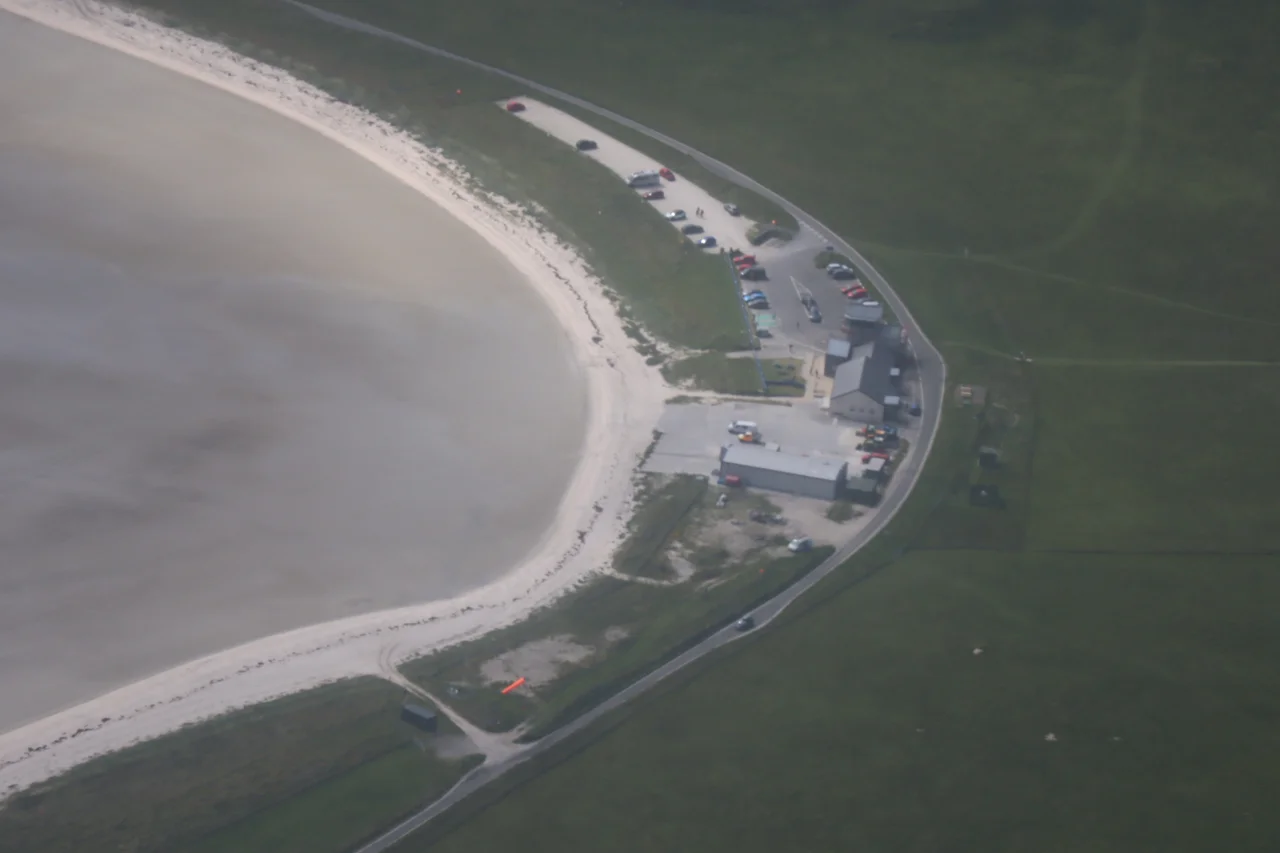

Barra Airport
The flight schedule depends on the tide. Twice a day the runways at Barra Airport are under the Atlantic Ocean, and twice a day they emerge as a wide, hard, wet shell beach called Traigh Mhor. This is the only airport in the world where scheduled passenger flights land on a tidal beach. The DHC-6 Twin Otter from Glasgow descends through Hebridean weather, lines up on three triangular runways marked only by wooden poles at their ends, and touches down on sand that the sea will reclaim within hours.
Tide and Runway
The bay of Traigh Mhor at the northern tip of Barra is shallow, wide, and floored with packed cockle sand. At low water it dries into a hard surface broad enough to fit three runways in a triangle, arranged for the three most useful wind directions: 07/25, 11/29, and 15/33. The triangle pattern means the Twin Otter aircraft can almost always land into the wind, whatever direction it is blowing from. The runways are marked at their ends by permanent wooden poles. There is no tarmac. There are no lights. Flight times shift each day to match the tide tables. Pilots check tide before they check weather.
The Twin Otter from Glasgow
Barra Airport opened in 1936, served first by a de Havilland Dragon biplane. Today Loganair operates the route with the venerable Twin Otter, a short-takeoff aircraft built to do exactly the kind of flying that Barra demands. The single scheduled destination is Glasgow, an hour and a quarter southeast. Highlands and Islands Airports Limited operates Barra along with most of the other regional airports in Scotland. The aerodrome holds a Civil Aviation Authority Ordinary Licence, number P792, which permits public-transport passenger flights. It is not licensed for night use, although emergency flights occasionally operate after dark with vehicle headlights and reflective strips on the beach.
No Security and a Cafe with a View
Since 2017, passengers departing from Barra have not been subject to security checks. The same applies at Campbeltown and Tiree, the only other airports in the United Kingdom with this arrangement. Passengers declare they are not carrying prohibited items, then walk to the aircraft. Connecting passengers go through security when they arrive at Glasgow. The terminal is small and unfussed. In 2024 the operator invested 1.5 million pounds in refurbishment, adding external wall insulation, paving, and decking, and modernising the cafe and lobby. The cafe is something of an institution. Visitors come not always to fly but to sit and watch the Twin Otter pirouette down onto a tidal beach.
Beach Airport, Bucket-List Stop
Aviation magazines regularly list Barra among the world's most spectacular airport approaches. The view from the right-hand seat on final, the white shell sand growing closer, the silver sea retreating to either side, has earned it a permanent place on aviation bucket lists. The job at the airport is unusual too. Staff must know the tide tables, the wind, and the precise condition of the sand on any given day. The BBC ran a story in 2023 calling it the dream job working on the beach. Glasgow is a fast flight south. The Outer Hebrides are immediately to the north and west. For passengers who walk down the boarding stairs and feel cockle shells under their feet, the journey is the destination.
From the Air
Barra Airport (EGPR) is located at 57.0236 N, 7.4417 W, in the wide shallow bay of Traigh Mhor at the northern tip of Barra. The three beach runways form a triangle on the white shell sand. The airport operates only at low tide. Recommended overflight altitude 1,500-3,000 ft for the unique beach-runway perspective. Caution: do not assume the airport is operational without checking; the runways flood twice daily. Nearest other airports: Benbecula (EGPL) approximately 47 nm north, Stornoway (EGPO) approximately 95 nm north, Tiree (EGPU) approximately 95 nm south. The scheduled service to Glasgow (EGPF) is operated by Loganair using DHC-6 Twin Otter aircraft.
Nearby Stories
- Our Lady of the Isles 13 km away
- German submarine U-722 14 km away
- Neist Point 20 km away
- Tiree 32 km away
- SS Polonia 46 km away
- St Kilda, Scotland 64 km away
- German submarine U-516 94 km away
- German submarine U-764 119 km away