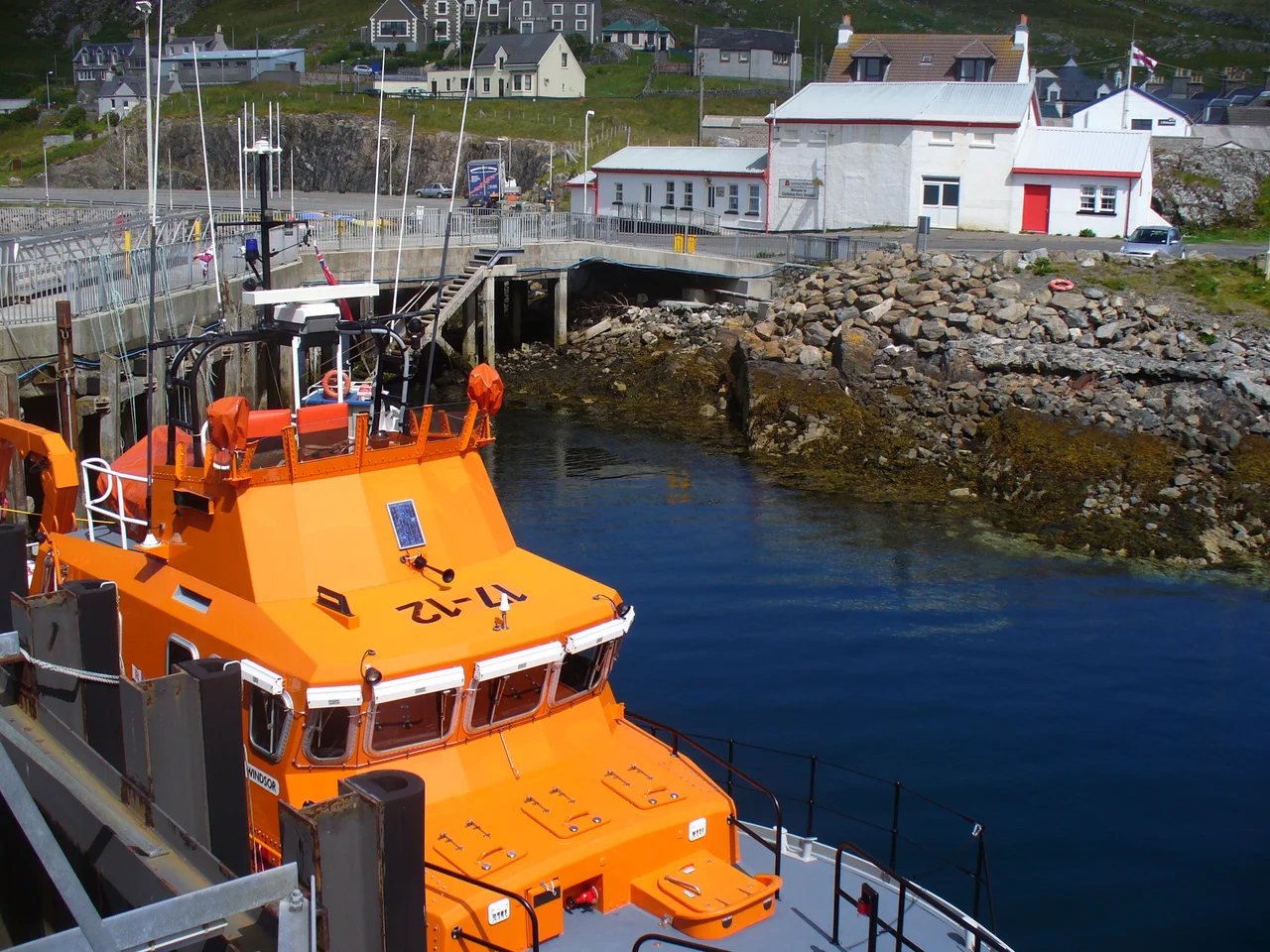

Barra Island Lifeboat Station
At 01:43 on a November night in 1979, the Islay lifeboat capsized in winds gusting to 65 knots. She self-righted. The crew, bruised but breathing, limped back through hurricane-force seas. Her companion vessel that night was the Barra Island lifeboat R. A. Colby Cubbon No.3, both racing toward a Danish coaster called Lone Dania, listing six miles northwest of Skerryvore Lighthouse with her cargo shifted. That a small Hebridean station could be summoned into a force-12 storm and come home is the entire reason Barra has a lifeboat in the first place.
A Station Born of Wrecks
For most of the nineteenth century, a single boat at Stornoway covered the entire Outer Hebrides chain. The arithmetic never quite worked. Wrecks accumulated in the south, lives were lost, and on 16 July 1931 the RNLI management committee finally voted to plant a station at the opposite end of the islands. Castlebay was the natural choice, sheltered under Kisimul Castle, with deep water and a sailing community already accustomed to bad weather. By September 1931 a former Tenby boat had been renamed 684 RM and tied up at the new pier. Six months later, on 31 March 1932, the station's own mechanic watched the steam trawler Eamont strike a submerged rock heading into the bay. The new lifeboat was launched, a crewman taken off injured, and the station's working life began before its first proper boat had even arrived.
Lloyd's, Cubbin, Edna Windsor
The boats came in a sequence that doubles as a social history of British maritime philanthropy. The 51-foot Lloyd's (1932) cost £9,443 and was named for the London insurance market that had funded twenty-six lifeboats as far back as 1802, helping seed the Institution itself. In 1957, R. A. Colby Cubbon No.3 arrived courtesy of a bequest from Mrs E. M. M. Gordon Cubbin of the Isle of Man, large enough to fund four boats simultaneously. Since 1998 the station has operated 17-12 Edna Windsor, a Severn-class all-weather lifeboat designed to survive exactly the kind of night the Lone Dania required. A new boat store rose in 1991, a Schat davit for the boarding boat in 1994, an alongside berth in 1998, and in 2023 the RNLI announced another round of upgrades.
The Urlana Service
Service histories rarely read like adventure novels. The 1943 Urlana call is one exception. At 9:00 on Sunday 5 September the relief boat Duke of Connaught launched for a 9,000-ton steamship aground at Idrigill Point, forty miles away on Skye, returning from Buenos Aires in convoy. By 14:15 the lifeboat reached the scene to find fifteen men still aboard the Urlana's motor-powered ship's boat, its engine just failed. The lifeboat managed to set up a tow before the boat was dashed on rocks. The fifteen men transferred safely to the nearby Thurland Castle. Conditions made the run home impossible, so the lifeboat fought engine problems all the way to Carbost on Loch Harport, finally crawling back into Castlebay at 16:00 on Tuesday 7 September. Coxswain Murdo Sinclair received the RNLI Silver Medal.
What the Station Stands For
The roll of honour at Castlebay is mercifully short: John McNeil, taken ill and died of pneumonia after a service call on 22 January 1942. That single line stands for an entire ethos. Barra is a small island, the southern end of a long, exposed archipelago that catches everything the North Atlantic generates. A handful of volunteers, on call in all weathers, have made the difference between a captain's mayday and a family's funeral for ninety-four years and counting. The station sits beside Kisimul Castle, in plain view of every ferry that arrives at Castlebay, a working argument for the proposition that small communities can do extraordinary things if you give them the right boat and trust them with it.
From the Air
Coordinates 56.9541N, 7.48709W. Visible from cruising altitude as a small building beside Castlebay's pier, with Kisimul Castle on a low islet in the bay. Recommended viewing altitude 2,000-3,000 ft for a clear look at the station, harbour, and the Severn-class lifeboat berthed alongside. Nearest airport is Barra (ICAO: EGPR), about 7 miles north, with its famous tidal beach runway at Traigh Mhor. Expect frequent Atlantic weather: low cloud, marine haze, and southwesterlies; visibility can collapse quickly off the western approaches.
Nearby Stories
- Our Lady of the Isles 13 km away
- German submarine U-722 14 km away
- Neist Point 20 km away
- Tiree 32 km away
- SS Polonia 46 km away
- St Kilda, Scotland 64 km away
- German submarine U-516 94 km away
- German submarine U-764 119 km away