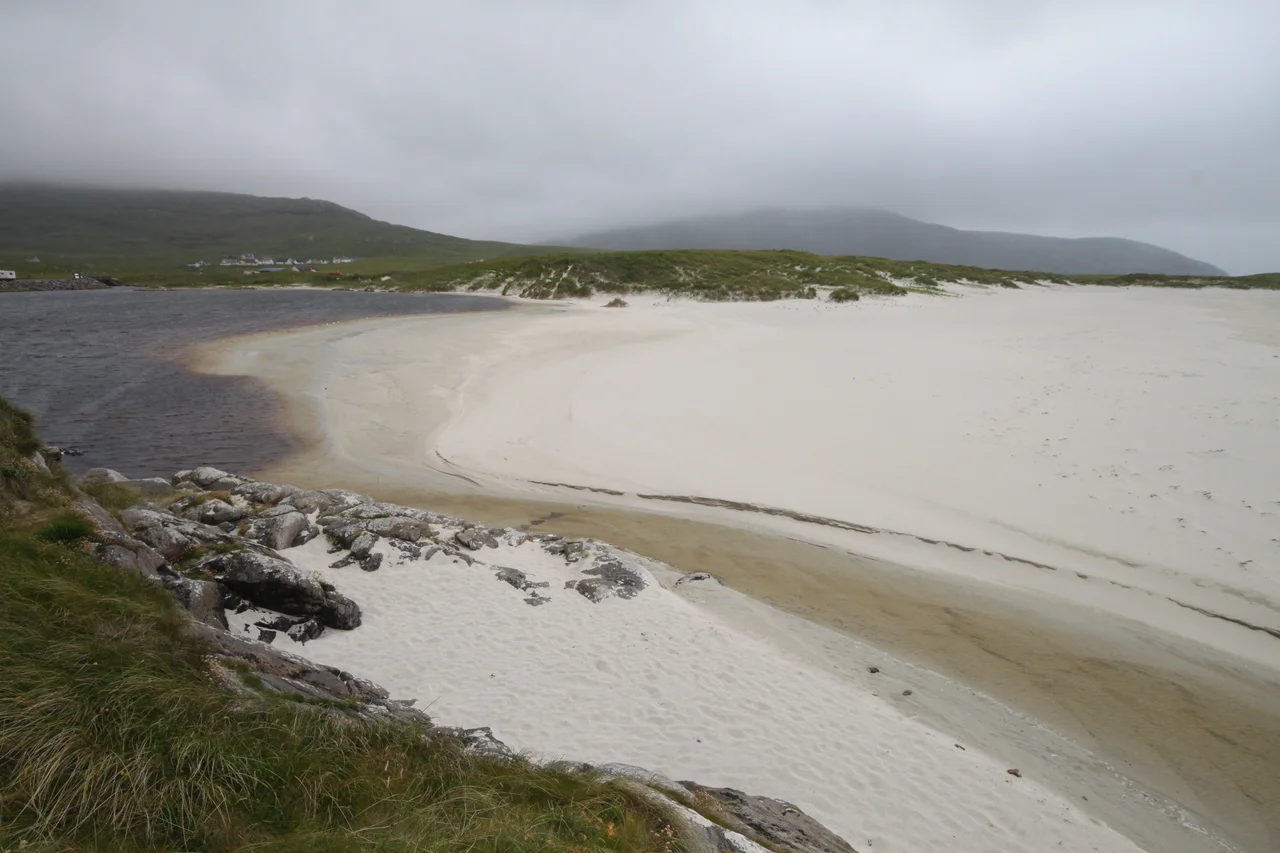

Barra
The whole island fits inside a thirteen-mile coastal road. Drive it once and you have circled Barra. Drive it slowly and you have crossed peat moor, white shell beaches, Iron Age duns, a Madonna-and-Child statue on a 1,257-foot hilltop, a Catholic church above a herring port, and a beach airport where the timetable bends to the tide rather than the other way around. Most Hebridean islands ask you to imagine the past. Barra just hands it over: a 2,500 BC pottery beaker turned up during road construction, and the MacNeil clan still gathers here every two years from a diaspora that reaches every continent.
Castlebay and the Castle in the Bay
Castlebay gets its name with the directness of a child describing what it sees. Kisimul Castle, the seat of Clan MacNeil, sits on a rock out in the bay, and the Gaelic ciosamul itself means castle island. The ferry pulls in beside the seat of a clan that became famous for piracy under Queen Elizabeth I, and whose chief once talked his way out of King James VI's wrath by arguing he had only been avenging the king's mother. Today's chief, an American by birth, leased the castle to Historic Scotland for a thousand years in exchange for £1 a year and a bottle of whisky. Above the village, Our Lady, Star of the Sea, opened in 1888 for the Catholic workforce that arrived with the herring boom, still holds Mass on Saturday and Sunday mornings.
The Beach That Lands Planes
At the north end of the island lies Traigh Mhor, the Great Beach, a vast expanse of compacted shell sand that doubles as Barra Airport's runway. Three runways, actually, marked with crosses, oriented for whichever direction the Atlantic wind happens to favour that morning. A siren sounds when an aircraft is on approach and the beach clears, which is helpful information if you are a tourist walking a dog. Scheduled flights to Glasgow land between tides, on hard wet sand washed twice a day by the sea. It is the only such operation in the world, and Condé Nast Traveller called Barra a delightful little island with its own castle and beach airport, which is succinct and accurate.
Walks, Wrecks, and Mingulay
Heaval rises 383 metres above Castlebay and the climb takes most people forty minutes. Two-thirds of the way up stands a marble Madonna and Child, erected during the Marian year of 1954, looking down on the ferry pier. From the summit you can sometimes see the hills of Ireland. South of Barra a chain of uninhabited islands runs to Mingulay, whose vast cliffs hold a tumult of seabirds; calm-weather boat trips sail out to it. The causeway to Vatersay, built in 1991, ends at a memorial to the Annie Jane, a ship from Liverpool taking emigrants to Quebec in 1853 and wrecked on Vatersay's beach with the loss of around 350 lives. The tombola here is the start of the Hebridean Way, which walks and pedals the whole archipelago up to Stornoway.
Gin, Toffee, and the Slow Return of Whisky
About 1,200 people live on Barra now; two-thirds speak Gaelic, and everyone speaks English. Tourism is the main income, with the high season running May to September, but the island also makes things. Isle of Barra Distillers in Castlebay produce gin, dark rum, and vodka, and they are building a second distillery to begin single malt whisky production. The first bottles will not appear until around 2029. The Hebridean Toffee Factory in Castlebay sells locally and ships worldwide. Barratlantic at Northbay processes king scallops, langoustines, and white fish caught around the islands. Eat at the Castlebay or Craigard hotels, book ahead, and be prepared for the wind to dictate ferry schedules in winter.
From the Air
Coordinates 56.983N, 7.467W. Barra is the second-southernmost inhabited island of the Outer Hebrides, ten miles long by six miles wide. Heaval (383m / 1,257 ft) is the obvious landmark on approach, with a white Madonna statue near its summit. The airport (ICAO: EGPR) lies on Traigh Mhor at the north end; tide tables determine the schedule. Castlebay sits at the south end with Kisimul Castle on an islet. Recommended viewing altitude 3,000-5,000 ft to take in the whole island and Vatersay to the south. Expect strong westerlies, low cloud, and rapidly changing visibility off the North Atlantic.
Nearby Stories
- Our Lady of the Isles 13 km away
- German submarine U-722 14 km away
- Neist Point 20 km away
- Tiree 32 km away
- SS Polonia 46 km away
- St Kilda, Scotland 64 km away
- German submarine U-516 94 km away
- German submarine U-764 119 km away