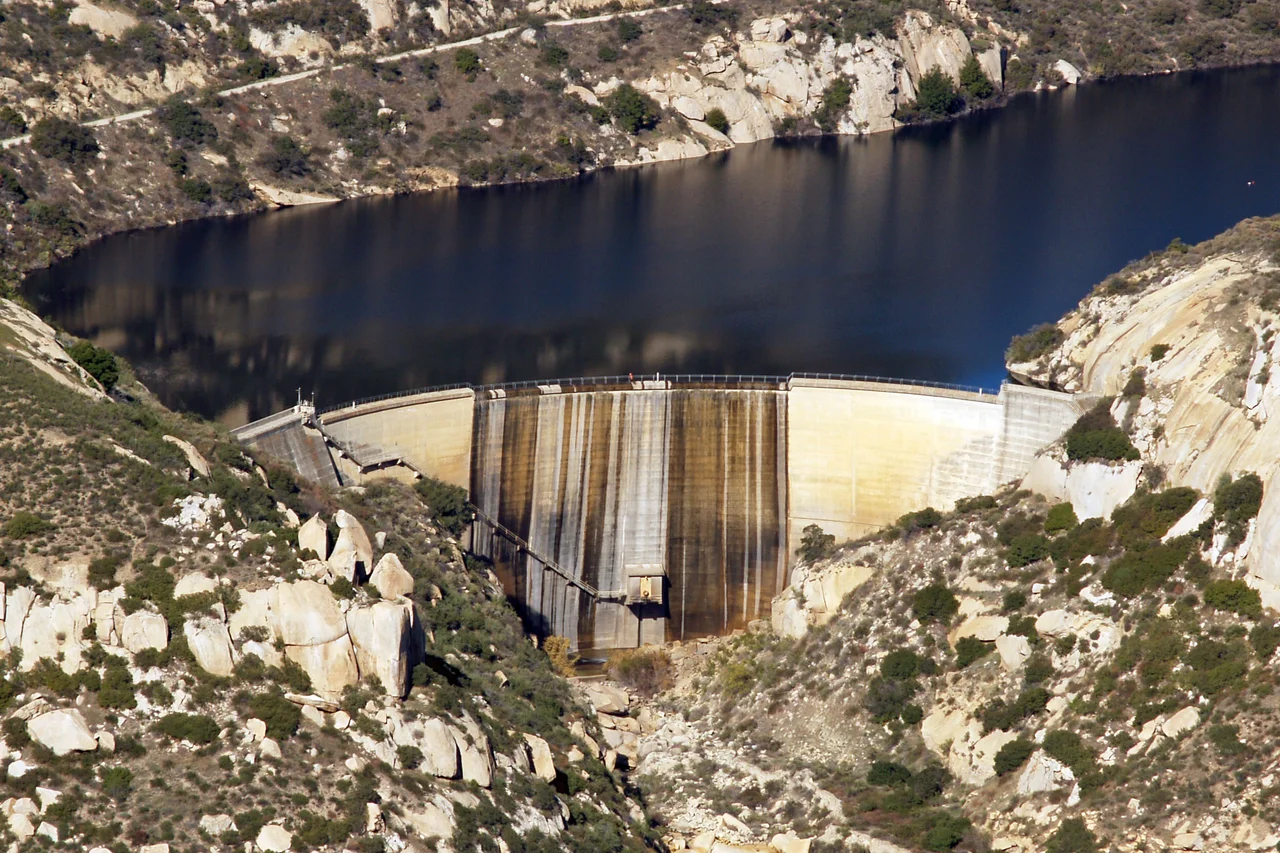

Barrett Dam
In December 1919, construction workers at the Barrett Dam site faced a situation that dam builders hope never to encounter: unusually heavy rainfall began filling the reservoir behind a dam that was nowhere near complete. The concrete was still being poured. The water kept rising. For months, the structure that was supposed to hold back the water was itself barely holding on.
Why the Dam Needed to Be Built
The story of Barrett Dam begins with a disaster and a rainmaker. In 1916, a man named Charles Hatfield had persuaded the San Diego City Council to hire him to fill the city's reservoirs using his proprietary rain-making techniques. Whether or not Hatfield caused what followed, what followed was catastrophic: flooding broke the dam at Lower Otay and overflowed the upstream Morena Dam. The flooding killed people, destroyed property, and made clear that San Diego's water storage system was inadequate for a growing city.
The city had already purchased the existing water infrastructure in the area for $2.5 million in 1913, including a 20-foot concrete diversion dam at the Barrett site that dated to the 1890s. That small dam fed a wooden flume called the Dulzura Conduit, which carried water twelve miles west to the Lower Otay reservoir. What San Diego needed was not a conduit — it needed storage. The Barrett site, where Cottonwood Creek and Pine Valley Creek converge in a narrow canyon about 35 miles east of downtown, was the place to build it.
Building Under Water
Construction began in 1919 under the direction of engineer Hiram N. Savage. By December of that year, the reservoir was filling faster than the dam could be built. The structure was held together with wooden flashboards — temporary barriers — while the water level actually exceeded the height of the poured concrete for most of the construction period. Temporary sluiceways had to be maintained continuously to drain excess water, because the lake was consistently threatening to overtop the incomplete dam.
It was a controlled emergency that lasted months. Workers poured concrete and managed water simultaneously, racing the reservoir level with each new course of the structure. The dam was finally completed in 1923 — a concrete arch-gravity structure 171 feet high above the riverbed and 746 feet long, containing 139,569 cubic yards of concrete. The reservoir it formed holds 34,206 acre-feet of usable capacity.
When it was finished, the observation made was that by the time the dam was completed, the value of the water stored behind it already exceeded the entire cost of construction.
The Reservoir Today
Barrett Lake, the reservoir formed behind the dam, is part of San Diego's local water supply system. Its management reflects the city's priorities: recreational access is extremely limited in order to protect water quality. The lake is open only on Wednesdays, Saturdays, and Sundays, and visitors are required to make reservations in advance. Fishing is permitted on a strict catch-and-release basis — a policy that keeps the water clean while offering something to people who make the trip to this remote canyon.
The dam itself sits in terrain that has burned repeatedly. The backcountry of southern San Diego County is fire country, and the chaparral-covered hillsides above the reservoir have seen major fires in 2007, 2016, and 2022. The dam infrastructure has continued to function through all of it — a reminder that what was built under duress in 1919 to 1923 was built to last.
A Canyon That Earns Its Quiet
Barrett Dam does not attract visitors the way the reservoir might if it were more accessible. The restricted access, the reservation requirement, the catch-and-release rule — all of it keeps Barrett Lake quieter than it might otherwise be. For San Diego, that is the point. The city built this dam to store water, and it has been doing that for over a century.
Flying over this part of San Diego County, the reservoir appears as a long narrow lake in a steep canyon, the dam visible at its western end where the terrain pinches tight. It is a small piece of infrastructure serving a large city, built in conditions that tested everyone involved, and still doing what it was built to do.
From the Air
Barrett Dam is located at approximately 32.678°N, 116.670°W in a narrow canyon in southern San Diego County, about 35 miles east of downtown San Diego. The reservoir is visible from altitude as a long, narrow lake east of Dulzura. Nearest airports: KSAN (San Diego International, ~35 nm W), KSEE (Gillespie Field, ~28 nm NW), KNZJ (El Toro, ~45 nm N).
Nearby Stories
- La Jolla Complex 2.6 km away
- Ballast Point Brewing Company 4.9 km away
- Naval Outlying Landing Field Imperial Beach 4.9 km away
- Cuyamaca Rancho State Park 7.3 km away
- Fish Creek Mountains Wilderness 11 km away
- Spanish Missions in Baja California 37 km away
- Off-roading in Baja 164 km away
- Guadalupe Island Biosphere Reserve 384 km away