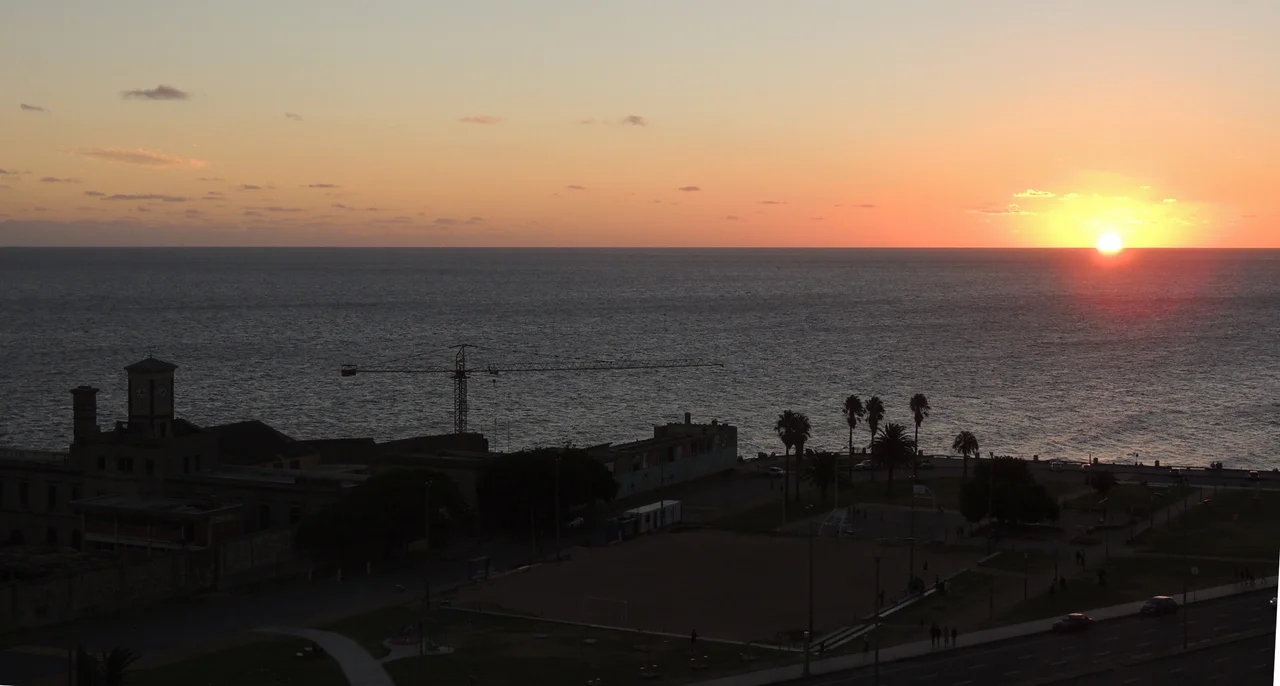

Barrio Sur, Montevideo
On a Sunday afternoon in Barrio Sur, the first sound is fire. Drummers gather around small blazes on the sidewalk, holding the skins of their tambores close to the flames to tune them, and the talk and laughter build until someone strikes the first beat. Then the street fills with the rolling, interlocking pulse of candombe, and the whole neighborhood seems to lean into it. This narrow district, wedged between Ciudad Vieja, the city's center, the sea, and the leafy streets of Palermo, is where that rhythm first took shape. UNESCO recognized candombe as Intangible Cultural Heritage of Humanity in 2009. In Barrio Sur, it has simply always been the sound of home.
When the Walls Came Down
Barrio Sur emerged in the first half of the nineteenth century, after Montevideo's defensive walls were demolished and the city spread south toward the water. Among the first to settle the new ground were Afro-Uruguayans, many of them freed when Uruguay abolished slavery in 1842. They made their homes in crowded tenements called conventillos, the most storied of which was the Mediomundo, a building whose name became shorthand for a whole way of life. These were not comfortable places. Families shared a single courtyard, a single tap, a single rhythm of days. But they were genuine communities, and within those shared patios people kept alive the songs, dances, and ceremonies their families had carried from Africa across the worst of crossings. From those gatherings, in those packed and humming courtyards, candombe was born. Decades later, in the dictatorship years of the 1970s, residents of the Mediomundo and the nearby Ansina conventillo were forcibly evicted, an act of displacement the neighborhood has never entirely forgotten.
Three Drums
Candombe speaks through three drums, and to hear it is to hear them argue and agree at once. The chico is smallest and highest, hammering out the underlying pulse that never lets go. The repique sits in the middle, restless and improvisatory, darting around the beat. The piano is the largest and deepest, and its pattern is so distinctive that listeners can tell which neighborhood a parade comes from by the way its piano drum speaks. The streets themselves give the styles their names. In the candombe tradition, the cadences of Cuareim and Ansina carry the memory of particular blocks, particular families, particular generations of drummers who passed the rhythm hand to hand.
A Melting Pot by the Sea
Afro-Uruguayan culture gave Barrio Sur its heartbeat, but it was never the only voice here. From the late nineteenth century into the twentieth, waves of European immigrants arrived, and the neighborhood became a genuine melting pot of Afro-Uruguayan, Spanish, Italian, and Jewish life, a synagogue and a candombe parade sharing the same few blocks. There was a rougher side too. The southwestern corner belonged to El Bajo, a district of cabarets and brothels that stretched into the lower reaches of Ciudad Vieja, until the construction of the southern rambla swept much of it away in the 1930s. The coastal promenade that replaced it gave the barrio the sea breeze it carries today.
The Living Pulse
Barrio Sur remains the beating heart of Afro-Uruguayan culture and of Montevideo's Carnival, the longest carnival celebration in the world. The llamadas, the great drum-call parades, still wind through these streets, led by the most respected drummers from families honored across generations for keeping the tradition. Candombe is more than music here; it has long been understood as an expression of resistance and belonging, woven into ordinary daily life. The neighborhood keeps adding its own chapters. In 2022, Montevideo's mayor proposed renaming a Barrio Sur street to honor Gloria Meneses, a transgender activist for LGBT rights, a small civic gesture in a place that has always made room for the people history tried to push to its edges.
From the Air
Barrio Sur lies on Montevideo's southern shore at roughly 34.91 degrees south, 56.19 degrees west, bordered by the Río de la Plata to the south and the curving line of the rambla. From the air, the neighborhood reads as the strip between the dense old-city peninsula to the west and the green of Parque Rodó and Palermo to the east, with the coastal promenade tracing its seaward edge. Carrasco International Airport (ICAO: SUMU) lies about 18 km east along the coast; Ángel S. Adami Airport (ICAO: SUAA) sits to the northwest. The clearest views come on bright, dry days when the brown estuary and the city's grid stand out sharply against the water.
Nearby Stories
- Piriápolis 24 km away
- Minas 40 km away
- Tronador (rocket) 67 km away
- Nueva Helvecia 69 km away
- La Plata Museum 122 km away
- Battle of Sarandí 126 km away
- Mundo Marino 145 km away
- South Georgia Island 2584 km away